BG-Chapter-13
Kñetra-kñetrajïäVibhägaYoga
| TOPIC | SLOKA |
|---|---|
| Kñetra and Kñetrajïä | 1-7 |
| The Process of Knowledge Jïäna | 8–12 |
| The Object of Knowledge jïeyam | 13–19 |
| Prakåti, Puruña and Their Union | 20–26 |
| Jïäna-cakñusä: Vision of Knowledge | 27–35 |
#BG-13-1-2
Arjuna enquires about 6 things -
- Prakriti - material nature
- Purusa - enjoyer (Supreme Lord)
- Kshetra - field of activities
- Ksetragya - knower of field
- Jnana - knowledge
- Jneyam - object of knowledge
Body is called is field (ksetra) because of all the 24 elements -
- Gross body - panch maha-bhuta
- Subtle body - mind (master of all senses), intelligence ego
- 5 knowledge acquiring senses - eyes, nose, ear, tongue and skin
- 5 working senses - speech, hands, legs, genitals and rectum
The conditioned soul is entrapped in material existence, and he attempts to lord it over material nature. And so, according to his capacity to dominate material nature, he gets a field of activity. That field of activity is the body. And what is the body? The body is made of senses.
Body acts as the instrument to engage in various material activities. Field is very plants / crops grow. This body is field where the experience the happiness and distress, or growth of a tree of repeated birth and death. Every activity of this body gives a reaction, which moulds and defines the next body.
The person, who should not identify himself with the body, is called kṣetra-jña, the knower of the field.
there is a difference between the knower of the field of activities and the actual field of activities. A living conditioned soul can thus understand that he is different from the body. It is described in the beginning – dehino ’smin – that the living entity is within the body
Body is changing, and that is the field.
In the first six chapters of Bhagavad-gītā the knower of the body (the living entity) and the position by which he can understand the Supreme Lord are described. In the middle six chapters of the Bhagavad-gītā the Supreme Personality of Godhead and the relationship between the individual soul and the Supersoul in regard to devotional service are described.
Now, starting with the Thirteenth Chapter, how the living entity comes into contact with material nature and how he is delivered by the Supreme Lord through the different methods of fruitive activities, cultivation of knowledge, and the discharge of devotional service are explained. Although the living entity is completely different from the material body, he somehow becomes related.
#BG-13-3
Krishna is clarifying that He is also Ksetra-jna.
BG is instructions by Krishna and SB is instructions from Vyasadeva and other sages about Krishna.
One who studies the subject matter of the field of activity and the knower of the field very minutely, in terms of this Bhagavad-gītā, can attain to knowledge.
The individual may be the knower of his own body, but he is not in knowledge of other bodies. The Supreme Personality of Godhead, who is present as the Supersoul in all bodies, knows everything about all bodies. He knows all the different bodies of all the various species of life.
Individual soul is knower and super soul is super knower.
सर्वस्य चाहं हृदि सन्निविष्टो
मत्त: स्मृतिर्ज्ञानमपोहनं च ।
वेदैश्च सर्वैरहमेव वेद्यो
वेदान्तकृद्वेदविदेव चाहम् ॥ १५ ॥
_sarvasya cāhaṁ hṛdi sanniviṣṭo
mattaḥ smṛtir jñānam apohanaṁ ca
vedaiś ca sarvair aham eva vedyo
vedānta-kṛd veda-vid eva cāham
I am seated in everyone’s heart, and from Me come remembrance, knowledge and forgetfulness. By all the Vedas, I am to be known. Indeed, I am the compiler of Vedānta, and I am the knower of the Vedas.
King is proprietor of the entire kingdom and oversees everything that's happening in his kingdom.
There are three Brahman conceptions: prakṛti is Brahman as the field of activities, and the jīva (individual soul) is also Brahman and is trying to control material nature, and the controller of both of them is also Brahman, but He is the factual controller.
We need to understand that these are 3 different and unique identities with no overlap and should not confuse each of them. And Supreme Lord is the supreme controller.
out of the two knowers, one is fallible and the other is infallible. One is superior and the other is subordinate. One who understands the two knowers of the field to be one and the same contradicts the Supreme Personality of Godhead, who states here very clearly, “I am also the knower of the field of activity.” One who misunderstands a rope to be a serpent is not in knowledge.
मयाध्यक्षेण प्रकृति: सूयते सचराचरम् ।
हेतुनानेन कौन्तेय जगद्विपरिवर्तते ॥ १० ॥
mayādhyakṣeṇa prakṛtiḥ
sūyate sa-carācaram
hetunānena kaunteya
jagad viparivartate
Translation
This material nature, which is one of My energies, is working under My direction, O son of Kuntī, producing all moving and nonmoving beings. Under its rule this manifestation is created and annihilated again and again.
ईश्वर: सर्वभूतानां हृद्देशेऽर्जुन तिष्ठति ।
भ्रामयन्सर्वभूतानि यन्त्रारूढानि मायया ॥ ६१ ॥
īśvaraḥ sarva-bhūtānāṁ
hṛd-deśe ’rjuna tiṣṭhati
bhrāmayan sarva-bhūtāni
yantrārūḍhāni māyayā
Translation
The Supreme Lord is situated in everyone’s heart, O Arjuna, and is directing the wanderings of all living entities, who are seated as on a machine, made of the material energy.
शृण्वतां स्वकथा: कृष्ण: पुण्यश्रवणकीर्तन: ।
हृद्यन्त:स्थो ह्यभद्राणि विधुनोति सुहृत्सताम् ॥ १७ ॥
śṛṇvatāṁ sva-kathāḥ kṛṣṇaḥ
puṇya-śravaṇa-kīrtanaḥ
hṛdy antaḥ stho hy abhadrāṇi
vidhunoti suhṛt satām
Śrī Kṛṣṇa, the Personality of Godhead, who is the Paramātmā (Supersoul) in everyone's heart and the benefactor of the truthful devotee, cleanses desire for material enjoyment from the heart of the devotee who has developed the urge to hear His messages, which are in themselves virtuous when properly heard and chanted.
Servant we must remain. Intelligent one decides to be servant of Krishna only.
Kṛṣṇa explicitly says here that real knowledge is to know that the Supersoul is the controller of both the field of activities and the finite enjoyer.
#BG-13-4
Lord is going to explain -
- field of activity and how it is constituted
- what its changes are
- whence it is produced
- who that knower of the field of activities is, and
- what his influences are.
Every step He is the one controlling. When we understand what changes are happening and why they are happening, we will be peaceful, as we'll know they are all temporary. Knowing the
actual form of the soul and the ultimate goal of life makes it easier to just accept everything.
The soul and the supersoul will never merge.
One just has to understand this Bhagavad-gītā directly from the description given by the Supreme Personality of Godhead, and all this will be clarified. But one should be careful not to consider the Supreme Personality of Godhead in every body to be one with the individual soul, the jīva. This is something like equating the potent and the impotent.
We cannot pull down the supersoul to our level and start comparing. He is pure and we are impure. He is the ocean and we are a drop.
#BG-13-5
That knowledge of the field of activities and of the knower of activities is described by various sages in various Vedic writings. It is especially presented in Vedānta-sūtra with all reasoning as to cause and effect.
The Supreme Personality of Godhead, Kṛṣṇa, is the highest authority in explaining this knowledge. Still, as a matter of course, learned scholars and standard authorities always give evidence from previous authorities. Kṛṣṇa is explaining this most controversial point regarding the duality and nonduality of the soul and the Supersoul by referring to a scripture, the Vedānta, which is accepted as authority.
Vedanta-sutra is the essence of vedic philosophies (553). Srimad Bhagavatam is commentary on Vedanta Sutra.
We have to follow great Mahajanas since we cannot study all the Shashtra / Veda. Follow a bonafide spiritual master who can help navigate and understand the Vedas.
Stages of consciousness and different levels of brahman realisation
5 Kosas / Stages of Brahman realisation / Brahma puccham -
- Annamaya Kosa
- Consciousness - animalistic. Focused only on food.
- Realisation - realises Absolute truth in food
- Pranamaya Kosa
- Consciousness - consciousness of life. defend from everything possible.
- Realisation - realises Absolute Truth in living symptoms
- Manomayi / Jnanamayi Kosa - level of mind. focuses on philosophical approach
- Consciousness - starts thinking, feeling and willing. Derives happiness at mental platform. Philosophical approach to life values.
- Realisation - low-level, conditioned state.
- Vignanmayi Kosa - intellectual analysis
- Consciousness - Higher than others.
- Realisation - Not the body, but spirit soul. Self is different from field of activity. Soul is ultimate aim of realisation.
- Anandmaya Kosa
- Consciousness - Highest
- Realisation - Supersoul. Blissful relationship with Him.
#BG-13-6-7
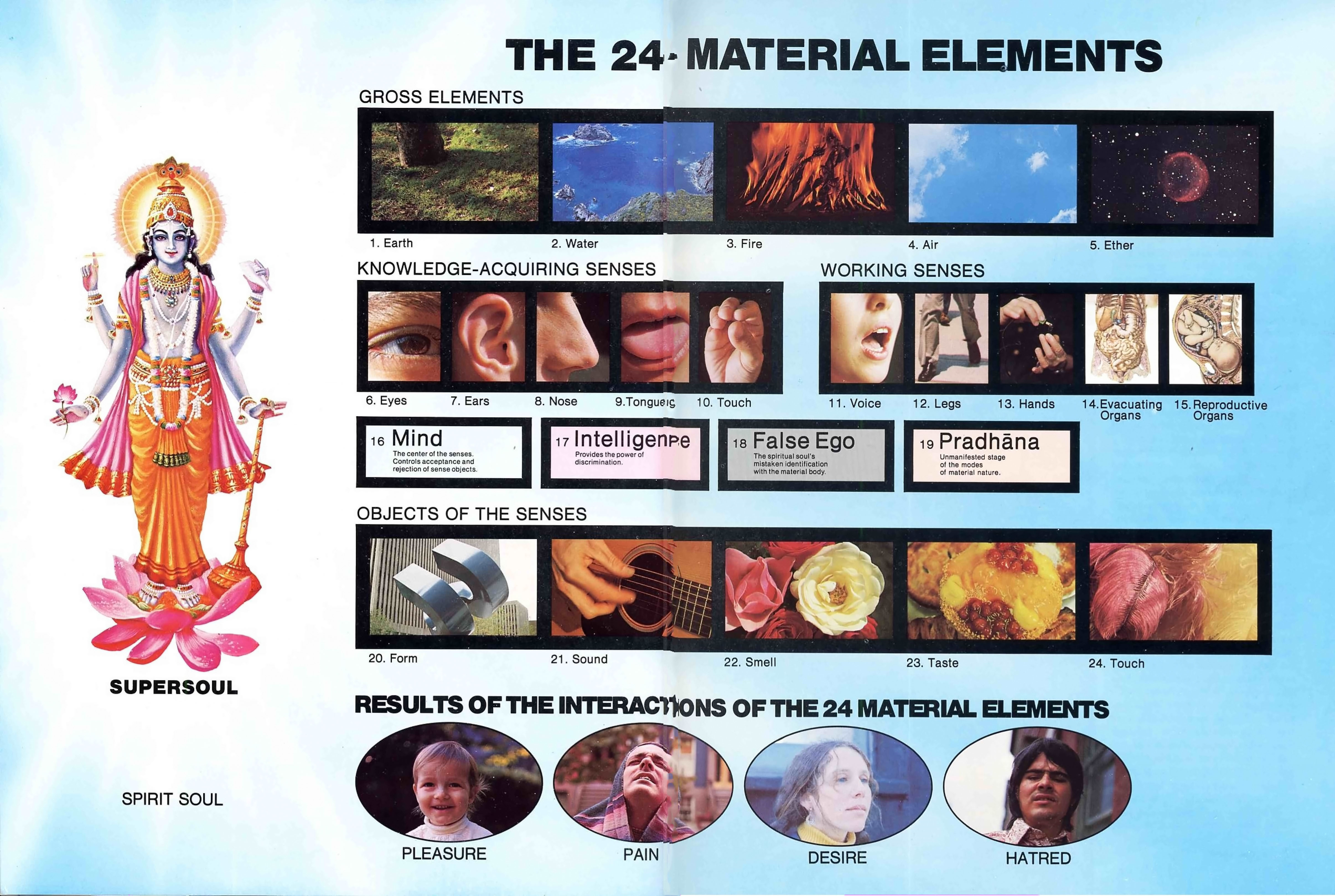
Sankhya philosophy - in this material world, there are total 24 elements of cosmic manifestation, which is what our body is made up of.
- Maha-bhuta - earth, water, fire, air and ether
- false ego, intelligence and the unmanifested stage of the three modes of nature
- five senses for acquiring knowledge: the eyes, ears, nose, tongue and skin
- five working senses: voice, legs, hands, anus and genitals
- Mind
- five objects of the senses: smell, taste, form, touch and sound
- desire, hatred, happiness and distress, which are interactions, representations of the five great elements in the gross body
The living symptoms, represented by consciousness, and convictions are the manifestation of the subtle body – mind, ego and intelligence. These subtle elements are included within the field of activities.
One who desires to know the twenty-four elements in detail along with their interactions should study the philosophy in more detail. In Bhagavad-gītā, a summary only is given.
The body is the representation of all these factors, and there are changes of the body, which are six in number: the body is born, it grows, it stays, it produces by-products, then it begins to decay, and at the last stage it vanishes. Therefore the field is a nonpermanent material thing. However, the kṣetra-jña, the knower of the field, its proprietor, is different.
#BG-13-8-12
अमानित्वमदम्भित्वमहिंसा क्षान्तिरार्जवम् ।
आचार्योपासनं शौचं स्थैर्यमात्मविनिग्रह: ॥ ८ ॥
इन्द्रियार्थेषु वैराग्यमनहङ्कार एव च ।
जन्ममृत्युजराव्याधिदु:खदोषानुदर्शनम् ॥ ९ ॥
असक्तिरनभिष्वङ्ग: पुत्रदारगृहादिषु ।
नित्यं च समचित्तत्वमिष्टानिष्टोपपत्तिषु ॥ १० ॥
मयि चानन्ययोगेन भक्तिरव्यभिचारिणी ।
विविक्तदेशसेवित्वमरतिर्जनसंसदि ॥ ११ ॥
अध्यात्मज्ञाननित्यत्वं तत्त्वज्ञानार्थदर्शनम् ।
एतज्ज्ञानमिति प्रोक्तमज्ञानं यदतोऽन्यथा ॥ १२ ॥
amānitvam adambhitvam
ahiṁsā kṣāntir ārjavam
ācāryopāsanaṁ śaucaṁ
sthairyam ātma-vinigrahaḥ
indriyārtheṣu vairāgyam
anahaṅkāra eva ca
janma-mṛtyu-jarā-vyādhi-
duḥkha-doṣānudarśanam
asaktir anabhiṣvaṅgaḥ
putra-dāra-gṛhādiṣu
nityaṁ ca sama-cittatvam
iṣṭāniṣṭopapattiṣu
mayi cānanya-yogena
bhaktir avyabhicāriṇī
vivikta-deśa-sevitvam
aratir jana-saṁsadi
adhyātma-jñāna-nityatvaṁ
tattva-jñānārtha-darśanam
etaj jñānam iti proktam
ajñānaṁ yad ato ’nyathā
Translation
Humility; pridelessness; nonviolence; tolerance; simplicity; approaching a bona fide spiritual master; cleanliness; steadiness; self-control; renunciation of the objects of sense gratification; absence of false ego; the perception of the evil of birth, death, old age and disease; detachment; freedom from entanglement with children, wife, home and the rest; even-mindedness amid pleasant and unpleasant events; constant and unalloyed devotion to Me; aspiring to live in a solitary place; detachment from the general mass of people; accepting the importance of self-realization; and philosophical search for the Absolute Truth – all these I declare to be knowledge, and besides this whatever there may be is ignorance.
[BG 13.8-12 on Vedabase]
Planets in our universe are aligned in the shape of an egg and hence it's called anda and Brahma jagdandanath.
Knowledge of Devotional Service to Krishna is the most critical and important, which will lead to development of all others.
Hankering for something temporary is not intelligent.
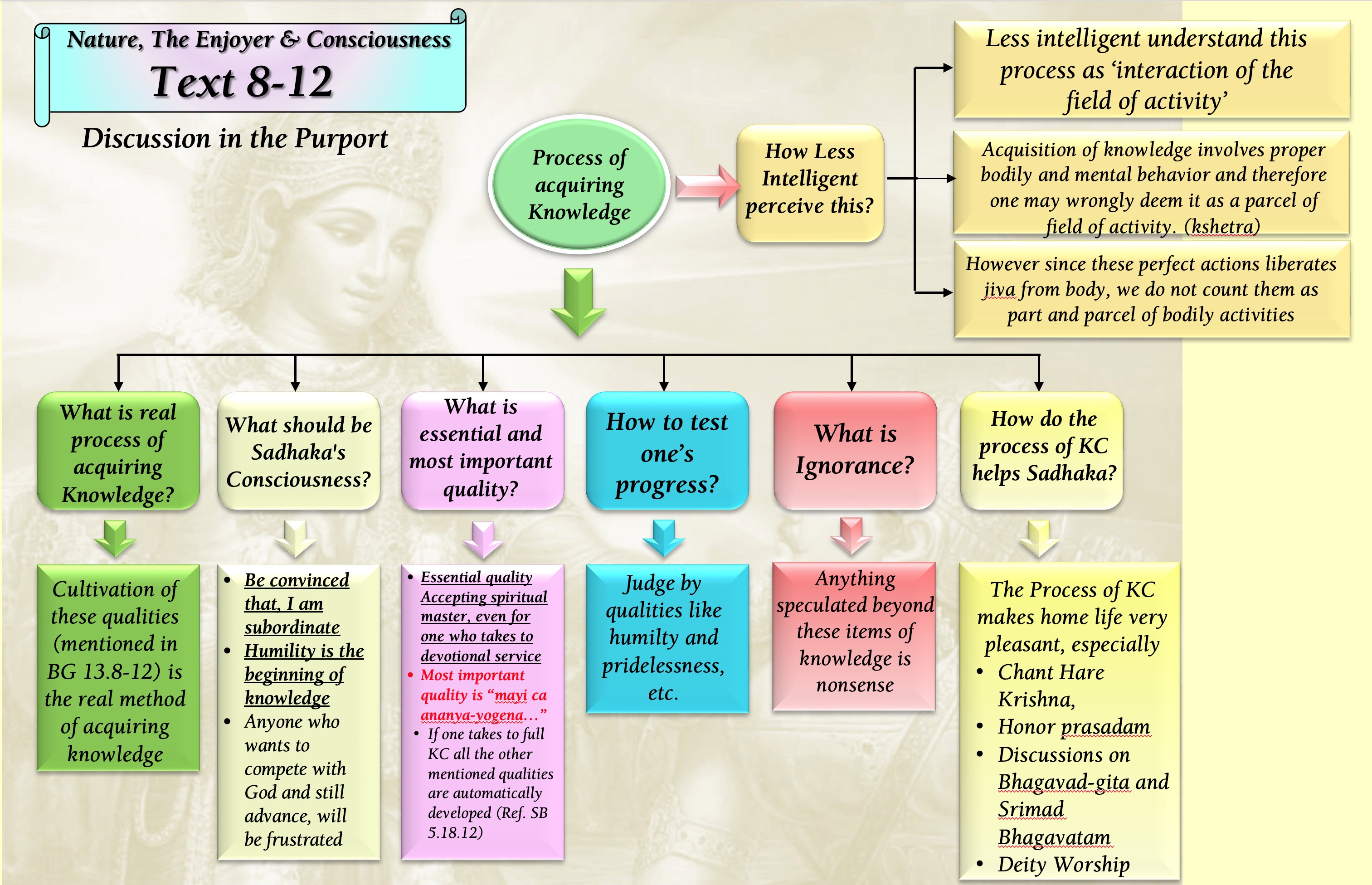
Process of acquiring Knowledge -
- What is the real process -
- Cultivation of these 19 qualities'
- What should be Sadhaka's consciousness
- Conviction - I am subordinate to Krishna
- Humility is beginning of knowledge
- Cannot compete with God and not be frustrated
- Most important quality
- mayi cānanya-yogena bhaktir avyabhicāriṇī - Unalloyed devotional service
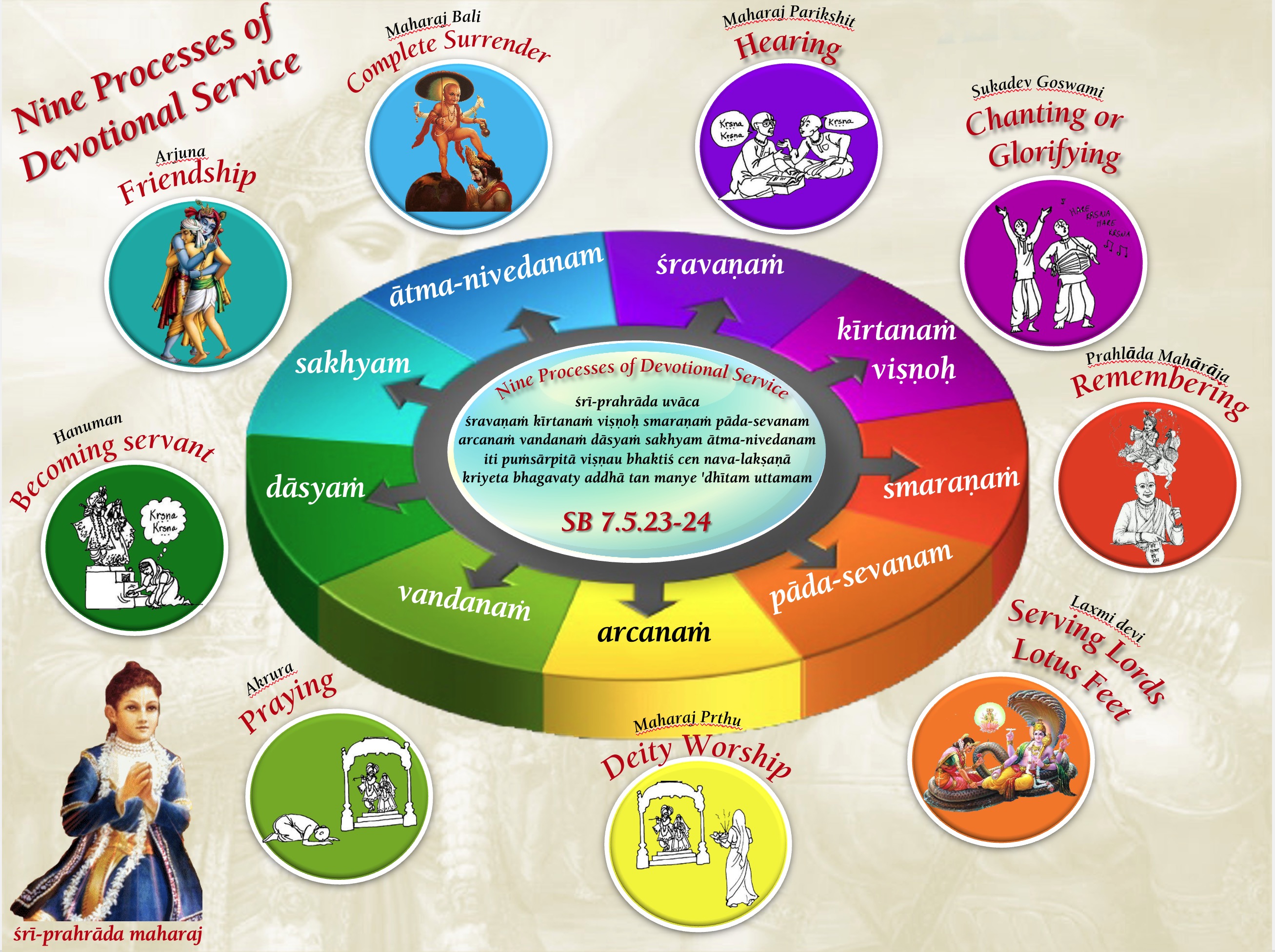
- Practice 9 limbs of Bhakti
- Essential quality -
- Accepting spiritual master, even for one who takes to devotional service
- Most important quality is "mayi ca ananya-yogena..." (ācāryopāsanaṁ)
- If one takes to full KC all the other mentioned qualities are automatically developed (Ref. SB 5.18.12)
- How to test one's progress
- Based on the development of qualities
- What is ignorance?
- Anything speculated beyond these items of knowledge is nonsense
- How does the process help Sadhaka?
- home life very pleasant, especially
- Chant Hare Krishna
- Honor prasadam
- Discussions on Bhagavad-gita and Srimad Bhagavatam
- Deity Worship
- home life very pleasant, especially
- How less intelligent perceive this?
- Less intelligent understand this process as 'interaction of the field of the activity'
- Acquisition of knowledge involves proper bodily and mental behavior and therefore one may wrongly deem it as a parcel of field of activity. (kshetra)
- However since these perfect actions liberates jiva from body, we do not count them as part and parcel of bodily activities
#BG-13-13
#BG-13-17
#BG-13-18
#BG-13-19
#BG-13-20
#BG-13-21
#BG-13-22
पुरुष: प्रकृतिस्थो हि भुङ्क्ते प्रकृतिजान्गुणान् ।
कारणं गुणसङ्गोऽस्य सदसद्योनिजन्मसु ॥ २२ ॥
puruṣaḥ prakṛti-stho hi
bhuṅkte prakṛti-jān guṇān
kāraṇaṁ guṇa-saṅgo ’sya
sad-asad-yoni-janmasu
Synonyms
puruṣaḥ — the living entity; prakṛti-sthaḥ — being situated in the material energy; hi — certainly; bhuṅkte — enjoys; prakṛti-jān — produced by the material nature; guṇān — the modes of nature; kāraṇam — the cause; guṇa-saṅgaḥ — the association with the modes of nature; asya — of the living entity; sat-asat — in good and bad; yoni — species of life; janmasu — in births.
Translation
The living entity in material nature thus follows the ways of life, enjoying the three modes of nature. This is due to his association with that material nature. Thus he meets with good and evil among various species.
https://vedabase.io/en/library/bg/13/22/
SP Lecture - https://youtu.be/Ub9_TQNZW74?si=L5L1D3dX42xwqRS0
अहस्तानि सहस्तानामपदानि चतुष्पदाम् ।
फल्गूनि तत्र महतां जीवो जीवस्य जीवनम् ॥ ४७ ॥
ahastāni sahastānām
apadāni catuṣ-padām
phalgūni tatra mahatāṁ
jīvo jīvasya jīvanam
Translation
Those who are devoid of hands are prey for those who have hands; those devoid of legs are prey for the four-legged. The weak are the subsistence of the strong, and the general rule holds that one living being is food for another.
https://vedabase.io/en/library/sb/1/13/47/
Eating vegetables involves killing them. But since it is Krishna Prasadam we don't bear the sinful reactions.
https://vedabase.io/en/library/bg/9/26/
He is bhokta and we are bhogya.
3 modes + 3x3x3x3 =84 million species