Bhakti Sastri Orientation
Sarvesvara Syama Sundar Das - Course Coordinator
Ojasvi Krishna Das - Mayapur Institute Coordinator
Prabhupada said every temple should be educational center.
Seven purposes of ISKCON -
- To systematically propagate spiritual knowledge to society at large and to educate all people in the techniques of spiritual life in order to check the imbalance of values in life and to achieve real unity and peace in the world.
- To propagate a consciousness of Krishna (God), as it is revealed in the great scriptures of India, Bhagavad-gita, and Srimad-Bhagavatam.
- To bring the members of the Society together with each other and nearer to Krishna, the prime entity, thus developing the idea within the members, and humanity at large, that each soul is part and parcel of the quality of Godhead (Krishna).
- To teach and encourage the sankirtana movement, congregational chanting of the holy name of God, as revealed in the teachings of Lord Sri Caitanya Mahaprabhu.
- To erect for the members and for society at large a holy place of transcendental pastimes dedicated to the personality of Krishna.
- To bring the members closer together for the purpose of teaching a simpler, more natural way of life.
- With a view towards achieving the aforementioned purposes, to publish and distribute periodicals, magazines, books and other writings.
Ultimately, the “Seven Purposes of ISKCON” are to help each one of us to become Krishna conscious and to be able to share this message of Krishna consciousness with others too.
Aims of sastric courses
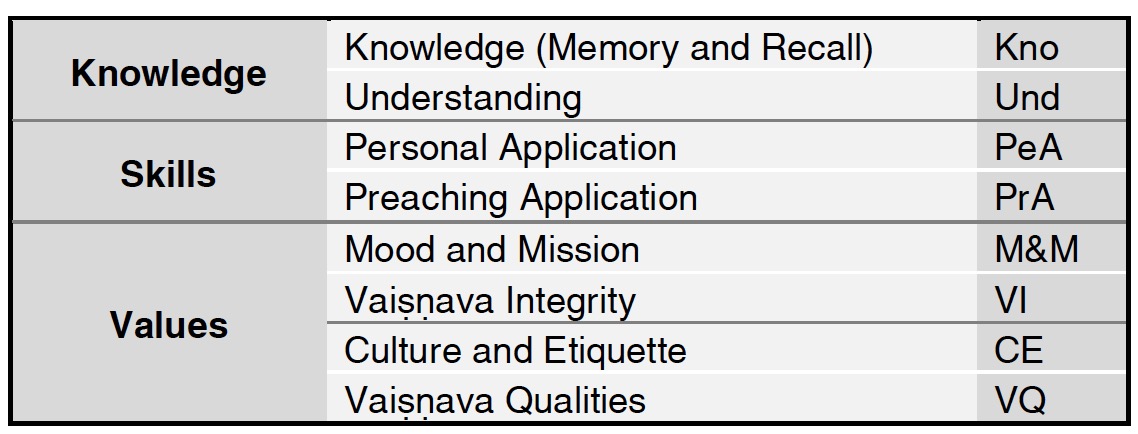
- Knowledge --> Sambandha
- Memory and Recall
- Understanding
- Skills --> Abhideya
- Personal Application
- Preaching Application
- Values --> Prayojana
- Mood and Mission
- Spiritual Culture and Etiquette
- Vaisnava Integrity
- Vaisnava Qualities
Books that will be covered
- BG - 3 units - 4-5 months
- NOD - 19 chapters - 1 unit -
- NOI (11 verses) and Sri Isopanisad (19 verses) - 1 unit
70 sessions over 10 months
Do a "Preacher Training Course" with Mayapur Institute after BS.
Recordings will be uploaded to Shyam Sundar Prabhuji's YouTube channel.
Course Schedule will be sent unit-wise ahead of each unit.
Batch code example : B-SAS-E-L13-2404-WE-16M-C1 - Will be added to WhatsApp group name.
Assessments
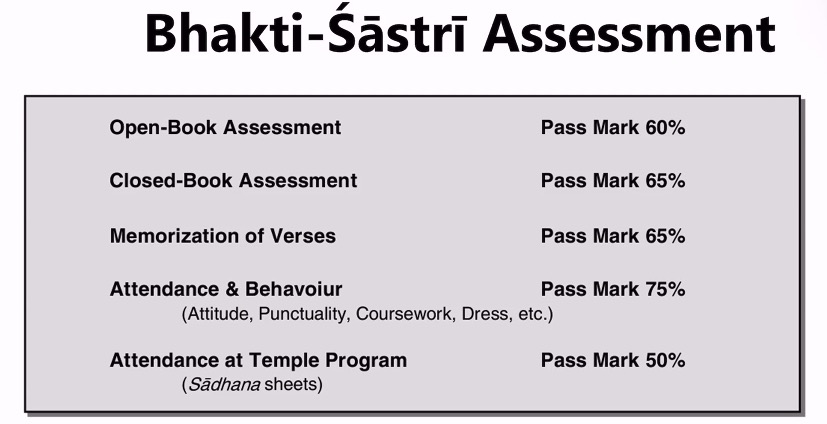
Open-Book Assessment (OBA) - 10 questions in Handbook per unit - 2 questions per unit will be shared beforehand x 5 units. Background research is very important - different acharyas.
Closed-Book Assessment (CBA) - 30 short-questions per unit - answer in one word. Out of these 15-20 questions would be asked in assessment as Multiple-choice.
Memorization of Verses (VMA) - 45 verses - unit-wise verses to be remembered
Attendance & Behaviour - attitude, punctuality, coursework, dress, etc.
Attendance at Temple Program - sadhana sheets - to be uploaded at the end of each unit
https://mayapurinstitute.org/studentlogin --> Check on access
Only word documents or TXT files are accepted for submission.
Verse Memorization Assessment (VMA)
- Record video with closed eyes and no headphones
- Use Clideo app on mobile to record and/or compress the videos before uploading to student portal
8th May
Use LiquidText app
Spend at least 30 minutes every day for self-study. Line-to-line study has to be done by student.
Books to refer -
- "Bhagavad Gita Notes" by Gauranga Priya Prabhuji - refer after reading BG each sloka
- "Gita Bhushan" by Bhakti Vinod Thakur
- "Sarartha Varshini Tika" by Vishwanath Chakravarti Thakur
- "Bhagavad Gita Subodhini" by Gauranga Darshan Das
- "Surrender Unto Me" by Bhurijana Prabhuji
- "Study Guide to Bhagavad Gita"
- "Gitamrita"
- Bhagavad Gita - Photographic Essay - Visakha DD
- Books by Caitanya Charan Prabhuji (will not be shared)
- Gita for Daily Enrichment
- 365 reflections for daily
- Mind it
- Relishing BG
- Belong
- Bhagavad Gita Insights
- Innerchange
- Gita Wisdom Tales by Gauranga Darshan Prj
- Basics of Bhagavad Gita
- Gita Mahatmaya
NOD related books
- First 19 chapters of Bhakti Rasamrta Sindhu
- Waves of Devotion by Dhanurdhar Swami
- Bhakti Rasamrta Subodhini by Gauranga Darshan
- Bhava Bhakti
- Bhakti Rasarmta Sindhu by Bhanu Swami
NOI related books
Verse memorisation - 6 verses in each video - 2 videos to be uploaded. Eyes closed.
AIMS OF THE MāYāPUR INSTITUTE BHAKTI-SASTRI COURSE
- To help students memorize and recall the essential knowledge of the bhakti-śāstras.
- To deepen students’ understanding of the theology of the bhakti-śāstras.
- To help students personally apply the teachings of the bhakti-śāstras in their lives.
- To enhance students' desire and ability to effectively preach Kåñëa consciousness based on the teachings of the bhakti-śāstras .
- To help students understand and appreciate the mood and mission of śréla Prabhupāda, as revealed in writings on the bhakti-śāstras, and to perpetuate that understanding within ISKCON.
- To help students apply the principles of the bhakti-śāstras with Vaiñëava integrity and appropriate consideration of time, candidate and country.
- To help students appreciate, and appropriately apply, Gaudiya Vaisnava culture, etiquette and principles of Vaisnava sanga, as imparted in the bhakti- śāstras.
- To help students imbibe Vaiñëava qualities enunciated in the bhakti-śāstras.
HG SANKARSANA GAURA DAS Profile
Sankarsana Gaura Das is a highly qualified and dedicated servant of ISKCON, who has dedicated his life to spreading the message of Lord Caitanya and Srila Prabhupada. With a background in Mechanical Engineering and Internal Combustion Engines, Sankarsana Gaura Das brings a unique perspective to his teachings and services within the society.
He completed his B.E. in Mechanical Engineering from Bharathiyar University, Tamilnadu in 2001, with a First Class with Distinction. He then went on to obtain his M.E. in Internal Combustion Engines from ANNA UNIVERSITY in 2005. During his time as a student, Sankarsana Gaura Das also worked as a Lecturer in the Mechanical Engineering Department of Government College of Technology under ANNA UNIVERSITY. Currently, he is pursuing a Ph.D. in Philosophical studies.
Sankarsana Gaura Das's association with ISKCON began in 1997, and he took his first initiation from His Holiness Jayapataka Swami Maharaj in January 2006. In August 2008, he took his brahminical initiation. He received his Bhakti Sastri degree from The Bhaktivedanta Academy, Coimbatore under the Board of Examinations and completed his Teacher Training Course I and II, Bhakti Sastri Teacher Training course under Mayapur Institute. Sankarsana Gaura Das has facilitated Bhakti Sastri courses and Bhakti Pravesh, Gita Saaram courses at Bhaktivedanta Academy in Coimbatore since 2007 , and completed his Bhakti Vaibhava studies at Bhaktivedanta Vidya Pitha in Govardhan Eco Village, Wada. He underwent a two-year residential course in the Complete Study of Srimad Bhagavatam and Sri Caitanya Caritamrta.
In 2005, Sankarsana Gaura Das joined the Brahmachari ashram and served as the Vice President of ISKCON Coimbatore until 2019. During his time in this position, he was instrumental in organizing various outreach programs, one-day workshops, seminars, and one-week courses in leading educational institutions in Coimbatore.
Sankarsana Gaura Das's devotion to Lord Caitanya and Srila Prabhupada, combined with his educational background and years of service within ISKCON, make him a highly valuable asset to the society. His teachings are sure to inspire and uplift anyone who has the opportunity to hear them.
6 schools of vedic knowledge -
- Nyaya - Gautam Rishi - 16 objects of knowledge. Analyse how soul is different from matter and the goal of the soul is to reach God
- Vaisaysikha - Kannada Rishi - everything is material world is nothing but minute eternal atoms
- Sankhya - Kapila Rishi - 26 elements in material nature and the nature
- Yoga-Sutra - Patanjali
- Karma - Jaimini Rishi
- Vedanta philosophy - Vyasadev
All the 5 schools don't understand Bhagvan. He can be only realised by the Vedanta philosophy.
Six Schools of Indian Philosophy
- The six schools of Indian Philosophy or the Vedic Philosophy or the Sad-Darshana (six philosophical views) are:
- Nyaya (logic),
- Vaisesika (atomic theory),
- Sankhya (analysis of matter and spirit),
- Yoga (the discipline of self-realisation),
- Karma-Mimamsa (science of furtive work) and
- Vedanta (science of God realisation).
All the above Vedic philosophies have been discussed in detail in the following section.
Nyaya Philosophy
- The sage Gautama established the Nyaya system of Vedic philosophy. As he was also known as Aksapada, this system is sometimes called the Aksapada system.
- Nyaya philosophy focuses on the criteria for valid knowledge and the methods for acquiring it.
- Nyaya philosophy is primarily grounded in reasoning and logic, earning the title Nyaya Vidya or Tarka Sastra, which translates to “the science of logic and reasoning.”
- Nyaya philosophy, which examines the nature, sources, and validity of knowledge, is also known as anviksiki, meaning “the science of critical study.”
- This Nyaya philosophy uses systematic reasoning to discriminate valid knowledge from invalid knowledge.
- According to the Nyaya philosophy, salvation can be attained through knowledge acquisition. The veracity of a proposition or statement can be tested through inference, hearing, and analogy.
Vaisesika Philosophy
- The Vaisesika philosophy was founded by the sage Kanada, also known as Uluka, and is sometimes referred to as aulukya.
- Kanada authored the first systematic text of this philosophy, the Vaisesika-sutra, which is organised into ten cantos, each divided into two sections.
- Prasastapada wrote a notable commentary on this sutra called Svartha Dharma Samgraha, often referred to simply as “bhasya” in Indian philosophical discussions.
- When the term bhasya is used without additional context, it generally denotes this particular commentary. Further interpretations of Prasastapada’s work include Udayana’s Kirana-vali and Sridhara’s Nyayakandali.
- A key aspect of the Vaisesika system is its introduction of a special category of reality known as uniqueness (visesa), which is why this system is called Vaisesika.
- This school emphasises the discussion of material elements or Dravya. It draws a line between particularities and their aggregate. When combined, earth, water, fire, air, and ether give rise to new objects.
- The Vaisheshika School propounded the Atom theory, which states that material objects are made up of atoms. Thus, the Vaisheshika School marked the beginning of physics in India.
- Gradually, the scientific view was diluted with belief in God and spiritualism, and this school put its faith in heaven and salvation.
Samkhya Philosophy
- Some consider Samkhya philosophy to be the oldest philosophical school. It was systematised by an ancient thinker named Kapila.
- The first work of nontheistic Samkhya, the Samkhya-sutra, is traditionally attributed to Kapila, but in its present form, it is different from his original work.
- So, the Karaka of Isvarakrishna is actually the earliest available Sankhya text. Among its more well-known commentaries are:
- Gaudapada’s bhasya,
- Vacaspati Misra’s Tattva-kaumudi,
- Vijnanabhiksu’s Sankhya-pravacanbhasya, and
- Mathara’s Matharavrtti.
- According to early Samkhya philosophy, which was rather rational and scientific, divine agency is not essential to the world’s creation.
- The world owes its creation and evolution more to nature or Prakriti than God.
- Around the 4th century AD, in addition to Prakriti, Purusha or spirit was introduced as an element in the system, and the world’s creation was attributed to both.
- According to this view nature and the spiritual element together created the world.
- According to this school, a person can attain salvation by acquiring real knowledge, and his misery can be ended forever. This knowledge can be acquired through perception (pratyaksha), inference (anumana) and hearing (shabda).
- Referred in 3rd Canto - talking about the 24 elements, 25th is the soul and 26th is the super soul.
Yoga Philosophy
- Yoga is derived from the Sanskrit root yuj, which means “to unite.”
- The yoga system provides a methodology for linking individual consciousness with Supreme Consciousness.
- There are various schools of yoga, among which bhakti yoga, jnana, karma yoga, and kundalini yoga are especially well known.
- The yoga system is counted as one of the six systems of Vedic philosophy, and it is the Patanjali system.
- This school of yoga, also known as ashtanga-yoga (the yoga of eight parts), is closely allied to Sankhya philosophy.
- According to Yoga school, a person can attain salvation through meditation and physical application. The practice of control over pleasure, senses and bodily organs is central to this system.
- To obtain salvation, physical exercises in various postures, called asana, and breathing exercises, called pranayama, are prescribed.
- It is believed that through these methods, the mind gets diverted from worldly matters and achieves concentration.
- Includes sadhana
Mimamsa Philosophy #karma-mimamsa
- Mimamsa literally means the art of reasoning and interpretation. But reasoning was used to justify various Vedic rituals, and the attainment of salvation depended on their performance.
- According to Mimamsa, the Vedas contained the eternal truth. The principal object of this philosophy was to attain heaven and salvation.
- To attain salvation, Mimamsa strongly recommended performing Vedic sacrifices, which required the services of priests and legitimised the social distance between various varnas.
- Propounded by Jaimini rishi
Vedanta Philosophy
- It refers to the philosophy pronounced in the Upanishads, the final parts of the Vedas. In a broad sense, Vedanta covers the fundamental philosophy enunciated by the Prasthantrayi—the Upanishads, the Brahma-Sutra, and the Bhagavad Gita.
- Vedanta means the end of the Veda. Its basic text was the Brahmasutra of Badarayana, compiled in the second century BC.
- According to Vedanta philosophy, Brahma is reality, and everything else is unreal (Maya).
- The self (soul) or Atma is identical to Brahma. Therefore, when a person realises knowledge of the self, he realises the knowledge of Brahma and thus attains salvation. Both Brahma and Atma are eternal and indestructible.
Source - https://www.nextias.com/blog/six-schools-of-indian-philosophy/