Bhakti Sastri - Unit 1 - Bhagavad-Gita
Bhakti Sastri - Home
Bhakti Sastri - Unit 2 - Bhagavad-Gita
Bhakti Sastri - Unit 3 - Bhagavad-Gita
Session 1 - 22nd April 2025
Video - https://www.youtube.com/watch?v=Hpt7ue_Nf8o
Chapters 1 to 6 - Unit 1 - Karma Yoga
Chapters 7 to 12 - Unit 2 - Bhakti Yoga
Chapters 13 to 18 - Unit 3 - Jnana Yoga
Throughout Gita, Krishna primarily wants to convey about Bhakti Yoga.
For Krishna's devotees, any moment they leave their body becomes auspicious. Slokas that cover about when is the ideal time to leave the body are focused on Yoga-mishra Bhakti (mix of ashtang yoga and bhakti yoga). 8th Chapter.
Ananya - pure / unadulterated
Karma-mishra Bhakti - post activity offer some of the results to Krishna
Pure Bhakti - right at the outset the activity is performed with the intention to offer the results to Krishna.
When Krishna comes to material world, he comes with all his incarnations - all rolled into one. Vishnu or any other avatar inside Krishna takes care of killing the demons, while Krishna's purpose is primarily to enjoy in the company of devotees.
9.24 - 3 items are edible and 1 not, but Krishna sometimes eats flowers also since devotee has offered with lots of love (Viswanath Chakravarti Thakur).
Only Arjuna and other devotees were able to hear Bhagavad Gita in the battlefield. Non-devotees were able to hear the sound vibration, but did not hear the words. Devotees will see a deity, but non-devotees will only see a person.
Devotees are more merciful than Krishna. Even though non-devotees may not be excited to hear Krishna katha, devotees should always be excited to share Krishna katha.
Arjunacharya - brahmana would read BG daily and leave a bookmark at the end of the day.
BG deals with 5 basic truths - Jiva, Isvara, Prakriti, Karma and Kala.
Animals can also be human beings in the garb of human.
Unit 1 - Session 2 - 24 April 2025
1.1
Kuruksetra is a place of sacrifice and hence it is considered a holy place / Dharma-ksetra. It is a place to do some holy activities and gain pious credits.
Dhrutarashtra was worried about various things
- his sons might give up their animosity in the Dharma-ksetra and stop the battle
- Pandavas might get influenced by the Dharma-ksetra and give up the fight
In the field of grains, unwanted weeds will also grow. Krishna wants to pull out all these unwanted weeds, so that the grains can easily grow.
1.2
Sanjaya's response is very clever and diplomatic (by calling Duryoudhana as Raja). While it'll not completely alleviate Dhrutarashtra's fears and give him satisfaction, at least they will make it better to handle. Internally he was supporting Pandavas.
1.3
Duryodhana is not approaching his seniors for blessings, but to instigate them. He speaks from verse 3 to 11. He is taunting Drona that Dhrstadhyumna - who was son of Drona's enemy - was taught by Drona and had arranged the Pandava family. He wanted to make Drona angry - asking what respect Pandava are showing to him by fighting him and trying to kill him. He wants to blame Drona that it was because of his teaching
1.4 , 1.5 , 1.6
Duryodhana is listing all the great warriors on the side of Pandavas. 17 people are mentioned across these 3 Slokas. All these are Maharathi
- Atirathi - can fight 60000 people at a time - Arjuna, Bhishma
- Maharathi - can fight with 10000 people at a time
- Rathi - can fight 1 person at a time
- Ardha-rathi - someone who is not fit to fight, even with 1 opponent
Bhima's vows
- Kill all 100 sons of Drtarastra
- Tear open chest of Dusasana and smear the blood on Draupadi's hair
- Break thigh of Duryodhana
1.7
Duryodhana wants to show off his army and generals now, and does not want Dronacharya to get fearful. He wants to say that even if Dronacharya is not in the mood or does not fight at 100%, he is confident of winning.
1.8
He is calling out Drona before Bhishma to stoke his ego. He is naming only 1 of his brothers - Vikarna - out of all 100, as he was the only one who was opposing when Draupadi was being dishonoured. He was trying to flatter Vikarna. Bhishma and Karna were not seeing eye to eye. He knows that Karna will take over once Bhishma dies.
1.9
1.10
Duryodhana is trying to stoke Bhishma's ego.
Aparyaptam - immeasurable, but it can also be called insufficient (Baladeva Vidya Ghosh and Ramanujacharya). Sridhar Swami and
Paryaptam - measurable or sufficient (real meaning)
With Bhishma, Duryodhana thinks his military strength is immeasurable. He is asking Dronacharya to also take lead role, as with only Bhishma, the army is insufficient. Duryodhana knows and intends both meanings for each word.
He is confident that Bhishma will support him without any questions, just like he didn't say a word when Draupadi was being insulted.
1.11
Duryodhana being diplomatic and ensure other soldiers and generals are also inspired and praised enough to give their 100%.
1.12
Blowing the conchshell is an auspicious activity associated with the Supreme Lord, but since Krishna was opposite Kaurvas, Bhishma was indirectly conveying Duryodhana about his loss.
1.13
1.14
Conchshell blown by Bhishmadev is not regarded as transcendental, while the ones blown by Pandavas are mentioned as transcendental.
1.15
Conchshells blown
- Krsna - Pāñcajanya
- Arjuna - Devadatta
- Bhima - Paundra
- Yudhiṣṭhira - Ananta-vijaya
- Nakula - Sughoṣa
- Sahadeva - Maṇipuṣpaka
Each of these were attributed because of the personalities and their actions, while no such outstanding action existed for Bhishmadev and Kauravas.
1.16-18
Sanjay was speaking in support of Pandavas.
1.19
Bhishamdev blowing conchshell did not do anything to Pandavas, but Kauravas were shaken by blowing of conchshells by Pandavas.
One who takes shelter of the Supreme Lord has nothing to fear, even in the midst of the greatest calamity.
1.20
1.21-22
The servitor is always ready to render service to the Lord, and, similarly, the Lord is always seeking an opportunity to render some service to the devotee.
Arjuna knew who all are really on the battlefield, but Krsna's Yoga-Maya was acting on him and hence he insisted on being taken to the middle of battlefield to see everyone. It was Krsna's plan to use his Yoga-Maya on Arjuna, so that he can pass on the knowledge of Bhagavad-Gita to the entire world.
Krsna is Bhakta-vatsala and hence is ready to take orders from Arjuna.
Arjuna is calling Krsna Hrisikesa - to control his senses on the battlefield, acyuta - infallible one - someone who will not fail or fall - nobody can challenge his transcendental position.
1.23
Draupadi wanted a 1000 petal lotus flower and asked Bhima to get it to gift to Yudhishthira. Bhima saw a monkey with his tail spread across the road. Bhima requested and monkey said he is old and cannot do so. Bhima tried to lift the tail and he couldn't. Finally they realised that the monkey is nobody else but Hanuman. Both sons of Vayu, they embraced each other. And Hanuman mentioned that he'll join Bhima in the battle in the flag hoisted on Arjuna's chariot.
Signs of Victory for Pandavas
- Conchshell is symbol of Vishnu
- Blowing of Transcendental Conchshells by Pandavas, which is associated with Supreme Lord
- Arjuna's Chariot given by Agnidev which can conquer all 3 worlds
- Hanuman's symbol on the flag hoisted on Arjuna's chariot
- Fight is happening in Kuruksetra which is a Dharma-ksetra
- Krsna is with Pandavas
Unit 1 - Session 3 - 29 April 2025
1.24
Gudakesa - conqueror of sleep and ignorance - both. BG can be read anywhere anytime. No restrictions.
Viswanath Chakravarti Thakur - Gud-a-ke-isa - Gud = jaggery / sweetness, a = Lord Visnu (First letter of alphabet), ka = brahma, isa = shiva - one who gives sweetness to Tridev.
A devotee of Kṛṣṇa can conquer both sleep and ignorance simply by thinking of Kṛṣṇa constantly. This is called Kṛṣṇa consciousness, or samādhi.
28 to 46 - Arjuna is giving 4 reasons for not fighting
- Compassion (BG 1.28 - 1.29)
- Loss of enjoyment (BG 1.30 - 1.36)
- Destruction of family and traditions (BG 1.37 - 1.43)
- Fear of unwanted progeny (BG 1.44 - 45)
Indecision is another reason that Arjuna gives for not fighting.
1.28
Prahalad Maharaj - SB 5.18.12 - anyone who surrenders to Krishna, will take all the good qualities of Krishna and His devotees.
yasyāsti bhaktir bhagavaty akiñcanā
sarvair guṇais tatra samāsate surāḥ
harāv abhaktasya kuto mahad-guṇā
mano-rathenāsati dhāvato bahiḥ
Prabhupada - you cannot expect honest from thieves. Leader says he will go for bath and asks his subordinates to equally distribute the loot.
Everyone will get the same punishment - death eventually.
A pure devotee is soft-hearted.
1.29
There are two kinds of trembling of the body, and two kinds of standings of the hair on end. Such phenomena occur either in great spiritual ecstasy or out of great fear under material conditions.
1.30
Excessive attachment for material things puts a man in such a bewildering condition of existence. Bhayaṁ dvitīyābhiniveśataḥ syāt (SB 11.2.37): such fearfulness and loss of mental equilibrium take place in persons who are too affected by material conditions.
As soon as we think from a bodily concept of life, fear will attack. Our happiness often lies in appreciation by others.
1.32-35
Govinda is not meant for satisfying our senses. If we try to satisfy the senses of Govinda, however, then automatically our own senses are satisfied. Materially, everyone wants to satisfy his senses, and he wants God to be the order supplier for such satisfaction.
Hrishikena hrisikesa sevanam bhaktir ucyate...
killed. The devotee of the Lord does not retaliate against the wrongdoer, but the Lord does not tolerate any mischief done to the devotee by the miscreants. The Lord can excuse a person on His own account, but He excuses no one who has done harm to His devotees.
Janardhana can mean either of these 2 -
- One who kills distress/doubts of people
- One who destroys the people
1.36
Arjuna sarcastically calls Krishna Madhava.
According to Vedic injunctions there are six kinds of aggressors:
(1) a poison giver
(2) one who sets fire to the house
(3) one who attacks with deadly weapons,
(4) one who plunders riches,
(5) one who occupies another’s land, and
(6) one who kidnaps a wife.
We should not harm any living entity - no matter what - Dharma Sastra. Artha Sastra - focus on personal benefits.
Forgiveness is quality of saintly people.
1.37-38
We should not have any inclination to commit sin - we should free of greed.
1.39
Elderly people maintain the traditions and we hear about it from them only.
1.40
5 classes of people to be protected by Ksatriyas / Kings -
- Child
- Women
- Elderly people
- Brahmana
- Cows
Elder people are slained --> Family members are filled with Adharma --> Women of the family become polluted --> Varna-sankara --> Everyone will go to hell (no shraddha/pinda) --> Forefathers will fall from Ptrloka --> family welfare activities are devastated
1.41
Simply by performing devotional service, one can deliver hundreds and thousands of forefathers from all kinds of misery. It is stated in the Bhāgavatam (SB 11.5.41):
devarṣi-bhūtāpta-nṛṇāṁ pitṝṇāṁ
na kiṅkaro nāyam ṛṇī ca rājan
sarvātmanā yaḥ śaraṇaṁ śaraṇyaṁ
gato mukundaṁ parihṛtya kartam
“Anyone who has taken shelter of the lotus feet of Mukunda, the giver of liberation, giving up all kinds of obligation, and has taken to the path in all seriousness, owes neither duties nor obligations to the demigods, sages, general living entities, family members, humankind or forefathers.” Such obligations are automatically fulfilled by performance of devotional service to the Supreme Personality of Godhead.
5 debts are fulfilled by serving Krsna
- demigods
- other living entities
- sages
- family members / forefathers
- humankind
1.42
Leaders nowadays are all blind - with no spiritual connection - and are leading us blind.
1.43
One cannot reach the real point of factual knowledge without being helped by the right person who is already established in that knowledge.
While Krishna was reciting BG, non-devotees were hearing, but not understanding at all, while devotees were hearing, understanding and relishing.
Unit 1 - Session 4 - 6 May 2025
Chapter 2
2.7 - Karpanya dosho...
Krsna starts speaking from 2.11 as a Guru. And as a Guru He chastises Arjuna.
Chastisement is mother of devotion.
2.31 - 2.37 - Krsna is answering Arjuna's concern of not being able to enjoy without family.
2.42 - Going to heaven is not the highest goal.
Bhakti Yoga is a simple process, but in Kali-yuga people can't accept anything easily and hence Krsna goes in a round about way to explain the same.
2.38 - 53 - Arjuna query "Fear of sinful reactions" - Krsna answers via sankhya-yoga
2.45 - 46 - destruction of family values
2.41 - indecision
2.1
Material compassion, lamentation and tears are all signs of ignorance of the real self. Compassion for the eternal soul is self-realization.
No one knows where compassion should be applied. Not in improving physical condition, but improving spiritual condition. Saving a drowning man's coat is not going to save the drowning man (SP analogy). Social welfare organizations are doing the same thing - trying to save drowning men's coats. That will not give ultimate solution. Highest welfare is to teach out Krishna, distributing books, distributing Prasadam - doing anything that brings more souls towards Krsna.
This chapter instructs us in self-realization by an analytical study of the material body and the spirit soul, as explained by the supreme authority, Lord Śrī Kṛṣṇa. This realization is possible when one works without attachment to fruitive results and is situated in the fixed conception of the real self.
Sakama Karma-yoga 2.37-38 onwards
Niskama Karma-yoga 2.39
Madhusudhana -
- Killed the demon Madhu
- doubts are like demons - destroy them
- one who is really sweet and will remove lamentations of Arjuna
Lamenting for outward
2.2
The Absolute Truth is realized in three phases of understanding, namely Brahman, or the impersonal all-pervasive spirit; Paramātmā, or the localized aspect of the Supreme within the heart of all living entities; and Bhagavān, or the Supreme Personality of Godhead, Lord Kṛṣṇa.
Śrīmad-Bhāgavatam (1.2.11) this conception of the Absolute Truth is explained thus: vadanti tat tattva-vidas
tattvaṁ yaj jñānam advayam
brahmeti paramātmeti
bhagavān iti śabdyate
“The Absolute Truth is realized in three phases of understanding by the knower of the Absolute Truth, and all of them are identical. Such phases of the Absolute Truth are expressed as Brahman, Paramātmā and Bhagavān.”
These three divine aspects can be explained by the example of the sun, which also has three different aspects, namely the sunshine, the sun’s surface and the sun planet itself. One who studies the sunshine only is the preliminary student. One who understands the sun’s surface is further advanced. And one who can enter into the sun planet is the highest.
6 opulences of Krsna / Bhagavan by Parasara Muni, father of Vyasadeva -
- Beauty
- Fame
- Wealth
- Strength
- Knowledge
- Renuniciation
All demigods are wonderful and dedicated devotees who are sincerely trying to carry out the orders of Bhagavan and hence they are sometimes referred as Bhagavan. They have most of the qualities of Krsna. Chapter 6 of Adi-lila.
Krsna also prefers being called a servant of Krsna and hence he came as Caitanya Mahaprabhu.
2.3
2.4
Arjuna is repeating that Krsna is demon killer - Madhu and Ari - that is a sign of bewilderment. He is not in control of what he is talking and not aware of it.
Madhu is name of father of Vrsni (Krsna's ancestor), while Madhu is also name of the demon who was killed by Krsna.
2.5
2.6
Unless the senses are controlled, there is no chance of elevation to the platform of knowledge, and without knowledge and devotion there is no chance of liberation. Arjuna was competent in all these attributes, over and above his enormous attributes in his material relationships.
Qualifications of a sincere disciple who can become fit for liberation -
- Perfect control of mind and senses (not anxious, greedy) - BG 1.31 - sama / dama
- Indifferent to worldly enjoyments - Arjuna doesn't want to kill kinsmen even if he gets to rule over all 3 worlds - BG 1.35
- Tolerance of the duality of the nature and everyone around
- Deep faith in the words of the Guru (BG 2.7)
Brhad-āraṇyaka Upanisad is referred here.
2.7
In the Bṛhad-āraṇyaka Upaniṣad (3.8.10) the perplexed man is described as follows: yo vā etad akṣaraṁ gārgy aviditvāsmāİ lokāt praiti sa kṛpaṇaḥ. “He is a miserly man who does not solve the problems of life as a human and who thus quits this world like the cats and dogs, without understanding the science of self-realization.” This human form of life is a most valuable asset for the living entity, who can utilize it for solving the problems of life; therefore, one who does not utilize this opportunity properly is a miser. On the other hand, there is the brāhmaṇa, or he who is intelligent enough to utilize this body to solve all the problems of life. Ya etad akṣaraṁ gārgi viditvāsmāİ lokāt praiti sa brāhmaṇaḥ.
Disciple should always present oneself as fool number one in front of spiritual master. Disciple should be always ready to follow or implement the answer to a question that s/he poses to the Guru. Attitude should not be to showcase your knowledge, but only to genuinely clarify the doubt.
2.12
Refuting Mayavadi philosophy -
- Lord and Jiva-tattva are same
- We say Lord and Jiva are different entities (same quality, different quantity)
- We merge into impersonal Brahman and lose individual existence
- We do not merge into anything and maintain our individual existence
- Individually is only in conditioned state, after liberation we don't exist
- After liberation also we maintain individual existence
- Krsna is an ordinary, material person
- He knows past, present and future and hence He is spiritual
- Plurality is conventional - it refers to the body only
- We are different - body and soul
- Bodily conception are condemned
- Body and soul are different. Body is required to support the soul
BG can be understood only by devotees.
Don't read mayavadi commentaries as it's forbidden by Caitanya Mahaprabhu.
Unit 1 - Session 5 - 8 May 2025
2.13 to 2.30 - Knowledge of the soul
2.13
Moving from boyhood to youthhood to adulthood to old age - we don't cry at all because the body is changing gradually and we don't realise it so much. We all cry only at the time of dying. No need for it.
Nitya-pralaya - gradually, eternally material bodies are destroyed / changing.
VCT says the body and everything related to it becomes object of affection. And this also brings about lamentation if anything related to body is affected.
2.14
In the proper discharge of duty, one has to learn to tolerate nonpermanent appearances and disappearances of happiness and distress.
One has to execute his duty in spite of climatic inconveniences.
One has to follow the prescribed rules and regulations of religious principles in order to rise up to the platform of knowledge, because by knowledge and devotion only can one liberate himself from the clutches of māyā (illusion).
A great heritage brings responsibility in the matter of proper discharge of duties; therefore, he cannot avoid fighting.
We are always more focused and try to attain things that are not favourable for our Bhakti, while things favourable for Bhakti are ignored often.
2.15
Anyone who is steady in his determination for the advanced stage of spiritual realization and can equally tolerate the onslaughts of distress and happiness is certainly a person eligible for liberation.
We should maintain our conciousness as if in the sannyasa-ashram. Externally we can be engaged, but internally we need to maintain this consciousness.
All living beings are maintained by Krsna - and hence we need not use that as an excuse for not taking care of their prescribed duties. Sridhar Swami story (married, got a child, wife died, lizard gave birth, kid eats insect).
Soul never gets attached to the matter. It does not having any connection or relationship with anything in this material world.
2.17
Injection is giving in hand, while the pain can be anywhere in the body. Soul is even smaller than the injection / medicine, and hence it can definitely have the power to manage and move the body.
2.18
Body itself is unimportant, the soul is the one that drives it, even though it's hardly visible. Nature of body can be understood by material methods, but not the nature of soul.
In the Vedānta-sūtras the living entity is qualified as light because he is part and parcel of the supreme light. As sunlight maintains the entire universe, so the light of the soul maintains this material body.
2.19
The Vedic injunction is mā hiṁsyāt sarvā bhūtāni: never commit violence to anyone. Nor does understanding that the living entity is not killed encourage animal slaughter. Killing the body of anyone without authority is abominable and is punishable by the law of the state as well as by the law of the Lord.
nāyaṁ hanti na hanyate - the soul cannot kill or be killed.
2.20
na hanyate hanyamāne śarīre - soul is never killed, only body is killed.
The soul is called the steady, or kūṭa-stha.
The body is subject to six kinds of transformations. It takes its birth from the womb of the mother’s body, remains for some time, grows, produces some effects, gradually dwindles, and at last vanishes into oblivion. The soul, however, does not go through such changes.
The soul is full of knowledge, or full always with consciousness. Therefore, consciousness is the symptom of the soul.
Soul does not have a form (or even frequently changing), while body does.
There are two kinds of souls – namely the minute particle soul (aṇu-ātmā) and the Supersoul (vibhu-ātmā).
Soul is joined to the body, but it's not subservient to it.
Heart transplantation can happen, so what about the permanency of soul?
2.21
In Manu-saṁhitā, the lawbook for mankind, it is supported that a murderer should be condemned to death so that in his next life he will not have to suffer for the great sin he has committed. Therefore, the king’s punishment of hanging a murderer is actually beneficial.
Everything has its proper utility, and a man who is situated in complete knowledge knows how and where to apply a thing for its proper utility.
2.23
Soul and supersoul are same in quality, but different in quantity.
Soul has a form of sac-cidananda vigraha, and quality of ... but keeps traveling in different bodies.
26 and 27 is giving wrong philosophy. Charvaka philosophy is introduced here.
Vaibhasika philosophy - buddhist - atma is different from body but it's destructible.
Out of 6 philosophies, only Vedanta-sutra philosophy speaks truth.
2.28
Both at the beginning and at the end, all elements remain unmanifested, and only in the middle are they manifested, and this does not make any real material difference. And if we accept the Vedic conclusion as stated in the Bhagavad-gītā that these material bodies are perishable in due course of time (antavanta ime dehāḥ) but that the soul is eternal (nityasyoktāḥ śarīriṇaḥ), then we must remember always that the body is like a dress; therefore why lament the changing of a dress? The material body has no factual existence in relation to the eternal soul.
Therefore, in either case, whether one believes in the existence of the soul or one does not believe in the existence of the soul, there is no cause for lamentation for loss of the body.
2.31 to 2.38 refute the 2nd argument of Arjuna - Loss of enjoyment. He is talking about sakama-karma yoga.
2.31
There are two kinds of sva-dharmas, specific duties. As long as one is not liberated, one has to perform the duties of his particular body in accordance with religious principles in order to achieve liberation. When one is liberated, one’s sva-dharma – specific duty – becomes spiritual
and is not in the material bodily concept.
Discharging one’s specific duty in any field of action in accordance with the orders of higher authorities serves to elevate one to a higher status of life.
2.33
2.33 refutes 3rd argument of Arjuna - incurring sinful reactions.
2.31 to 2.37 Krsna suggesting to fight for the kingdom, but from 2.38 onwards He is recommending fighting for self-realisation.
Sankhya-yoga can also be called jnana-yoga.
2.39 onwards niskama karma-yoga. Starts with buddhi-yoga. SP translates buddhi-yoga as Bhakti-yoga, while Krsna officially introductes bhakti-yoga only in Chapter 6.
Unit 1 - Session 6 - 13 May 2025
2.39
Buddhi Yoga here and in 10th Chapter is both different.
Thus the buddhi-yoga mentioned in this verse is the devotional service of the Lord, and the word Sāṅkhya mentioned herein has nothing to do with the atheistic sāṅkhya-yoga enunciated by the imposter Kapila.
Sāṅkhya means analytical description of the body and the soul. Lord Kṛṣṇa made an analytical description of the soul just to bring Arjuna to the point of buddhi-yoga, or bhakti-yoga. Therefore, Lord Kṛṣṇa’s Sāṅkhya and Lord Kapila’s Sāṅkhya, as described in the Bhāgavatam, are one and the same. They are all bhakti-yoga. Lord Kṛṣṇa said, therefore, that only the less intelligent class of men make a distinction between sāṅkhya-yoga and bhakti-yoga (sāṅkhya-yogau pṛthag bālāḥ pravadanti na paṇḍitāḥ).
Prabhupada wanted to introduce Bhakti-yoga right from the start and hence he did not mention niskama karma-yoga when Krsna means that.
2.40
Activity in Kṛṣṇa consciousness, or acting for the benefit of Kṛṣṇa without expectation of sense gratification, is the highest transcendental quality of work.
Material activities and their results end with the body. But work in Kṛṣṇa consciousness carries a person again to Kṛṣṇa consciousness, even after the loss of the body.
2.41
A strong faith that by Kṛṣṇa consciousness one will be elevated to the highest perfection of life is called vyavasāyātmikā intelligence.
Only with resolute intelligence, one can gain Krsna consciousness.
The resolute purpose of a person in Kṛṣṇa consciousness is based on knowledge.
One who is not firmly fixed in mind is diverted by various types of fruitive acts.
2.42-43
As fools are attached to the flowers of poisonous trees without knowing the results of such attractions, unenlightened men are similarly attracted by such heavenly opulence and the sense enjoyment thereof.
2.44
The Vedic dictionary, the Nirukti, says, samyag ādhīyate ’sminn ātma-tattva-yāthātmyam: “When the mind is fixed for understanding the self, it is said to be in samādhi.”
Everyone is interested in bhoga and
2.45
All the living entities who are in the material world are struggling very hard for existence. For them the Lord, after creation of the material world, gave the Vedic wisdom advising how to live and get rid of the material entanglement. When the activities for sense gratification, namely the karma-kāṇḍa chapter, are finished, then the chance for spiritual realization is offered in the form of the Upaniṣads, which are part of different Vedas, as the Bhagavad-gītā is a part of the fifth Veda, namely the Mahābhārata. The Upaniṣads mark the beginning of transcendental life.
For people in lower modes, Mahabharata is referred, so that they can gradually elevate themselves.
2.46
The living entities are parts and parcels of Kṛṣṇa; therefore, revival of Kṛṣṇa consciousness by the individual living entity is the highest perfectional stage of Vedic knowledge.
2.47
Whenever we get opportunity to serve Krsna, we should take it. And we should not claim the results of such action.
Don't think you are the cause of the results of your work. Don't get attached to the non-performance of the work also.
There are three considerations here: prescribed duties, capricious work, and inaction. Prescribed duties are activities enjoined in terms of one’s acquired modes of material nature. Capricious work means actions without the sanction of authority, and inaction means not performing one’s prescribed duties.
As far as prescribed duties are concerned, they can be fitted into three subdivisions, namely routine work, emergency work and desired activities.
Work with results becomes the cause of bondage; therefore such work is not auspicious.
2.48
One has to become the servant of Kṛṣṇa, or the servant of the servant of Kṛṣṇa. That is the right way to discharge duty in Kṛṣṇa consciousness, which alone can help one to act in yoga.
unless one satisfies Kṛṣṇa, one cannot correctly observe the principles of varṇāśrama-dharma.
2.49
One should therefore never desire to be the cause of work. Everything should be done in Kṛṣṇa consciousness, for the satisfaction of Kṛṣṇa.
2.50
Krsna is talking about art of working - yogaḥ karmasu kauśalam
We have to act in such a way that action never produces a reaction.
2.51
Out of ignorance only, less intelligent persons try to adjust to the situation by fruitive activities, thinking that the resultant actions will make them happy. They do not know that no kind of material body anywhere within the universe can give life without miseries.
Service for the cause of the Lord is called karma-yoga or buddhi-yoga, or in plain words, devotional service to the Lord.
2.52
Persons in Kṛṣṇa consciousness transcend the limit of śabda-brahma, or the range of the Vedas and Upaniṣads.
Become indifferent to the sakama karma yoga topics.
Śrī Mādhavendra Purī, a great devotee and ācārya in the line of the devotees, says: sandhyā-vandana bhadram astu bhavato bhoḥ snāna tubhyaṁ namo
bho devāḥ pitaraś ca tarpaṇa-vidhau nāhaṁ kṣamaḥ kṣamyatām
yatra kvāpi niṣadya yādava-kulottaṁsasya kaṁsa-dviṣaḥ
smāraṁ smāram aghaṁ harāmi tad alaṁ manye kim anyena me “O my prayers three times a day, all glory to you. O bathing, I offer my obeisances unto you. O demigods! O forefathers! Please excuse me for my inability to offer you my respects. Now wherever I sit, I can remember the great descendant of the Yadu dynasty (Kṛṣṇa), the enemy of Kaṁsa, and thereby I can free myself from all sinful bondage. I think this is sufficient for me.”
Try to remember this above Sloka.
2.53
39 - 53 is Niskama Karma Yoga
NOD verse quoted for "jivan mukta"
2.54
54 to 72 is for Stitha-pragnya
Symptoms after getting atma-gyaan.
The immediate symptom of a Kṛṣṇa conscious man is that he speaks only of Kṛṣṇa and of matters relating to Him.
2.55
Apart from literal meaning of "sit", this also refers to that person's attitude / position when faced with tough times - ideally non-responsive.
4 questions from Arjuna -
- stitha-pragnya - 2.55
- kiṁ prabhāṣeta - how does he speak - 2.56 and 57
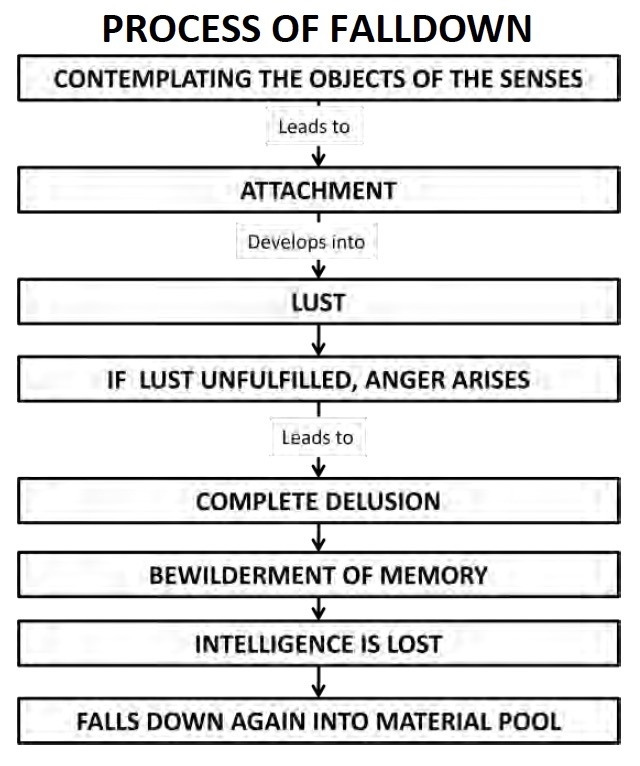
- kim āsīta - how to remain non-responsive to sense objects - 2.58 to 2.63 - eight steps of falling down
- vrajeta kim - how to respond to sense objects - 2.64 to 2.72
stitha-pragnya
- Gives up all desire for sense-gratification. Person in KC has all good qualifications, while one who is not is affected by mental concoctions and hence is bewildered by sense gratification.
Another world is jeevan-mukta.
2.56 and 2.57
kiṁ prabhāṣeta - how does he speak - 2.56 and 57
- surpassed the stage of mental speculations and hence steady mind, and not agitated
- only engaged in Krsna consciousness and always speaking only about Krsna
- accepts all misery as mercy of Lord, and gives credit to the Lord
- steady and determined in service to Lord and encourages others to serve the Lord
- he is not at all angry even when his attempts are unsuccessful
- he is simply concerned with Kṛṣṇa and not disturbed by the dualities of good and evil
stitha-dhir muni - close to stitha-pragnya
2.58 to 2.63
kim āsīta - how to remain non-responsive to sense object s- how to sit - 2.58 to 2.63 - eight steps of falling down
- Be like the tortoise against senses when they attack or coming in contact with sense objects who are like snakes packed in a jar and when opened would start running in all directions
- Sense objects always exist, but it's important to restrict in engaging with the same while being engaged in KC
- Senses are very strong. Analogy of Viswamitra, who wasn't able to control his senses and got carried away. Pramati.
- When we fix our consciousness on Krsna, our intelligence becomes stronger and controls over mind, which can control the senses
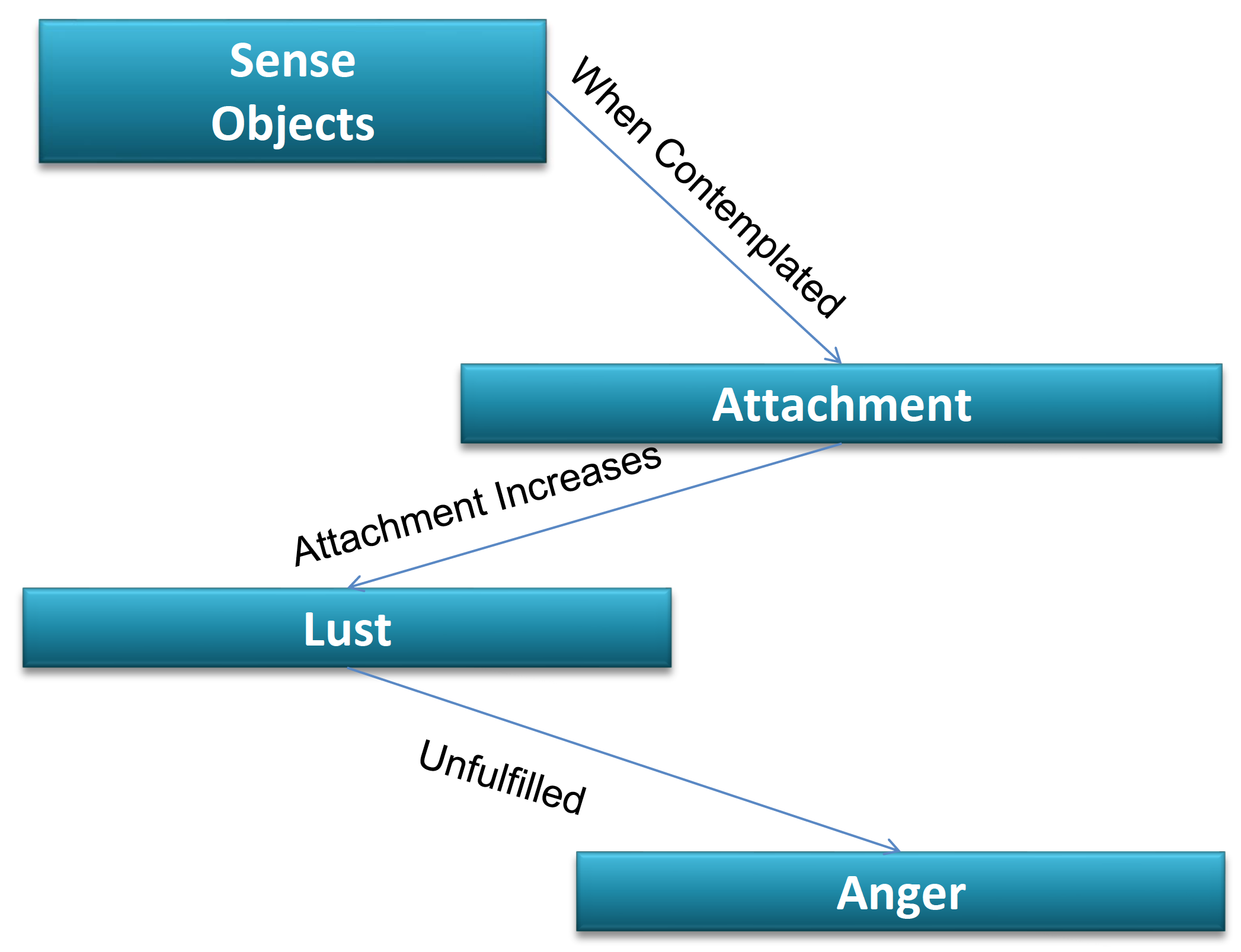
- Contact with sense objects --> desire --> anger --> bewilderment --> intelligence is lost
- Avoiding contemplation of sense objects
- mat-para - completely devoted to Krsna - 2.61 - Bhakti Yoga
2.64 to 2.72
vrajeta kim - how to respond to sense objects - 2.64 to 2.72
- Fix mind on Krsna.
- Only by KC we can curb the forces of sense gratification
As long as one has the material body, the demands of the body for sense gratification will continue. The devotee, however, is not disturbed by such desires, because of his fullness.
Sankhya-yoga is trying to find the root of the bhakti tree, while the bhakti yoga is serving / watering the root.
Book - "Our Original Position"
Unit 1 - Session 9 - 29 May 2025
3.36
To achieve artha, we need to follow Dharma. And because of lust and greed, we break Dharma.
If we viskruti, we act irrationally and against Dharma.
Sinful activities are not influenced by Super Soul. Krishna does not easily give permissions for performing sinful activities.
Chatper 18 - 5 factors / things that the body uses to execute anything.
3.38
In the platform of Sadhana, follow the rules & regulations to avoid the influence of lust.
3 degrees of lust -
- strong - child covered in the womb of mother. Completely covered by ignorance. Even trees.
- medium - mirror covered by dust. Need more purification. Relates to bodies of animals and birds. Bhakti Yoga can purify this too.
- low - fire covered by smoke. Visible when smoke is cleared. KC becomes visible.
3.39
It is said in the Manu-smṛti that lust cannot be satisfied by any amount of sense enjoyment, just as fire is never extinguished by a constant supply of fuel.
Lust covers our spiritual knowledge and impairs our progress.
Lust puts on golden shackles. Modern culture is nothing but advancement in lusty things meant for sense gratification. It is like sweet poision.
3.40
The senses, the mind and the intelligence are the sitting places of this lust.
Hear about sense objects --> Mind gets obsessed by sense objects --> senses are more attuned towards the sense objects --> intelligence starts planning how to get closer to the sense objects --> Spirit soul acquires false ego and identifies with matter.
3.41
Jñāna refers to knowledge of self as distinguished from non-self, or in other words, knowledge that the spirit soul is not the body. Vijñāna refers to specific knowledge of the spirit soul’s constitutional position and his relationship to the Supreme Soul.
"Tasmat" is used to indicate a conclusion by Krishna.
Lust can be controlled only by 2 methodologies -
- Sadhna/Vidhi-bhakti - by following rules & regulations learn to control senses - yam and niyama
- Sadhya-bhakti - bhava and prema
Jnana - knowledge of self. Vignana - practical application of knowledge of self.
Lust is only the perverted reflection of the love of God which is natural for every living entity.
3.42
Matter < Working Senses < Mind < Intelligence < Soul
3.43
Vishwamitra fell down from spiritual position even after practicing for 40000 years.
4.1 #BG-4-1
Gītā was spoken by the Lord to His disciple the sun-god Vivasvān, a rough estimate is that the Gītā was spoken at least 120,400,000 years ago; and in human society it has been extant for two million years.
4.2 #BG-4-2
Krishna spoke BG in Kuruksetra because the people of Kali-yuga are interested in reading stories and puranas. Hence Vyasadeva incorporated it in Mahabharata.
Unit 1 - Session 10 - 3 June 2025
4.9 #BG-4-9
Antaranga-lakshan and bahiranga-lakshan
Antaranga-
One who can understand the truth of the appearance of the Personality of Godhead is already liberated from material bondage. Such liberation of the living entity from material bondage is not at all easy.
Krishna comes to material world in many forms and all His activities are also transcendental.
Anyone (impersonalists) who does not understand Lord Kṛṣṇa as the Supreme Personality of Godhead is surely in the mode of ignorance and consequently he will not attain salvation simply, so to speak, by licking the outer surface of the bottle of honey, or by interpreting the Bhagavad-gītā according to mundane scholarship.
4.10 #BG-4-10
Purified/Freed from by taking shelter of Krishna -
- Attachment (raga)
- Fear (bhaya)
- Anger (krodha)
When they are informed that spiritual life is also individual and personal, they become afraid of becoming persons again, and so they naturally prefer a kind of merging into the impersonal void. Generally, they compare the living entities to the bubbles of the ocean, which merge into the ocean.
One has to get rid of all three stages of material consciousness: attachment to material life, fear of a spiritual personal identity, and the conception of void that arises from frustration in life. To get free from these three stages of the material concept of life, one has to take complete shelter of the Lord, guided by the bona fide spiritual master, and follow the disciplines and regulative principles of devotional life.
According to Bhakti-rasāmṛta-sindhu (1.4.15–16), the science of devotional service:
ādau śraddhā tataḥ sādhu-saṅgo ’tha bhajana-kriyā
tato ’nartha-nivṛttiḥ syāt tato niṣṭhā rucis tataḥ athāsaktis tato bhāvas
tataḥ premābhyudañcati sādhakānām ayaṁ premṇaḥ
prādurbhāve bhavet kramaḥ
“In the beginning one must have a preliminary desire for self-realization. This will bring one to the stage of trying to associate with persons who are spiritually elevated. In the next stage one becomes initiated by an elevated spiritual master, and under his instruction the neophyte devotee begins the process of devotional service. By execution of devotional service under the guidance of the spiritual master, one becomes free from all material attachment, attains steadiness in self-realization, and acquires a taste for hearing about the Absolute Personality of Godhead, Śrī Kṛṣṇa. This taste leads one further forward to attachment for Kṛṣṇa consciousness, which is matured in bhāva, or the preliminary stage of transcendental love of God. Real love for God is called prema, the highest perfectional stage of life.”
We need Bhava or Prema to go back to Goloka Vrindavan.
4.11 #BG-4-11
As for those who are impersonalists and who want to commit spiritual suicide by annihilating the individual existence of the living entity, Kṛṣṇa helps also by absorbing them into His effulgence.
Jnani/Brahmavadi, Parmatmavadi and Devotee - 3 types of devotees based on the feature of Godhead they focus on.
5 kind of primary rasa (dasya, vatsalya, shanta, madhurya, ) and 7 kind of secondary rasa (hasya, bhayanaka, gupt, acharya, bhibatsa)
4.12 #BG-4-12
Section on Demerits of worshipping demigods.
The demigods are not different forms of God, but they are God’s different parts and parcels.
4.13 #BG-4-13
as Kṛṣṇa is transcendental to this system of the four divisions of human society, a person in Kṛṣṇa consciousness is also transcendental to all divisions of human society, whether we consider the divisions of community, nation or species.
4.14 #BG-4-14
In the Vedānta-sūtra (2.1.34) it is confirmed, vaiṣamya-nairghṛṇye na sāpekṣatvāt: the Lord is never partial to any living entity. The living entity is responsible for his own acts. The Lord only gives him facilities, through the agency of material nature, the external energy.
Unit 1 - Session 13 - 11 June 2025
6.1 #BG-6-1
Although the eightfold yoga system is recommended in this chapter, the Lord emphasizes that the process of karma-yoga, or acting in Kṛṣṇa consciousness, is better.
Tridandi sannyasi - body, mind and intelligence - all 3 being spent in service of Krishna. They do not focus on or relish the fruits of their activity.
na dhanaṁ na janaṁ na sundarīṁ
kavitāṁ vā jagad-īśa kāmaye
mama janmani janmanīśvare
bhavatād bhaktir ahaitukī tvayi
“O Almighty Lord, I have no desire to accumulate wealth, nor to enjoy beautiful women. Nor do I want any number of followers. What I want only is the causeless mercy of Your devotional service in my life, birth after birth.”
6.2 #BG-6-2
He is the marginal energy of the Supreme. When he is entrapped by material energy, he is conditioned, and when he is Kṛṣṇa conscious, or aware of the spiritual energy, then he is in his real and natural state of life.
6.3 #BG-6-3
The complete ladder is called yoga and may be divided into three parts, namely jñāna-yoga, dhyāna-yoga and bhakti-yoga. The beginning of the ladder is called the yogārurukṣu (neophyte) stage, and the highest rung is called yogārūḍha (nitya siddha).
Ashtang-Yoga
- Yama
- Niyama
- Asana
- Pranayama
- Pratyahara
- Dharana
- Dhyana
- Samadhi
6.4 #BG-6-4
anyābhilāṣitā-śūnyaṁ jñāna-karmādy-anāvṛtam
ānukūlyena kṛṣṇānu-śīlanaṁ bhaktir uttamā
When first-class devotional service develops, one must be devoid of all material desires, knowledge obtained by monistic philosophy, and fruitive action. The devotee must constantly serve Kṛṣṇa favorably, as Kṛṣṇa desires.
6.5 #BG-6-5
The mind is the friend of the conditioned soul, and his enemy as well.
mana eva manuṣyāṇāṁ
kāraṇaṁ bandha-mokṣayoḥ
bandhāya viṣayāsaṅgo
muktyai nirviṣayaṁ manaḥ
“For man, mind is the cause of bondage and mind is the cause of liberation. Mind absorbed in sense objects is the cause of bondage, and mind detached from the sense objects is the cause of liberation.” (Amṛta-bindu Upaniṣad 2)
We should refer this sloka when someone asks for reference of atma referring to mind.
6.6 #BG-6-6
One who cannot control his mind lives always with the greatest enemy.
6.8 #BG-6-8
Book knowledge without realization of the Supreme Truth is useless. This is stated as follows:
ataḥ śrī-kṛṣṇa-nāmādi
na bhaved grāhyam indriyaiḥ
sevonmukhe hi jihvādau
svayam eva sphuraty adaḥ
“No one can understand the transcendental nature of the name, form, qualities and pastimes of Śrī Kṛṣṇa through his materially contaminated senses. Only when one becomes spiritually saturated by transcendental service to the Lord are the transcendental name, form, qualities and pastimes of the Lord revealed to him.” (Bhakti-rasāmṛta-sindhu 1.2.234)
6.11-12 #BG-6-11-12
The so-called yoga societies in big cities may be successful in earning material benefit, but they are not at all suitable for the actual practice of yoga. One who is not self-controlled and whose mind is not undisturbed cannot practice meditation.
6.13 #BG-6-13
3 stages of consciousness
- Jagruk
- Susupta
- Swapna avastha
All 3 stages of consciousness one should be focus on Krishna.
One cannot be fearless unless one is fully in Kṛṣṇa consciousness.
6.15 #BG-6-15
6.16 #BG-6-16
Bhuñjate te tv aghaṁ pāpā ye pacanty ātma-kāraṇāt. Anyone who eats for sense pleasure, or cooks for himself, not offering his food to Kṛṣṇa, eats only sin. One
6.17 #BG-6-17
Extravagance in the matter of eating, sleeping, defending and mating – which are demands of the body – can block advancement in the practice of yoga.
6.20-23 #BG-6-20-23
Krishna is talking about Samadhi stage of Ashtanga-yoga.
A person who is in pure bhakti-yoga, or in Kṛṣṇa consciousness, does not arouse the senses while meeting the demands of the body. Rather, he accepts the bare necessities of life, making the best use of a bad bargain, and enjoys transcendental happiness in Kṛṣṇa consciousness.
6.24 #BG-6-24
utsāhān niścayād dhairyāt
tat-tat-karma-pravartanāt
saṅga-tyāgāt sato vṛtteḥ
ṣaḍbhir bhaktiḥ prasidhyati
“One can execute the process of bhakti-yoga successfully with full-hearted enthusiasm, perseverance, and determination, by following the prescribed duties in the association of devotees and by engaging completely in activities of goodness.” (Upadeśāmṛta 3)
6 important aspects of Bhakti
- Full-hearted enthusiasm
- Perseverance
- Determination
- Following prescribed duties
- Association of Devotees
- Engaging completely in activities of goodness
6.27 #BG-6-27
Brahma-bhūta is the state of being free from material contamination and situated in the transcendental service of the Lord.
6.29 #BG-6-29
A Kṛṣṇa conscious yogī is the perfect seer because he sees Kṛṣṇa, the Supreme, situated in everyone’s heart as Supersoul (Paramātmā). Īśvaraḥ sarva-bhūtānāṁ hṛd-deśe ’rjuna tiṣṭhati. The Lord in His Paramātmā feature is situated within both the heart of the dog and that of a brāhmaṇa.
The Lord has, primarily, two energies – the spiritual (or superior) and the material (or inferior). The living entity, although part of the superior energy, is conditioned by the inferior energy; the living entity is always in the Lord’s energy.
The yogī sees equally because he sees that all living entities, although in different situations according to the results of fruitive work, in all circumstances remain the servants of God.
6.32 #BG-6-32
The cause of the distress of a living entity is forgetfulness of his relationship with God.
The yogī who has withdrawn to a secluded place in order to meditate perfectly may not be as perfect as a devotee who is trying his best to turn every man toward Kṛṣṇa consciousness.
6.33 #BG-6-33
Arjuna starts countering Krishna's proposal of practising Ashtanga-yoga, citing the difficulty with mind control. It is not possible for an ordinary man to leave home and go to a secluded place in the mountains or jungles to practice yoga in this Age of Kali.
6.34 #BG-6-34
Kaṭha Upaniṣad 1.3.3–4 #KU
ātmānaṁ rathinaṁ viddhi
śarīraṁ ratham eva ca
buddhiṁ tu sārathiṁ viddhi
manaḥ pragraham eva ca
indriyāṇi hayān āhur
viṣayāṁs teṣu gocarān
ātmendriya-mano-yuktaṁ
bhoktety āhur manīṣiṇaḥ
“The individual is the passenger in the car of the material body, and intelligence is the driver. Mind is the driving instrument, and the senses are the horses. The self is thus the enjoyer or sufferer in the association of the mind and senses. So it is understood by great thinkers.”
6.35 #BG-6-35
Vairāgya means detachment from matter and engagement of the mind in spirit. Impersonal spiritual detachment is more difficult than attaching the mind to the activities of Kṛṣṇa. This is practical because by hearing about Kṛṣṇa one becomes automatically attached to the Supreme Spirit. This attachment is called pareśānubhūti, spiritual satisfaction. It is just like the feeling of satisfaction a hungry man has for every morsel of food he eats. The more one eats while hungry, the more one feels satisfaction and strength.
6.37 #BG-6-37
Self-realization is sought by the path of knowledge, by the practice of the eightfold system or by bhakti-yoga.
6.40 #BG-6-40
Those who are following the path of auspiciousness can be divided into three sections, namely
- karmis - the followers of scriptural rules and regulations who are enjoying material prosperity,
- mumuksuh - those who are trying to find ultimate liberation from material existence, and
- bhakta - those who are devotees in Kṛṣṇa consciousness.
6.46 #BG-6-46
When we speak of yoga we refer to linking our consciousness with the Supreme Absolute Truth. Such a process is named differently by various practitioners in terms of the particular method adopted. When the linking process is predominantly in fruitive activities it is called karma-yoga, when it is predominantly empirical it is called jñāna-yoga, and when it is predominantly in a devotional relationship with the Supreme Lord it is called bhakti-yoga.