Bhakti Sastri - Unit 2 - Bhagavad-Gita
Bhakti Sastri - Home
Bhakti Sastri - Unit 1 - Bhagavad-Gita
Bhakti Sastri - Unit 3 - Bhagavad-Gita
Session 1 - 3rd July 2025
HG Haladhar Nitai Das Prabhuji
Summary of 1-6
- In the First Chapter of Bhagavad-gita, Arjuna becomes depressed and refuses to fight due to family attachment.
- In the beginning of Second Chapter, he surrenders to Krsna and begs for guidance. To remove Arjuna's illusion, Krsna explains the position of the soul. Since Arjuna's lamentation is still not dispelled, the Lord gives the method by which the soul can be realized (naiskarmya). At the end of the Second Chapter, the Lord describes the characteristics of the self-realized person.
- In the beginning of the Third Chapter, Arjuna is confused because he misunderstood that acquiring transcendental knowledge is incompatible with work. To eradicate this mistake Krsna explains naiskarmya (buddhi-yoga) as work combined with knowledge. Such detached work is a sacrifice and it is the means of attaining transcendental realization. It is performed even by great self-realized persons in order to set a good example for others. The Lord emphasizes that in order to perform naiskarmya steadily, one should conquer lust and thus overcome material dualities.
-
- In the Third Chapter, it is explained that naiskarmya culminates in transcendental knowledge. In the Fourth Chapter, the Lord glorifies transcendental knowledge as the goal of all sacrifices. Krsna gives the essence of the transcendental knowledge by revealing the cause of His appearance and the transcendental nature of His pastimes.
- Arjuna is still confused because he did not understand that work in full knowledge is nonreactive and is therefore the same as inaction. As a result, in the beginning of Fifth Chapter he asks which is more beneficial, work or renunciation of work. Krsna explains that though they are equal, work in knowledge is better than renunciation of work because it is easier and safer. Karma-yoga can be replaced with jana-yoga only by a person who is sufficiently purified by detached work.
- Sixth Chapter describes how one can attain self-realization by the method of astanga-yoga. As with jana-yoga, astanga-yoga is suitable for a person who has been purified by karma-yoga. The astanga-yogi is the best of all transcendentalists, and the devotee is the topmost among all yogis.
Part 2 - Bhakti Yoga
Chapter list
- Chapter 7 : Knowledge of the Absolute
- Chapter 8: Attaining the Supreme
- Chapter 9 : The Most Confidential Knowledge
- Chapter 10 : The Opulence of the Absolute
- Chapter 11 : The Universal Form
- Chapter 12 : Devotional Service
MIDDLE SIX CHAPTERS ARE THE ESSENCE
In his purport to Verse 8.28 ( #BG-8-28), Srila Prabhupada writes: Chapters Seven through Twelve are the essence of Bhagavad-gita. The first six and the last six chapters are like coverings for the middle six chapters, which are especially protected by the Lord. If one is fortunate enough to understand Bhagavad-gita-especially these middle six chapters-in the association of devotees, then his life at once becomes glorified beyond all penances, sacrifices, charities, speculations, etc., for one can achieve all the results of these activities simply by Krsna consciousness.
Srila Visvanatha Cakravarti Thakura explains why bhakti-yoga is placed between karma and jnana:
Bhakti-yoga is placed between karma and jñana-yoga because of its confidential nature, because of its superiority by which it is able to give life to the other two, and because of its being so rare. And moreover, because these two are useless without bhakti, the karma and jnana presented in the Gita have been mixed with bhakti and become more acceptable.
Bhakti is the only independent process, while Karma and Jnana are supportive to Bhakti. Gita explains how to purify our Karma and Janana to achieve pure bhakti.
According to Srila Baladeva Vidyabhusana the first six chapters have spoken mainly about the svarupa of the jiva and the means to realize this svarupa.
The middle six chapters speak about the svarupa of the Lord, who is the object of worship of the jiva, and the means to realize Him.
The first six chapters of Bhagavad-gétä deal primarily with karma-yoga, the middle six chapters with bhakti-yoga, and the last six chapters with jnana-yoga. Krsna has explained in Chapter Six that the yogi most intimately united with Him was thinking of Him within. Now, the Seventh Chapter explains how one can become such a Krsna conscious person. By engaging in devotional service one gains determined faith, drdha-vrata, and becomes convinced that simply by such service all his objectives will be fulfilled.
Chapter 7 - Knowledge of the Absolute Truth JÑANA-VIJÑÃNA YOGA
| Mayy asakta-manäh - Hear from Krsna | 1-7 | |
|---|---|---|
| Krsna as Source of Everything | 4-12 | |
| Mama maya duratyaya | 13-14 | |
| Who Surrenders To Krsna | 15-19 | |
| Demigod Worshippers and Impersonalists | 20-25 | |
| Iccha-dvesa - punya-karmanam | 26-30 |
SUMMARY OF VERSES
Verses 1-3 : Knowing Krsna by hearing from Him
Since this subject is very important the Lord speaks about it without being asked further by Arjuna.
Verses 4-14: Krsna is the source of all spiritual and material energies, and the controller of the three modes
One who is situated in knowledge of Krsna and acts accordingly is executing devotional service; thus devotion resides in perfect knowledge of the supreme. (4-5)
Verses 15-19: Two classes of people-pious and impious
After many births and deaths a pious person realizes that in everything there is a relationship with the Supreme Lord Sri Krsna. (19)
Verses 20-23 : The demigod worshipers
Those whose intelligence is weakened by strong material desires do not surrender to the Lord but to the demigods.
Verses 24-28 : The impersonalists
Due to desire and hate the mayavadis are envious of Krsna and want to become one with Him (27)
Verses 29-30 : The yoga-misra bhakta
By claiming the three key positions (adhibhuta, adhidaiva, and adhiyajña) the Lord attracts different types of materialistic people to His lotus feet, and also shows to His devotees how they should see everything in connection with Him.
From Bhakti Sastri Handbook
KNOWING KRNA IN FULL BY HEARING ABOUT HIM (1-7)
In Chapter Seven, Kna begins to explain how to attain this state. Krna urges Arjuna to hear with mind attached to Him as He explains knowledge of Himself (verses 1-3). He explains how He is the origin of everything, both material and spiritual (verses 4-7).
KNOWING KRNA AS THE SOURCE OF BOTH MATERIAL AND SPIRITUAL ENERGIES (8-12)
Krsna describes how He is the essence of everything in verses 8-12. If Krsna is the origin and essence of everything, as explained in texts 4-12, why do some people not recognize him as the Supreme Personality of Godhead?
THE THREE MODES ARE CONTROLLED BY KRSNA - THEREFORE SURRENDER (13-14)
Verses 13-14 explain how the living entities are deluded and controlled by the three modes, but are able to go beyond them by surrendering to Krsna, since He is the controller of the modes.
FOUR KINDS OF IMPIOUS PERSONS WHO DO NOT SURRENDER TO KRSNA AND FOUR KINDS OF PIOUS PERSONS WHO Do (15-19)
Liberation from the laws of material nature has been sought by the leaders of mankind with great plans and perseverance for many years. If such liberation is attained by surrendering to Krsna, why don't they adopt this method? Verse 15 describes four types of unqualified persons who do not surrender to Kisna and who sometimes pose themselves as leaders simply for material gain.
Verses 16-19 describe four types of persons who surrender to Krsna, and how the wise man is the best because he does not desire some gain.
DEMIGOD WORSHIPPERS AND IMPERSONALISTS WHOSE SURRENDER Is MISPLACED (20-25)
Verses 20-23 describe less intelligent persons who worship demigods for material gain. Verses 24-25 describe the impersonalists who surrender to the formless aspect of Krsna. They cannot see Krsna, who covers Himself from their vision.
BEWILDERMENT OF THE LIVING ENTITY AND KNOWLEDGE OF KRSNA (26-30)
Krsna knows all and is thus different from these foolish living entities that are born into delusion and are bewildered by dualities arising from desire and hate. Pious persons, freed from dualities arising from delusion engage in devotional service with determination and attain liberation. They have knowledge of Krsna as adhibhuta, adhidaiva, and adhiyajña.
Verses 1-3 : Knowing Krsna by hearing from Him
"The Supreme Personality of Godhead said: Now hear, O son of Prtha, how by practicing yoga in full consciousness of Me, with mind attached to Me, you can know Me in full, free from doubt." (1)
This can be attained simply by hearing from Krsna (tac chrnu).
The Lord continued: "I shall now declare unto you in full this knowledge, both phenomenal and numinous. This being known, nothing further shall remain for you to know." (2)
Knowledge about Krsna includes everything knowable. As Srila Prabhupada writes in his purport to Verse 2:
Complete knowledge includes knowledge of the phenomenal world, the spirit behind it, and the source of both of them. This is transcendental knowledge. The Lord wants to explain the above-mentioned system of knowledge because Arjuna is Krsna's confidential devotee and friend. In the beginning of the Fourth Chapter this explanation was given by the Lord, and it is again confirmed here: complete knowledge can be achieved only by the devotee of the Lord in disciplic succession directly from the Lord. Therefore one should be intelligent enough to know the source of all knowledge, who is the cause of all causes and the only object for meditation in all types of yoga practice. When the cause of all causes becomes known, then everything knowable becomes known, and nothing remains unknown.
The Lord continued: "Out of many thousands of men, one may endeavor for perfection and of those who have achieved perfection hardly one can know Me in truth." (3)
Srila Prabhupada explains in his purport to Verse 3:
Even the great demigods are sometimes confused about Krsna (muhyanti yat surayah). Mãm tu veda na kascana: "No one knows Me as I am," the Lord says. And if one does know Him, then sa mahatma su-durlabhah. "Such a great soul is very rare." Therefore unless one practices devotional service to the Lord, one cannot know Krsna as He is (tattvatah), even though one is a great scholar or philosopher...Krsna is the last word in Brahman realization, and the devotees alone can realize Him as He is.
Verses 4-14: Krsna is the source of all spiritual and material energies, and the controller of the three modes
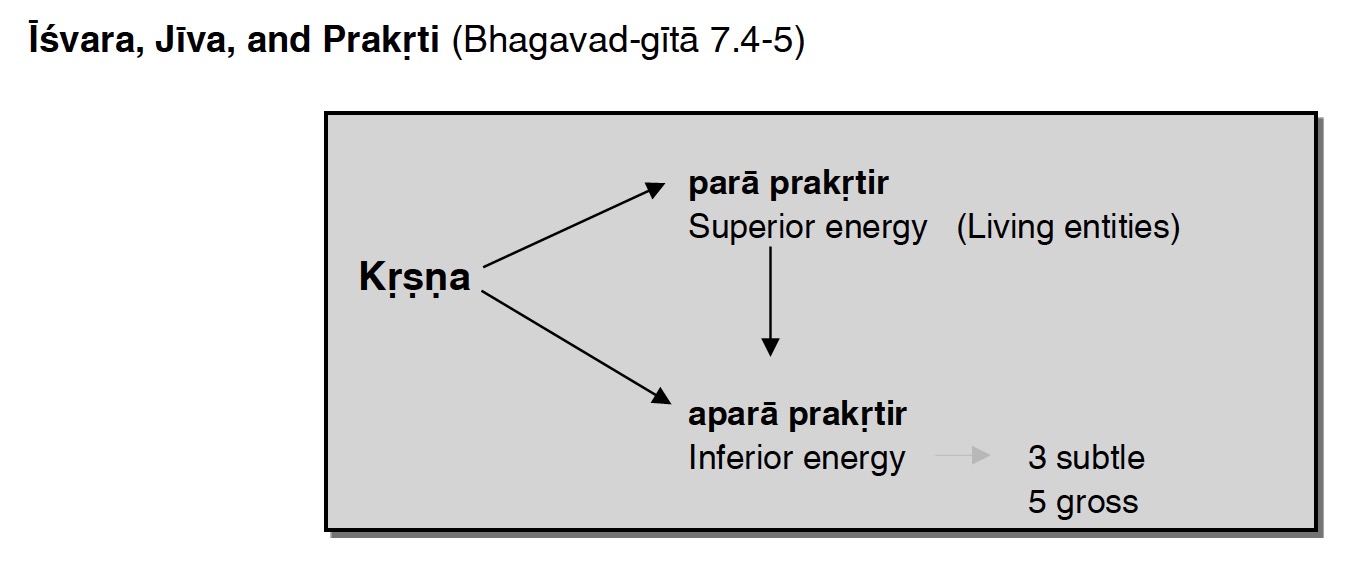
In verses 4-5 Krsna summarizes everything that exists in the material world into two categories.
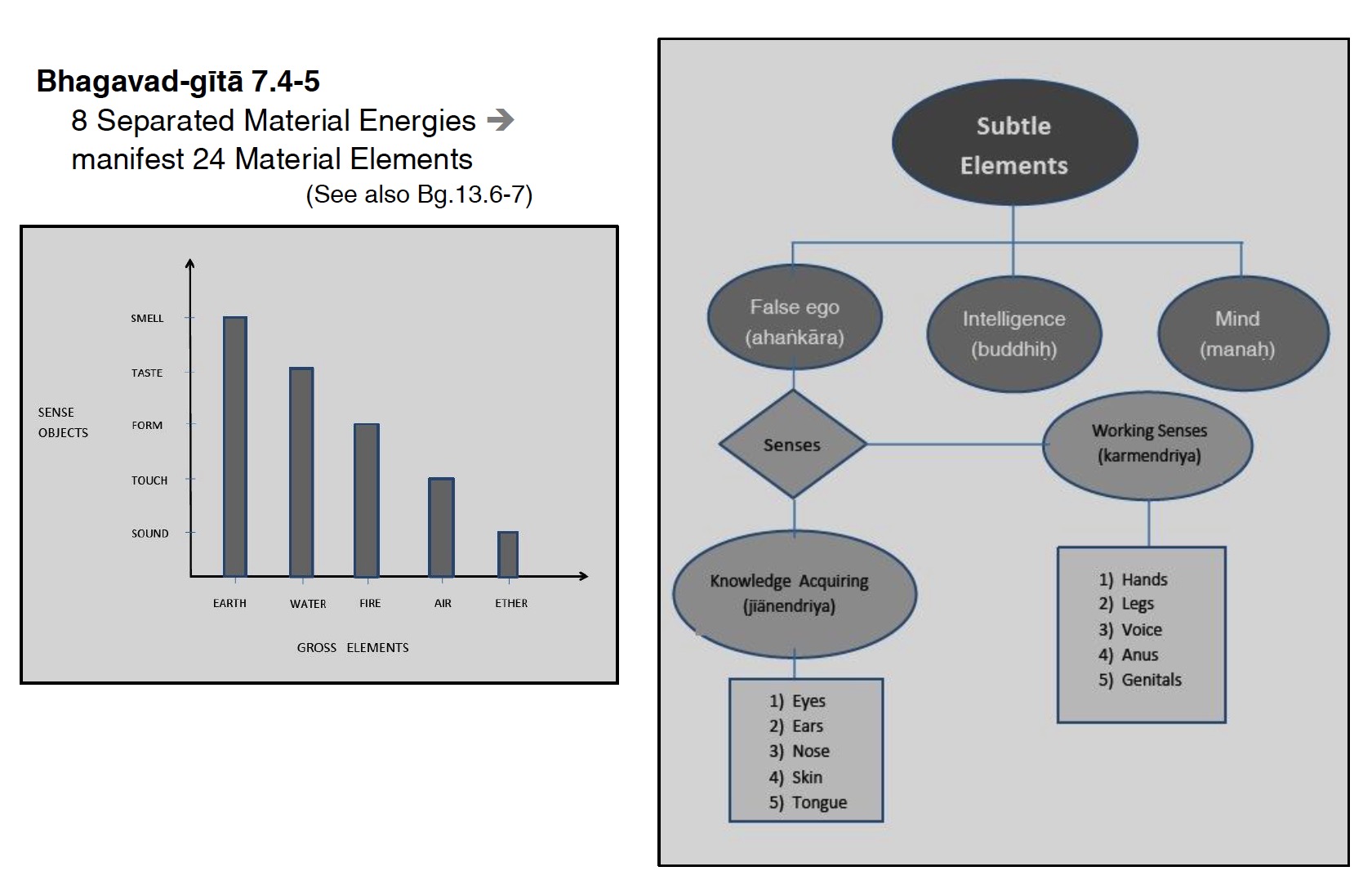
The Lord continued: "Earth, water, fire, air, ether, mind, intelligence and false ego—all together these eight constitute My separated material energies." (4) The Lord continued: "Besides these, O mighty-armed Arjuna, there is another, of Mine, superior energy of Mine, which comprises the living entities who are exploiting the resources of this material, inferior nature." (5)
In a Bhagavad-gita lecture, Srila Prabhupada explains how the material elements are the separated energy of the Lord:
Bhinna means separated. An example is when I speak into the tape recorder. When you replay the tape recorder, you hear my voice. But it is not me, it is my separated energy. With my energy I have spoken, I have vibrated some sound and it is recorded on the tape. When it is played back, it produces exactly the same sound but it is separated from me. Try to understand. This material world is just like that, bhinna, separate. Real life is in the spiritual world ... and these energies, the external energy, Krsna says, are separated. Separated means you cannot perceive Krsna directly from this energy. (Lect. #BG-7-4 New Vrndavana 1974)
Everything we see in the material world is Krsna's energy. The advanced devotees are aware of the connection between the energy and the Energetic. Thus while working in the material world they can always remember Krsna.
On the other hand, the materialistic scholars try to understand the energy without connecting it with the Energetic. Out of ignorance they limit their study with the gross material elements only; and if they have any idea of the Lord's spiritual energy, it is very vague and incomplete. As Srila Prabhupada explains in his purport to Verse 5:
In the material energy, the principal manifestations are eight, as above mentioned. Out of these, the first five manifestations, namely earth, water, fire, air and sky, are called the tive gigantic creations or the gross creations, within which the five sense objects are included. They are the manitestations of physical sound, touch, form, taste and smell. Material science comprises these ten items and nothing more. But the other three items, namely mind, intelligence and false ego, are neglected by the materialists. Philosophers who deal with mental activities are also not perfect in knowledge because,they do not know the ultimate source, Krsna.
The false ego—"I am," and "It is mine," which constitute the basic principle of material existence-includes ten sense organs for material activities.
Intelligence refers to the total material creation, called the mahat-tattva.
Therefore from the eight separated energies of the Lord are manifest the twenty-four elements of the material world, which are the subject matter of Sankhya atheistic philosophy; they are originally offshoots from Krsna's energies and are separated from Him, but atheistic Sankhya philosophers with a poor fund of knowledge do not know Krsna as the cause of all causes. The subject matter for discussion in the Sankhya philosophy is only the manifestation of the external energy of Krsna, as it is described in the Bhagavad-gita.
In Verse 5 the Lord explains that the living entities who are exploiting the material elements are His superior energy. As Srila Prabhupada writes in Renunciation Through Wisdom:
It is easy to discern the superiority of spirit over inert matter. The jiva principle is setting into motion and sustaining everything in this material world. And if the jivas did not try to lord it over the material nature, then there would be no variegatedness in this phenomenal world. The material elements would have remained unchanged if the jivas had not been inclined to control and enjoy them. Only through the material energies' connection with the conscious living entity can such substances as earth, wood, stone, and iron be orchestrated so as to give rise to huge, opulent buildings, factories, and cities. Matter cannot organize itself.
As Srila Prabhupada explains in Renunciation Through Wisdom:
The jivas, being a product of the spiritual energy, try to exploit the material energy, but ultimately such attempts fail, because it is impossible for one energy to always exploit and lord it over another energy. The jivas can, however, eternally serve the Supreme Energetic, Lord Krsna.
When the jiva exploits the material energy in his endeavor to serve the Lord, that activity is transcendental-the performance of sacrifice. Any other kind of activity amounts to nothing but materialistic, fruitive work.
In the next two verses (6-7) Krsna introduces Himself as a separate category:
The Lord continued: "All created beings have their source in these two natures. Of all that is material and all that is spiritual in this world, know for certain that I am both the origin and the dissolution. O conqueror of wealth, there is no truth superior to Me. Everything rests upon Me, as pearls are strung on a thread." (6-7)
As Srila Prabhupada writes in his purport to Verse 7 #BG-7-7:
There is a common controversy over whether the Supreme Absolute Truth is personal or impersonal. As far as Bhagavad-gita is concerned, the Absolute Truth is the Personality of Godhead, Sri Krsna, and this is confirmed in every step. In this verse, in particular, it is stressed that the Absolute Truth is a person... The impersonalist, however, argues on the strength of the Vedic version given in the Svetasvatara Upanisad (3.10): tato yad uttarataram tad arupam anamayam/ ya etad vidur amtas te bhavanti athetare duhkham evapiyanti." In the material world Brahma, the primeval living entity within the universe, is understood to be the supreme amongst the demigods, human beings and lower animals. But beyond Brahma there is the Transcendence, who has no material form and is free from all material contaminations. Anyone who can know Him also becomes transcendental, but those who do not know Him suffer the miseries of the material world."
The impersonalist puts more stress on the word arupam. But this arupam is not impersonal. It indicates the transcendental form of eternity, bliss and knowledge...
As Srila Prabhupada writes in Renunciation Through Wisdom:
The Supreme Lord, endowed with the six transcendental opulences to the absolute degree, is the highest governing principle. Thus no other personality is equal to or greater than He. Lord Krsna confirms this point by saying "There is no truth superior to Me," and then explaining how He is present everywhere and intimately connected with everything through His all-pervasive energies.
In Verses 8-11 the Lord explains how everything is strung on Him. The Lord gives examples as to how we can remember Him while working in the material world.
The Lord continued: "O son of Kunti, I am the taste of water, the light of the sun and the moon, the syllable om in the Vedic mantras; I am the sound in ether and ability in man. I am the original fragrance of the earth, and I am the heat in fire. I am the life of all that lives, and I am the penances of all ascetics. O son of Prtha, know that I am the original seed of all existences, the intelligence of the intelligent, and the prowess of all powerful men. I am the strength of the strong, devoid of passion and desire. I am sex life which is not contrary to religious principles, O lord of the Bharatas (Arjuna)." (8-11)
He is the working potency of everything in this world. Nothing functions without Him or His sanction.
The Lord continued: "Know that all states of being—be they of goodness, passion or ignorance-are manifested by My energy. I am, in one sense, everything, but I am independent. I am not under the modes of material nature, for they, on the contrary, are within Me." (12)
Thus though everything is coming from the Lord, He is fully independent. He is not under the modes of material nature. Srila Prabhupada gives an example:
All material activities in the world are being conducted under the three modes of material nature. Although these material modes of nature are emanations from the Supreme Lord, Krsna, He is not subject to them. For instance, under the state laws one may be punished, but the king, the lawmaker, is not subject to that law. Similarly, all the modes of material nature-goodness, passion and ignorance-are emanations from the Supreme Lord, Krsna, but Krsna is not subject to material nature. Therefore He is nirguna, which means that these gunas, or modes, although issuing from Him, do not affect Him.
Furthermore, Verse 12 establishes the principle that the Supreme Absolute Person is inconceivably and simultaneously one with, and different from His energies. This philosophical conclusion is called acintya-bhedäbheda-tattva.
If Krsna is the Controller of the modes, and the origin and the essence of everything, why don't people recognize Him as the Supreme Personality of Godhead?
The Lord answers this question in Verses 13-14. The fools think that Krsna is under the modes of material nature just as they are:
"Deluded by the three modes (goodness, passion and ignorance), the whole world does not know Me, who am above the modes and inexhaustible.
This divine energy of Mine, consisting of the three modes of material nature, is difficult to overcome. But those who have surrendered unto Me can easily cross beyond it." (13-14)
In other words, both Brahma and Siva are also under the influence of maya. Only Visnu is the master of maya; therefore He alone can give release to the conditioned soul.
HOMEWORK - Why ist he living entity called nitya-baddha?
UNIT 2 - Session 2 - 8th July 2025
Verses 1-3 : Knowing Krsna by hearing from Him
Since this subject is very important the Lord speaks about it without being asked further by Arjuna.
Verses 4-14: Krsna is the source of all spiritual and material energies, and the controller of the three modes
One who is situated in knowledge of Kysna and acts accordingly is executing devotional service; thus devotion resides in perfect knowledge of the supreme. (4-5)
Verses 15-19 : Two classes of people-pious and impious
After many births and deaths a pious person realizes that in everything there is a relationship with the Supreme Lord Sri Krsna. (19)
Verses 15-19: Two classes of people-pious and impious
Liberation from the laws of material nature has been sought by the leaders of mankind with great plans and perseverance for many years. If such liberation is attained by surrendering to Kåñëa, why don’t they adopt this method? Verse 15 describes four types of unqualified persons who do not surrender to Kåñëa and who sometimes pose themselves as leaders simply for material gain. Verses 16–19 describe four types of persons who surrender to Kåñëa, and how the wise man is the best because he does not desire some gain.
It is said in Bhagavad-gītā that simply by surrendering oneself unto the lotus feet of the Supreme Personality Kṛṣṇa one can surmount the stringent laws of material nature. At this point a question arises: How is it that educated philosophers, scientists, businessmen, administrators and all the leaders of ordinary men do not surrender to the lotus feet of Śrī Kṛṣṇa, the all-powerful Personality of Godhead? Mukti, or liberation from the laws of material nature, is sought by the leaders of mankind in different ways and with great plans and perseverance for a great many years and births. But if that liberation is possible by simply surrendering unto the lotus feet of the Supreme Personality of Godhead, then why don’t these intelligent and hard-working leaders adopt this simple method?
They have no idea of God; they simply manufacture their own worldly plans and consequently complicate the problems of material existence in their vain attempts to solve them. Because material energy (nature) is so powerful, it can resist the unauthorized plans of the atheists and baffle the knowledge of "planning commissions."
The atheistic planmakers are described herein by the word duskrtinah, or "miscreants." Krti means one who has performed meritorious work. The atheist planmaker is sometimes very intelligent and meritorious also, because any gigantic plan, good or bad, must take intelligence to execute. But because the atheist's brain is improperly utilized in opposing the plan of the Supreme Lord, the atheistic planmaker is called duskrti, which indicates that his intelligence and efforts are misdirected.
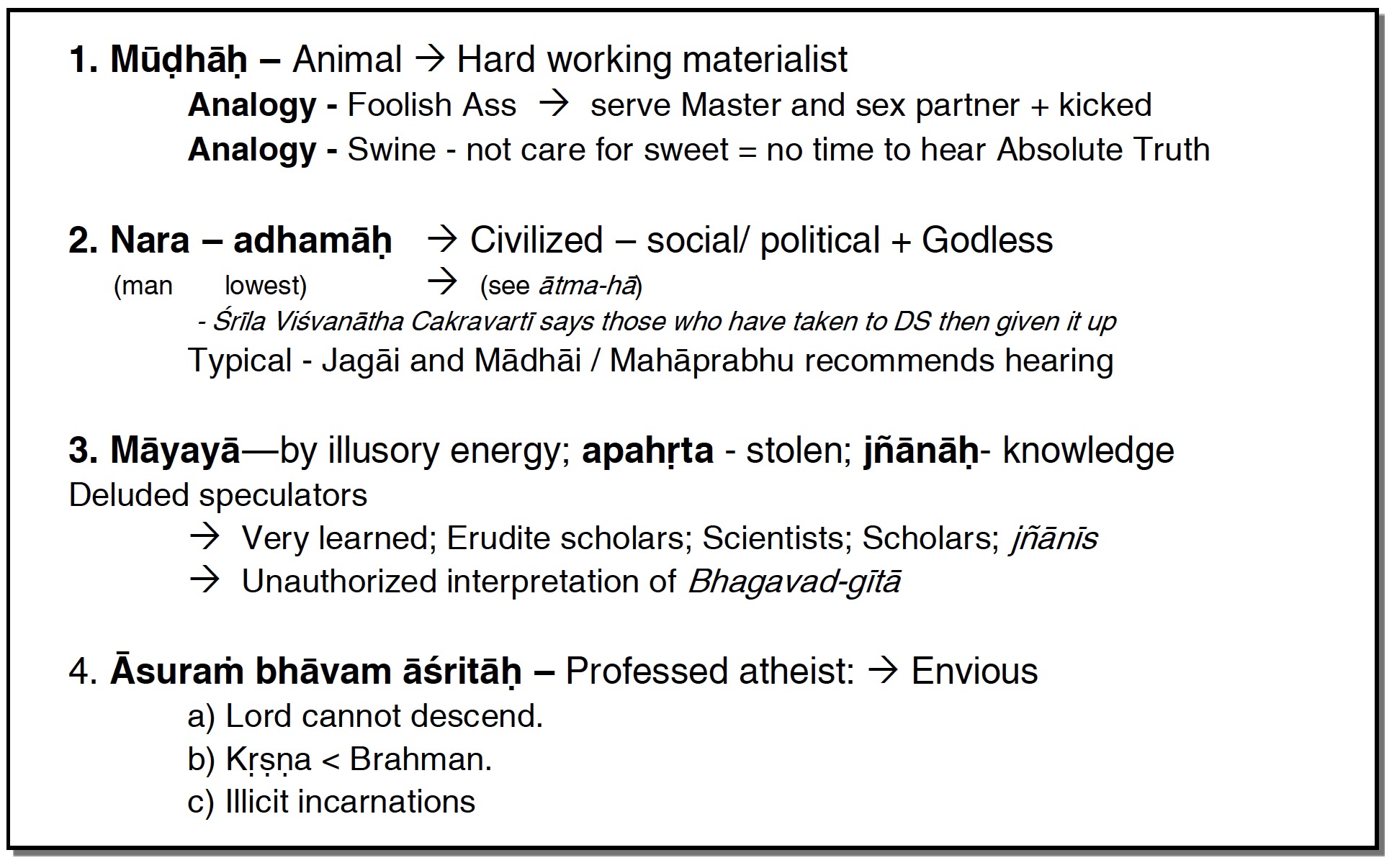
These duṣkṛtinas, or miscreants, are of four different patterns, as outlined below:
- The mūḍhas are those who are grossly foolish, like hardworking beasts of burden. They want to enjoy the fruits of their labor by themselves, and so do not want to part with them for the Supreme.
- Another class of duṣkṛtī, or miscreant, is called the narādhama, or the lowest of mankind. Nara means human being, and adhama means the lowest. The civilized human beings are those who have regulative principles of social, political and religious life. Those who are socially and politically developed but who have no religious principles must be considered narādhamas.
It is the duty of the guardians of children to revive the divine consciousness dormant in them. The ten processes of reformatory ceremonies, as enjoined in the Manu-smṛti, which is the guide to religious principles, are meant for reviving God consciousness in the system of varṇāśrama. However, no process is strictly followed now in any part of the world, and therefore 99.9 percent of the population is narādhama. - The next class of duṣkṛtī is called māyayāpahṛta-jñānāḥ, or those persons whose erudite knowledge has been nullified by the influence of illusory material energy. They are mostly very learned fellows – great philosophers, poets, literati, scientists, etc. – but the illusory energy misguides them, and therefore they disobey the Supreme Lord.
- The last class of duskrti is called asuram bhavam asritah, or those of demonic principles. This class is openly atheistic. Some of them argue that the Supreme Lord can never descend upon this material world, but they are unable to give any tangible reasons as to why not. There are others who make Him subordinate to the impersonal feature, although the opposite is declared in the Gità. Envious of the Supreme Personality of Godhead, the atheist will present a number of illicit incarnations manufactured in the factory of his brain.
Therefore, (1) grossly foolish persons, (2) the lowest of mankind, (3) the deluded speculators, and (4) the professed atheists, as above mentioned, never surrender unto the lotus feet of the Personality of Godhead in spite of all scriptural and authoritative advice.
Upadesa-Upakhyan - https://gurukul.iskcondesiretree.com/comics-srila-bhaktisidhanata-saraswati-thakur-upadesha-upakhyana/
3 stages of studying scriptures
- Shravan
- Manan
- Nidhidhyasana
What is Shravan, Manan and Nidhidhyasana?
In the context of Vedanta, an ancient Indian philosophical tradition, Shravan (श्रवण), Manan (मनन), and Nidhidhyasana (निदिध्यासन) are three crucial practices or stages aimed at gaining and internalizing spiritual knowledge. These practices are designed to help an individual move from intellectual understanding to deep realization and experiential knowledge of the Self (Atman) and ultimate reality (Brahman).
1. Shravan (श्रवण)
Shravan means “listening” or “hearing” in Sanskrit. It is the first step in the process of acquiring spiritual knowledge.
- Purpose: The aim of Shravan is to listen to the teachings of the scriptures (like the Upanishads, Bhagavad Gita) and the wisdom imparted by a qualified guru (spiritual teacher). This listening should be done with full attention and an open mind.
- Process: During Shravan, one absorbs the teachings and doctrines about the nature of reality, the Self, and the universe. It involves attending discourses, reading scriptures, and understanding the concepts as conveyed by the sages and teachers.
2. Manan (मनन)
Manan means “reflection” or “contemplation.”
- Purpose: The goal of Manan is to deeply reflect on the teachings heard during Shravan. This reflection helps in resolving doubts and achieving a clear and logical understanding of the concepts. Practical application, and understanding in the context of the book as well as in terms of spiritual knowledge.
- Process: During Manan, one engages in critical thinking and analytical contemplation on the teachings. This involves questioning, reasoning, and meditating on the lessons to ensure they make sense intellectually and are free from doubts. It’s a process of internalizing the teachings and making them one’s own through rational thought.
3. Nidhidhyasana (निदिध्यासन)
Nidhidhyasana means “profound meditation” or “concentrated contemplation.”
- Purpose: The aim of Nidhidhyasana is to deeply meditate on the knowledge gained from Shravan and clarified through Manan until it becomes an integral part of one’s consciousness and lived experience. It is the stage of internal realization and assimilation of the truth.
- Process: In Nidhidhyasana, one practices sustained and focused meditation on the essential truths learned. This stage involves turning inward and continuously meditating on the non-dual nature of reality and the unity of the Self with Brahman. It’s a process of dissolving the sense of separation and achieving direct experiential knowledge. Allows to reach the conclusion.
Integration in Spiritual Practice
These three practices form a progressive path in Vedantic sadhana (spiritual practice):
- Shravan provides the foundational knowledge.
- Manan ensures that this knowledge is thoroughly understood and free of doubts.
- Nidhidhyasana transforms intellectual understanding into experiential realization.
Together, Shravan, Manan, and Nidhidhyasana help a seeker move from ignorance (Avidya) to knowledge (Vidya), ultimately leading to Moksha (liberation) or the realization of one’s true nature as Brahman, the ultimate reality.
anyābhilāṣitā-śūnyaṁ
jñāna-karmādy-anāvṛtam
ānukūlyena kṛṣṇānu-
śīlanaṁ bhaktir uttamā
“One should render transcendental loving service to the Supreme Lord Kṛṣṇa favorably and without desire for material profit or gain through fruitive activities or philosophical speculation. That is called pure devotional service.”
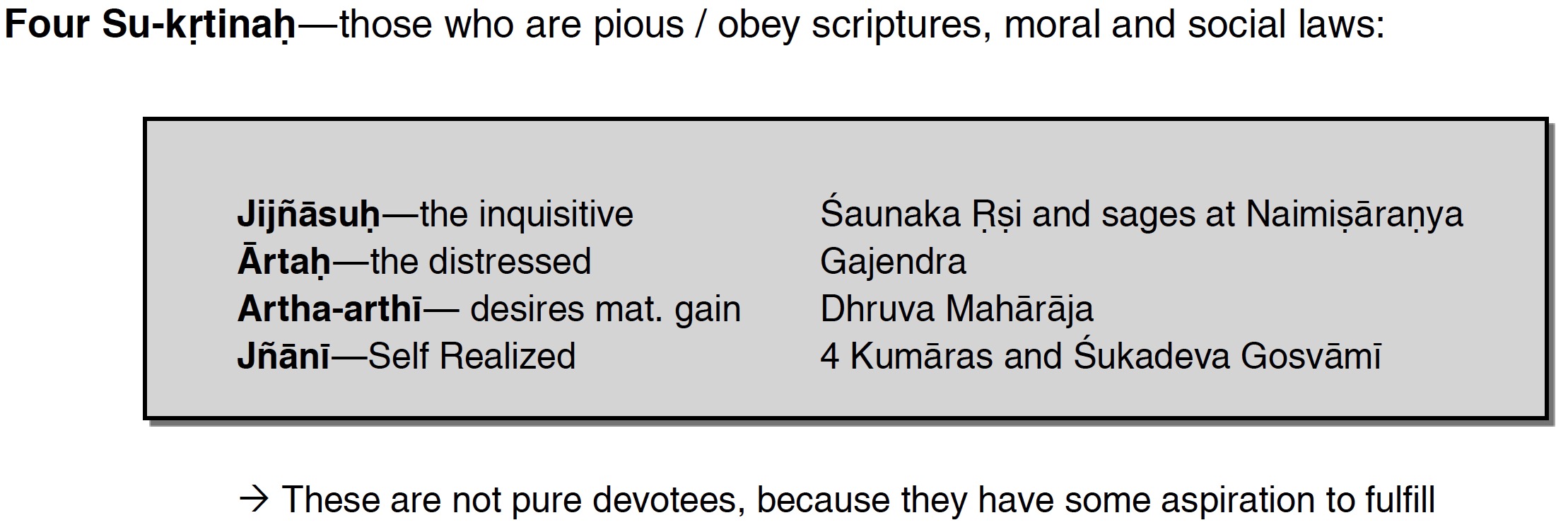
Unlike the miscreants, these are adherents of the regulative principles of the scriptures, and they are called su-kṛtinaḥ, or those who obey the rules and regulations of scriptures, the moral and social laws, and are, more or less, devoted to the Supreme Lord. Out of these there are four classes of men – those who are sometimes distressed, those who are in need of money, those who are sometimes inquisitive, and those who are sometimes searching after knowledge of the Absolute Truth. These persons come to the Supreme Lord for devotional service under different conditions. These are not pure devotees, because they have some aspiration to fulfill in exchange for devotional service. Pure devotional service is without aspiration and without desire for material profit.
On the whole, when the distressed, the inquisitive, the seekers of knowledge, and those who are in need of money are free from all material desires, and when they fully understand that material remuneration has nothing to do with spiritual improvement, they become pure devotees. As long as such a purified stage is not attained, devotees in transcendental service to the Lord are tainted with fruitive activities, the search for knowledge, etc.
tesam jani nitya-yukta eka-bhaktir visisyate
priyo hi iñanino 'tyartham aham sa ca mama priyah
TRANSLATION
Of these, the one who is in full knowledge and who is always engaged in pure devotional service is the best. For I am very dear to him, and he is dear to Me.
So by association with pure devotees the inquisitive, the distressed, the seeker after material amelioration and the man in knowledge all become themselves pure. But in the preparatory stage, the man who is in full knowledge of the Supreme Lord and is at the same time executing devotional service is very dear to the Lord. He who is situated in pure knowledge of the transcendence of the Supreme Personality of God is so protected in devotional service that material contamination cannot touch him.
udarah sarva evaite jani tv atmaiva me matam
ästhitah sa hi yuktatma mam evanuttamam gatim
TRANSLATION
All these devotees are undoubtedly magnanimous souls, but one who is situated in knowledge of Me I consider to be just like My own Self. Being engaged in My transcendental service, he is sure to attain Me, the highest and most perfect goal.
It is not that devotees who are less complete in knowledge are not dear to the Lord. The Lord says that all are magnanimous because anyone who comes to the Lord for any purpose is called a mahatma, or great soul... But the devotee in full knowledge is considered to be very dear to the Lord because his only purpose is to serve the Supreme Lord with love and devotion. Such a devotee cannot live a second without contacting or serving the Supreme Lord. Similarly, the Supreme Lord is very fond of His devotee and cannot be separated from him.
bahunam janmanãm ante janavan mãm prapadyate
väsudevah sarvam iti sa mahatma su-durlabhah
TRANSLATION
After many births and deaths, he who is actually in knowledge surrenders unto Me, knowing Me to be the cause of all causes and all that is. Such a great soul is very rare.
In the beginning of spiritual realization, while one is trying to give up one's attachment to materialism, there is some leaning towards impersonalism, but when one is further advanced he can understand that there are activities in the spiritual life and that these activities constitute devotional service. Realizing this, he becomes attached to the Supreme Personality of Godhead and surrenders to Him. At such a time one can understand that Lord Sri Krsna's mercy is everything, that He is the cause of all causes, and that this material manifestation is not independent from Him. Thus he thinks of everything in relation to Vasudeva, or Sri Krsna. Such a universal vision of Vasudeva precipitates one's full surrender to the Supreme Lord Sri Krsna as the highest goal. Such surrendered great souls are very rare.
Verses 20-23 : The demigod worshipers
Verses 20–23 describe less intelligent persons who worship demigods for material gain.
kamais tais tair hrta-janah prapadyante 'nya-devatah
tam tam niyamam asthaya prakrtya niyatah svaya
TRANSLATION
Those whose intelligence has been stolen by material desires surrender unto demigods and follow the particular rules and regulations of worship according to their own natures.
Those who are freed from all material contaminations surrender unto the Supreme Lord and engage in His devotional service. As long as the material contamination is not completely washed off, they are by nature nondevotees. But even those who have material desires and who resort to the Supreme Lord are not so much attracted by external nature; because of approaching the right goal, they soon become free from all material lust... The worshipers of demigods are motivated by small desires and do not know how to reach the supreme goal, but a devotee of the Supreme Lord is not misguided.
yo yo yam yam tanum bhaktah sraddhayarcitum icchati
tasya tasyacalam sraddhăm tãm eva vidadhamy aham
TRANSLATION
I am in everyone's heart as the Supersoul. As soon as one desires to worship some demigod, I make his faith steady so that he can devote himself to that particular deity.
God has given independence to everyone; therefore, if a person desires to have material enjoyment and wants very sincerely to have such facilities from the material demigods, the Supreme Lord, as Supersoul in everyone's heart, understands and gives facilities to such persons. As the supreme father of all living entities, He does not interfere with their independence, but gives all facilities so that they can fulfill their material desires.
sa tayà sraddhaya yuktas tasyarädhanam ihate
labhate ca tatah kãmãn mayaiva vihitãn hi tãn
TRANSLATION
Endowed with such a faith, he endeavors to worship a particular demigod and obtains his desires. But in actuality these benefits are bestowed by Me alone.
The demigods cannot award benedictions to their devotees without the permission of the Supreme Lord. The living entity may forget that everything is the property of the Supreme Lord, but the demigods do not forget. So the worship of demigods and achievement of desired results are due not to the demigods but to the Supreme Personality of Godhead, by arrangement. The less intelligent living entity does not know this, and therefore he foolishly goes to the demigods for some benefit.
antavat tu phalam tesam tad bhavaty alpa-medhasam
devan deva-yajo yanti mad-bhakta yanti mãm api
TRANSLATION
Men of small intelligence worship the demigods, and their fruits are limited and temporary. Those who worship the demigods go to the planets of the demigods, but My devotees ultimately reach My supreme planet.
Here the point may be raised that if the demigods are different parts of the body of the Supreme Lord, then the same end should be achieved by worshiping them.
However, worshipers of the demigods are less intelligent because they don't know to what part of the body food must be supplied. Some of them are so foolish that they claim that there are many parts and many ways to supply food. This isn't very sanguine... The results achieved by the demigods' benedictions are perishable because within this material world the planets, the demigods and their worshipers are all perishable.
Therefore it is clearly stated in this verse that all results achieved by worshiping demigods are perishable, and therefore such worship is performed by the less intelligent living entity.
4 reasons why demigod worship should not be done -
- Results are temporary
- Demigods cannot give faith in their worship
- Krishna is the bestower of results, demigods only are mediator to get sanction
- Ones who are overcome by material desires worship demigods
Verses 24-28 : The impersonalists
Verses 24–25 describe the impersonalists who surrender to the formless aspect of Krsna. They cannot see Krsna, who covers Himself from their vision. Krsna knows all and is thus different from these foolish living entities that are born into delusion nd are bewildered by dualities arising from desire and hate. Pious persons, freed from dualities rising from delusion engage in devotional service with determination and attain liberation. They have knowledge of Krsna as adhibhuta, adhidaiva, and adhiyajña.
avyaktam vyaktim apannam manyante mam abuddhayah
param bhavam ajananto mamavyayam anuttamam
TRANSLATION
Unintelligent men, who do not know Me perfectly, think that 1, the Supreme Personality of Godhead, Krsna, was impersonal before and have now assumed this personality. Due to their small knowledge, they do not know My higher nature, which is imperishable and supreme.
In the Brahma-samhita it is stated that the Personality of Godhead cannot be understood simply by study of the Vedanta literature. Only by the mercy of the Supreme Lord can the Personality of the Supreme be known. Therefore in this verse it is clearly stated that not only are the worshipers of the demigods less intelligent, but those nondevotees who are engaged in Vedanta and speculation on Vedic literature without any tinge of true Krsna consciousness are also less intelligent, and for them it is not possible to understand God's personal nature. Persons who are under the impression that the Absolute Truth is impersonal are described as abuddhayah, which means those who do not know the ultimate feature of the Absolute Truth.
Most important sloka to counter argue the mayavadi philosophy.
#BG-7-25
nāhaṁ prakāśaḥ sarvasya yoga-māyā-samāvṛtaḥ
mūḍho ’yaṁ nābhijānāti loko mām ajam avyayam
TRANSLATION
I am never manifest to the foolish and unintelligent. For them I am covered by My internal potency, and therefore they do not know that I am unborn and inexhaustible.
It may be argued that since Krsna was visible to everyone when He was present on this earth, how can it be said that He is not manifest to everyone? But actually He was not manifest to everyone. When Krsna was present there were only a few people who could understand Him to be the Supreme Personality of Godhead. He was manifest only to His devotees as the reservoir of all pleasure. But to others to unintelligent nondevotees, He was covered by His internal potency.
#BG-7-26
vedāhaṁ samatītāni vartamānāni cārjuna
bhaviṣyāṇi ca bhūtāni māṁ tu veda na kaścana
TRANSLATION
O Arjuna, as the Supreme Personality of Godhead, I know everything that has happened in the past, all that is happening in the present, and all things that are yet to come. I also know all living entities; but Me no one knows.
Here the question of personality and impersonality is clearly stated. If Krsna, the form of the Supreme Personality of Godhead, were maya, material, as the impersonalists consider Him to be, then like the living entity He would change His body and forget everything about His past life. Anyone with a material body cannot remember his past life, nor can he foretell his future life, nor can he predict what will happen in his present life; therefore he cannot know the events of past, present and future. Unless one is liberated from material contamination, he cannot know past, present and future.
Similar to #BG-4-5 Krishna is reminding Arjuna how He has shared this knowledge multiple times.
#BG-7-27
icchā-dveṣa-samutthena dvandva-mohena bhārata
sarva-bhūtāni sammohaṁ sarge yānti paran-tapa
TRANSLATION
O scion of Bharata, O conqueror of the foe, all living entities are born into delusion, bewildered by dualities arisen from desire and hate.
Due to desire and hate, the ignorant person wants to become one with the Supreme Lord and envies Krna as the Supreme Personality of Godhead. Pure devotees, who are not deluded or contaminated by desire and hate, can understand that Lord Sri Krsna appears by His internal potencies, but those who are deluded by duality and nescience think that the Supreme Personality of Godhead is created by material energies. This is their misfortune. Such deluded persons, symptomaticallv, dwell in dualities of dishonor and honor, misery and happiness, woman and man, good and bad, pleasure and pain, etc., thinking. "This is my wife; this is my house; I am the master of this house; I am the husband of this wife." These are the dualities of delusion. Those who are so deluded by dualities are completely foolish and therefore cannot understand the Supreme Personality of Godhead.
Ichha (desire) and dwesha (envy) are the causes for delusion in this material world.
#BG-7-28
yeṣāṁ tv anta-gataṁ pāpaṁ janānāṁ puṇya-karmaṇām
te dvandva-moha-nirmuktā bhajante māṁ dṛḍha-vratāḥ
TRANSLATION
Persons who have acted piously in previous lives and in this life and whose sinful actions are completely eradicated are freed from the dualities of delusion, and they engage themselves in My service with determination.
Verses 29-30 : The yoga-misra bhakta
#BG-7-29
jarā-maraṇa-mokṣāya mām āśritya yatanti ye
te brahma tad viduḥ kṛtsnam adhyātmaṁ karma cākhilam
TRANSLATION
Intelligent persons who are endeavoring for liberation from old age and death take refuge in Me in devotional service. They are actually Brahman because they entirely know everything about transcendental activities.
#BG-7-30
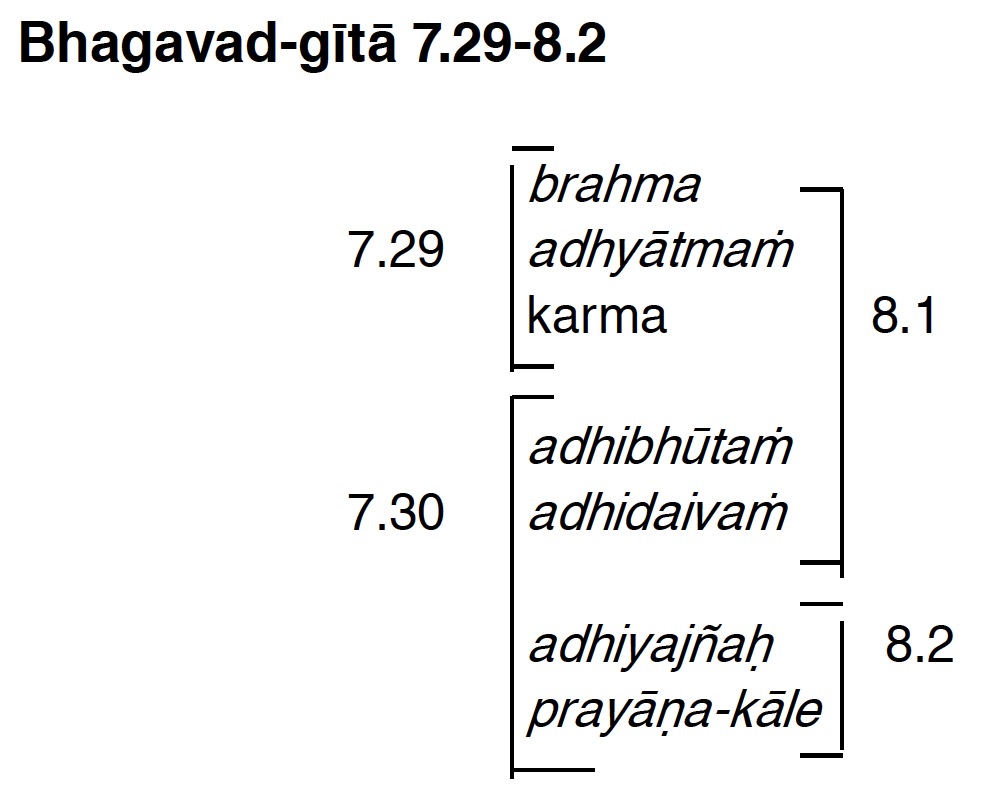
sadhibhutadhidaivam mam sadhiyajñam ca ye viduh
prayana-kale 'pi ca mam te vidur yukta-cetasah
TRANSLATION
Those in full consciousness of Me, who know Me, the Supreme Lord, to be the governing principle of the material manifestation, of the demigods, and of all methods of sacrifice, can understand and know Me, the Supreme Personality of Godhead, even at the time of death.
Lord is 4 things - adyatma, adhidaiva, adhibhuta, adhiyajnah
Refer Gita-Mahatmaya
UNIT 2 - Session 3 - 10th July 2025
Chapter 8 is called Attaining the Supreme.
Arjuna is asking questions about adyatma, adhidaiva, adhibhuta, adhiyajnah, what is the duty at the time of death.
First 4 verses are Arjuna asking questions and rest of the chapter is Krishna answering those questions.
Arjuna inquires about the six terms Krsna used at the end of Chapter 7: Brahma, adhyātma, karma, adhibhuta, adhidaiva, and adhiyajna.
KRSNA ANSWERS ARJUNA's QUESTIONS (1-4)
In this chapter Krsna answers Arjuna's questions and discusses yoga principles and pure devotional service. In verses 1-4 Krsna answers Arjuna's first seven questions.
REMEMBERING KRSNA (5-9)
In verses 5-8 Krsna answers his eighth question about the destination of one who thinks of Krsna at the time of death. Krsna explains that one must always think of Him, along with performing active devotional service. Such practice helps one remember Krsna at the time of death and attain to His nature. Krsna explains some ways to meditate on Him in verse 9.
YOGA-MISRA-BHAKTI (10-13)
A yogi can also attain Krsna by uttering om and thinking of Krna at death. Yoga-misra-bhakti is described in verses 10-13.
PURE DEVOTIONAL SERVICE (14-16)
Krsna urges Arjuna to engage in pure devotional service by remembering Him without deviation.
There is no impediment in such service and one easily attains Krsna.
COMPARING THE MATERIAL AND SPIRITUAL WORLDS (17-22)
The material world is miserable and temporary, as illustrated by the constant cycle of universal creation and destruction. By hearing this description one gains detachment from this world. In verses 20-22 the eternal nature of the spiritual world is described, as well as the means to attain it, devotional service to Krsna.
THE SUPREMACY OF DEVOTION IN ATTAINING THE SUPREME (23-28)
In verses 23-26, The Lord describes different ways of leaving this world for the karmis and jñãnis. But Krsna's devotees need not worry about these paths, because simply by engaging in devotional service, they attain the beneficial results of all paths and at the end reach the supreme destination (verses 27-28). By hearing the middle six chapters of Bhagavad-gita in the association of devotees, one gets the benefits of performing all sacrifices, penance, etc., and one progresses from anartha-nivritti to pure love of Krsna.
#BG-8-2
adhiyajñaḥ kathaṁ ko ’tra
dehe ’smin madhusūdana
prayāṇa-kāle ca kathaṁ
jñeyo ’si niyatātmabhiḥ
TRANSLATION
Who is the Lord of sacrifice, and how does He live in the body, O Madhusūdana? And how can those engaged in devotional service know You at the time of death?
“Lord of sacrifice” may refer to either Indra or Viṣṇu. Viṣṇu is the chief of the primal demigods, including Brahmā and Śiva, and Indra is the chief of the administrative demigods. Both Indra and Viṣṇu are worshiped by yajña performances. But here Arjuna asks who is actually the Lord of yajña (sacrifice) and how the Lord is residing within the body of the living entity.
Since Kṛṣṇa is so expert in killing demons, Arjuna here addresses Him as Madhusūdana so that Kṛṣṇa might kill the demonic doubts that arise in Arjuna’s mind.
Mahārāja Kulaśekhara, a great devotee, prays, “My dear Lord, just now I am quite healthy, and it is better that I die immediately so that the swan of my mind can seek entrance at the stem of Your lotus feet.” The metaphor is used because the swan, a bird of the water, takes pleasure in digging into the lotus flowers; its sporting proclivity is to enter the lotus flower. Mahārāja Kulaśekhara says to the Lord, “Now my mind is undisturbed, and I am quite healthy. If I die immediately, thinking of Your lotus feet, then I am sure that my performance of Your devotional service will become perfect. But if I have to wait for my natural death, then I do not know what will happen, because at that time the bodily functions will be disrupted, my throat will be choked up, and I do not know whether I shall be able to chant Your name. Better let me die immediately.” Arjuna questions how a person can fix his mind on Kṛṣṇa’s lotus feet at such a time.
We need to digest the knowledge. Just reading is not enough. It needs to be realised and internalised. It is said that we should not be reading too much even in the path of spirituality so as not to get confused. One should read only that much which allows one to understand and realise how to practically apply the same in their life.
Astrologers / jyotish are part of the 5th philosophy - #karma-mimamsa
#BG-8-3
śrī-bhagavān uvāca akṣaraṁ brahma paramaṁ
svabhāvo ’dhyātmam ucyate
bhūta-bhāvodbhava-karo
visargaḥ karma-saṁjñitaḥ
TRANSLATION
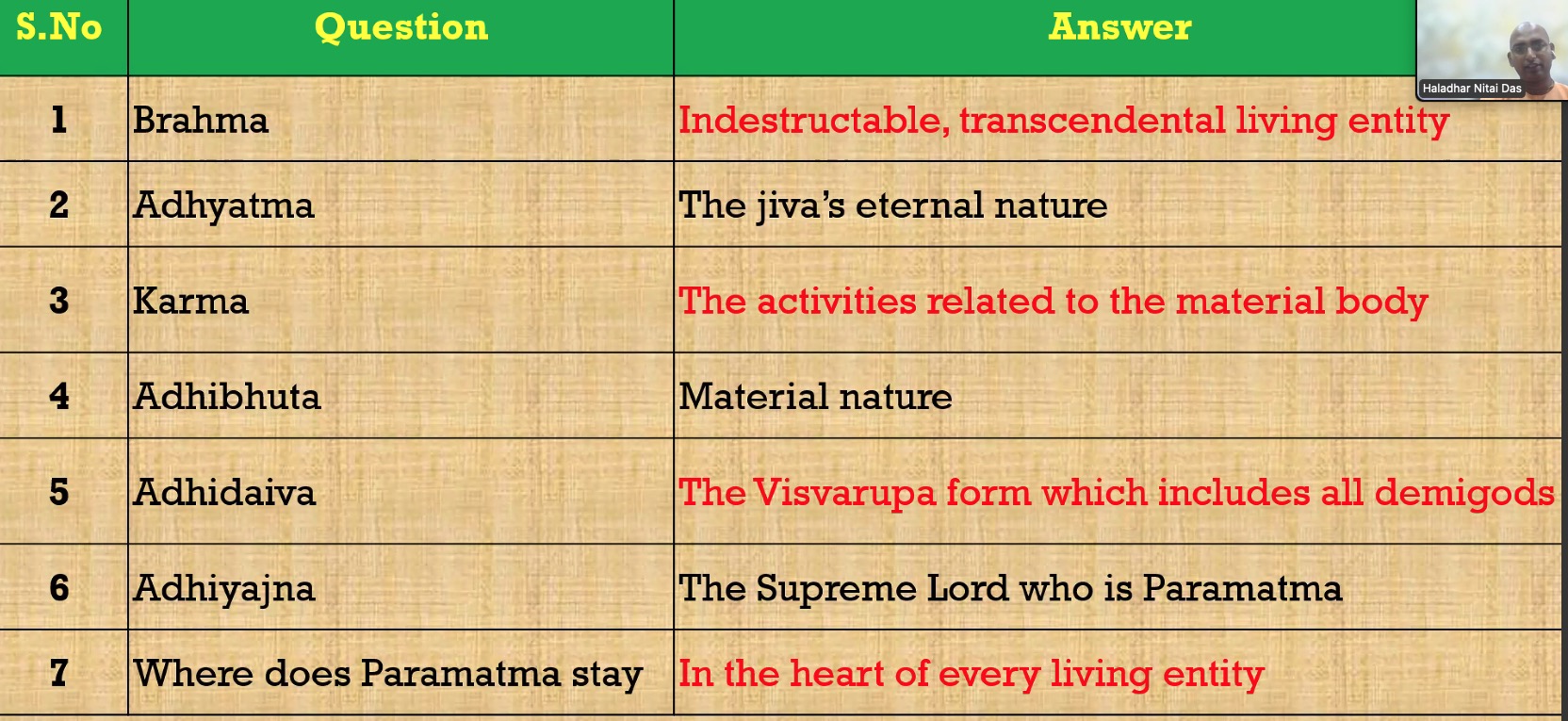
The Supreme Personality of Godhead said: The indestructible, transcendental living entity is called Brahman, and his eternal nature is called adhyātma, the self. Action pertaining to the development of the material bodies of the living entities is called karma, or fruitive activities.
Brahman is indestructible and eternally existing, and its constitution is not changed at any time. But beyond Brahman there is Para-brahman. Brahman refers to the living entity, and Para-brahman refers to the Supreme Personality of Godhead. The constitutional position of the living entity is different from the position he takes in the material world. In material consciousness his nature is to try to be the lord of matter, but in spiritual consciousness, Krsna consciousness, his position is to serve the Supreme.
#BG-8-4
adhibhūtaṁ kṣaro bhāvaḥ puruṣaś cādhidaivatam
adhiyajño ’ham evātra dehe deha-bhṛtāṁ vara
TRANSLATION
O best of the embodied beings, the physical nature, which is constantly changing, is called adhibhuta (the material manifestation). The universal form of the Lord, which includes all the demigods, like those of the sun and moon, is called adhidaiva. And I, the Supreme Lord, represented as the Supersoul in the heart of every embodied being, am called adhiyajña (the Lord of sacrifice).
The physical nature is constantly changing. Material bodies generally pass through six stages: they are born, they grow, they remain for some duration, they produce some by-products, they dwindle, and then they vanish. This physical nature is called adhibhuta. The conception of the universal form of the Supreme Lord, which includes all the demigods and their different planets, is called adhidaivata. The Supersoul is called the Paramatma or adhiyajña and is situated in the heart.
Verses 5-8 - How to remember Krsna at the time of death
#BG-8-5
anta-kale ca mãm eva smaran muktva kalevaram
yah prayati sa mad-bhavam yati nasty atra samsayah
TRANSLATION
And whoever, at the end of his life, quits his body remembering Me alone at once attains My nature. Of this there is no doubt.
In this verse the importance of Krsna consciousness is stressed. Anyone who quits his body in Krsna consciousness is at once transferred to the transcendental nature of the Supreme Lord... Remembrance of Krsna is not possible for the impure soul who has not practiced Krsna consciousness in devotional service.
Remembrance of Kṛṣṇa is not possible for the impure soul who has not practiced Kṛṣṇa consciousness in devotional service. Therefore one should practice Krsna consciousness from the very beginning of life. If one wants to achieve success at the end of his life, the process of remembering Krsna is essential. Therefore one should constantly, incessantly chant the maha-mantra-Hare Krsna, Hare Krsna, Krsna Krsna, Hare Hare / Hare Rama, Hare Rama, Rama Rama, Hare Hare.
Before Smaranam, we need to do Sravanam and Kirtanam.
The activities of the day evoke dreams at night and induce emotions appropriate to those activities. Similarly, the activities performed in one's lifetime flash across one's mind at the moment of death and determine one's next life. Therefore, if one's present activities are directed toward chanting, hearing, and remembering the Supreme Lord's transcendental name, along with descriptions of His beauty, qualities, pastimes, associates, and paraphernalia, then one's consciousness at the moment one leaves his body will automatically be attracted to the Lord...Therefore devotees always remember Him in all their activities—in their endeavors for food and safety and even in the middle of the battlefield while fighting a war. Life being like a battlefield, in which one may die at any time, the devotees remember Him at every moment, and He willingly becomes the charioteer of their chariotlike bodies.
The activities of their bodies, minds, and words are thus prompted by the Supreme Lord's will, and at the end, when they leave their gross and subtle bodies, they go directly to the spiritual sky.
In Verse 5 the Lord explained the specific situation of a devotee remembering Him at the time of death. In Verse 6 the general rule is presented
#BG-8-6
yam yam vapi smaran bhavam tyajaty ante kalevaram
tam tam evaiti kaunteya sada tad-bhava-bhavitah
TRANSLATION
Whatever state of being one remembers when he quits his body, O son of Kunti, that state he will attain without fail.
The process of changing one's nature at the critical moment of death is here explained. A person who at the end of his life quits his body thinking of Krsna attains the transcendental nature of the Supreme Lord, but it is not true that a person who thinks of something other than Krsna attains the same transcendental state. This is a point we should note very carefully. How can one die in the proper state of mind? Maharaja Bharata, although a great personality, thought of a deer at the end of his life, and so in his next life he was transferred into the body of a deer.
Similarly in chapter 7 #BG-7-23 , Krsna mentions that only those are devoted to Him go back to Him.
At the time of death, our state of consciousness determines our next birth. Death destroys the body made up of the five gross elements, but the subtle body, consisting of mind, intelligence, and false ego, remains. As the air carries the scent of the place it blows over, so the soul carries a person's subtle body of mind, intelligence, and false ego, along with his state of consciousness, on to his next birth, and his body is determined accordingly. When a breeze blows over a garden, it carries the fragrance of flowers with it, but when it blows over a rubbish heap, the breeze is filled with the stench. Similarly, the activities a person performs during his lifetime continuously influence his mentality, and at the time of death the cumulative effect of these activities determines his state of consciousness.
Hearing Krsna's instructions in Verses 5 and 6 one might conclude that since remembrance of the Lord is the most important thing, everyone should instantly abandon his duties and dedicate his time to hearing and chanting. To correct such hasty conclusion, Krsna says that Arjuna should always think of Him and at the same time carry on his prescribed duty.
Do you activity in such a way to become dear to everyone, but do it in such a way that people will get pleased. You cannot give shelter to everyone or please everyone, so don't try it.
#BG-8-7
tasmāt sarveṣu kāleṣu mām anusmara yudhya ca
mayy arpita-mano-buddhir mām evaiṣyasy asaṁśayaḥ
TRANSLATION
Therefore, Arjuna, you should always think of Me in the form of Kṛṣṇa and at the same time carry out your prescribed duty of fighting. With your activities dedicated to Me and your mind and intelligence fixed on Me, you will attain Me without doubt.
This instruction to Arjuna is very important for all men engaged in material activities. The Lord does not say that one should give up his prescribed duties or engagements. One can continue them and at the same time think of Krsna by chanting Hare Krsna. This will free one from material contamination and engage the mind and intelligence in Krsna. By chanting Krsna's names, one
will be transferred to the supreme planet, Krsnaloka, without a doubt.
In vedic fold, there are 3 types activities -
- Nitya-karma - daily activities including daily sadhana
- Naimitika-karma - occassional activities
- Kamya-karma - performing activities to satisfy personal desires
One who has taken up devotional service, they give up on kamya-karma, and even nitya-karma and naimitika-karma, they give up anything that is against principles of devotion.
In vaidhi sadhana, hearing and chanting is critical, while in rupanuga
For 4 generations above, we fast on their appearance / disappearance day, same way we do pitr.
#BG-8-9
abhyāsa-yoga-yuktena cetasā nānya-gāminā
paramaṁ puruṣaṁ divyaṁ yāti pārthānucintayan
TRANSLATION
He who meditates on Me as the Supreme Personality of Godhead, his mind constantly engaged in remembering Me, undeviated from the path, he, O Partha, is sure to reach Me.
The devotee can constantly think of the object of worship, the Supreme Lord, in any of His features-Narayana, Krsna, Rama, etc.—by chanting Hare Krsna. This practice will purify him, and at the end of his life, due to his constant chanting, he will be transferred to the kingdom of God. Yoga practice is meditation on the Supersoul within; similarly, by chanting Hare Krsna one fixes his mind always on the Supreme Lord. The mind is fickle, and therefore it is necessary to engage the mind by force to think of Krsna. One example often given is that of the caterpillar that thinks of becoming a butterfly and so is transformed into a butterfly in the same life. Similarly, if we constantly think of Krsna, it is certain that at the end of our lives we shall have the same bodily constitution as Krsna.
Unit 2 - Session - 29 July 2025
Chapter 9
SUMMARY OF VERSES
- Verses 1-3 : Who is qualified to hear about Krsna
- Verses 4-10: The acintya-bhedabheda relationship between cit, acit, and isvara
- Verses 11-15: Demons, Worshipers, and Pure Devotees
- Verses 16-25 : Krsna is the supreme object of worship
- Verses 26-34 : The glories of direct worship of Krsna
SIGNIFICANCE OF THIS CHAPTER
Bhagavad-gita is the essence of all Vedic knowledge. The middle six chapters of Gita are the essence of the book and thus they are "the essence of the essence." Among the middle six chapters, the Ninth and the Tenth Chapters are especially important and therefore they are "the essence of the essence of the essence" of all Vedic knowledge.
#BG-9-1
sri-bhagavan uvaca
idam tu te guhyatamam pravaksyamy anasuyave
janam vijñana-sahitam yaj iñatva moksyase 'subhāt
TRANSLATION
The Supreme Personality of Godhead said: My dear Arjuna, because you are never envious of Me, I shall impart to you this most confidential knowledge and realization, knowing which you shall be relieved of the miseries of material existence.
The devotees are constantly engaged in the Supreme Lord's service. The Lord understands the mentality and sincerity of a particular living entity who is engaged in Krsna consciousness and gives him the intelligence to understand the science of Krsna in the association of devotees. Discussion of Krsna is very potent, and if a fortunate person has such association and tries to assimilate the knowledge, then he will surely make advancement toward spiritual realization. Lord Krsna, in order to encourage Arjuna to higher and higher elevation in His potent service, describes in this Ninth Chapter matters more confidential than any He has already disclosed.
The very beginning of Bhagavad-gita, the First Chapter, is more or less an introduction to the rest of the book; and in the Second and Third chapters, the spiritual knowledge described is called confidential.
Topics discussed in the Seventh and Eighth chapters are specifically related to devotional service, and because they bring enlightenment in Krsna consciousness, they are called more confidential.
But the matters which are described in the Ninth Chapter deal with unalloyed, pure devotion. Therefore this is called the most confidential. One who is situated in the most confidential knowledge of Krsna is naturally transcendental; he therefore has no material pangs, although he is in the material world. In the Bhakti-rasamta-sindhu it is said that although one who has a sincere desire to render loving service to the Supreme Lord is situated in the conditional state of material existence, he is to be considered liberated. Similarly, we shall find in the Bhagavad-gita, Tenth Chapter, that anyone who is engaged in that way is liberated person.
Now this first verse has specific significance. The words idam janam ("this knowledge") refer to pure devotional service, which consists of nine different activities: hearing, chanting, remembering, serving, worshiping, praying, obeying, maintaining friendship and surrendering everything. By the practice of these nine elements of devotional service one is elevated to spiritual consciousness, Krsna consciousness. When one's heart is thus cleared of material contamination, one can understand this science of Krsna. Simply to understand that a living entity is not material is not sufficient. That may be the beginning of spiritual realization, but one should recognize the difference between activities of the body and the spiritual activities of one who understands that he is not the body.
In the Seventh Chapter we have already discussed the opulent potency of the Supreme Personality of Godhead, His different energies, the inferior and superior natures, and all this material manifestation. Now in Chapter Nine the glories of the Lord will be further delineated.
#BG-9-2
raja-vidya raja-guhyam pavitram idam uttamam pratyaksavagamam dharmyam su-sukham kartum avyayam
TRANSLATION
This knowledge is the king of education, the most secret of all secrets. It is the purest knowledge, and because it gives direct perception of the self by realization, it is the perfection of religion. It is everlasting, and it is joyfully performed.
This chapter of Bhagavad-gita is called the king of education because it is the essence of all doctrines and philosophies explained before... the Lord says that this Ninth Chapter is the king of all such knowledge, the essence of all knowledge that can be derived from the study of the Vedas and different kinds of philosophy. It is the most confidential because confidential or transcendental knowledge involves understanding the difference between the soul and the body.
And the king of all confidential knowledge culminates in devotional service
Generally, people are not educated in this confidential knowledge; they are educated in external knowledge. As far as ordinary education is concerned, people are involved with so many departments: politics, sociology, physics, chemistry, mathematics, astronomy, engineering, etc. There are so many departments of knowledge all over the world and many huge universities, but there is, unfortunately, no university or educational institution where the science of the spirit soul is instructed. Yet the soul is the most important part of the body; without the presence of the soul, the body has no value. Still people are placing great stress on the bodily necessities of life, not caring for the vital soul.
The Bhagavad-gita, especially from the Second Chapter on, stresses the importance of the soul. In the very beginning, the Lord says that this body is perishable and that the soul is not perishable (antavanta ime deha nityasyoktäh saririnah). That is a confidential part of knowledge: simply knowing that the spirit soul is different from this body and that its nature is immutable, indestructible and eternal. But that gives no positive information about the soul.
Sometimes people are under the impression that the soul is different from the body and that when the body is finished, or one is liberated from the body, the soul remains in a void and becomes impersonal. But actually that is not the fact.
How can the soul, which is so active within this body, be inactive after being liberated from the body? It is always active. If it is eternal, then it is eternally active, and its activities in the spiritual kingdom are the most confidential part of spiritual knowledge. These activities of the spirit soul are therefore indicated here as constituting the king of all knowledge, the most confidential part of all knowledge.
It is said that the execution of devotional service is so perfect that one can perceive the results directly. This direct result is actually perceived, and we have practical experience that any person who is chanting the holy names of Krsna (Hare Krsna, Hare Krsna, Krsna Krsna, Hare Hare / Hare Rama, Hare Rama, Rama Rama, Hare Hare) in course of chanting without offenses feels some transcendental pleasure and very quickly becomes purified of all material contamination. This is actually seen.
Furthermore, if one engages not only in hearing but in trying to broadcast the message of devotional activities as well, or if he engages himself in helping the missionary activities of Krna consciousness, he gradually feels spiritual progress. This advancement in spiritual life does not depend on any kind of previous education or qualification. The method itself is so pure that by simply engaging in it one becomes pure. Eg. Narada Muni in previous life.
Although they sometimes take to so-called devotional service, their idea is that as long as they are not liberated they will continue their devotional service, but at the end, when they become liberated, they will "become one with God." Such temporary time-serving devotional service is not accepted as pure devotional service. Actual devotional service continues even after liberation. When the devotee goes to the spiritual planet in the kingdom of God, he is also engaged there in serving the Supreme Lord. He does not try to become one with the Supreme Lord.
As will be seen in Bhagavad-gita, actual devotional service begins after liberation.
After one is liberated, when one is situated in the Brahman position (brahma-bhuta #BG-18-54), one's devotional service begins (samah sarvesu bhütesu mad-bhaktim labhate parăm)... When one's heart is cleared of all nonsense, then one can understand what God is. Thus the process of devotional service, of Krsna consciousness, is the king of all education and the king of all confidential knowledge. It is the purest form of religion, and it can be executed joyfully without difficulty. Therefore one should adopt it.
According to Srila Visvanatha Cakravarti Thakura Verse 3 answers the question,
"If this dharma is so easy to execute who will remain in this world?" A similar question is posed by Sri Sukadeva Gosvami in Srimad-Bhagavatam 2.3.12,
"Transcendental knowledge in relation with the Supreme Lord Hari is knowledge resulting in the complete suspension of the waves and whirlpools of the material modes. Such knowledge is self-satisfying due to its being free from material attachment, and being transcendental it is approved by authorities. Who could fail to be attracted?"
#BG-9-3
asraddadhanäh purusa dharmasyasya parantapa aprapya mam nivartante mrtyu-samsara-vartmani
TRANSLATION
Those who are not faithful in this devotional service cannot attain Me, O conqueror of enemies. Therefore they return to the path of birth and death in this material world.
The faithless cannot accomplish this process of devotional service; that is the purport of this verse. Faith is created by association with devotees. Unfortunate people, even after hearing all the evidence of Vedic literature from great personalities, still have no faith in God. They are hesitant and cannot stay fixed in the devotional service of the Lord. Thus faith is a most important factor for progress in Krsna consciousness. In the Caitanya-caritamta it is said that faith is the complete conviction that simply by serving the Supreme Lord, Sri Krsna, one can achieve all perfection. That is called real faith.
Now, the development of that faith is the process of Krsna consciousness. There are three divisions of Krsna conscious men. In the third class are those who have no faith. Even if they are officially engaged in devotional service, they cannot achieve the highest perfectional stage. Most probably they will slip, after some time...
It is only by faith that one can advance in Krsna consciousness. As far as the development of faith is concerned, one who is well versed in the literatures of devotional service and has attained the stage of firm faith is called a first-class person in Krsna consciousness.
The third-class person in Krna consciousness may fall down, but when one is in the second class he does not fall down, and for the first-class person in Krsna consciousness there is no chance of falling down. One in the first class will surely make progress and achieve the result at the end.
Faith in Krsna is also divided into three stages and described in Srimad-Bhagavatam. First-class attachment, second-class attachment and third-class attachment are also explained in Srimad-Bhagavatam in the Eleventh Canto.
Those who have no faith even after hearing about Krsna and the excellence of devotional service, who think that it is simply eulogy, find the path very difficult, even if they are supposedly engaged in devotional service. For them there is very little hope of gaining perfection. Thus faith is very important in the discharge of devotional service.
Verses 1-3 contain all the aspects of anubanda-catustaya, the four essential elements of a book or work:
- The qualification of the person who may study the book—he should be anasuyu, non-envious of Krsna.
- The connection (sambandha) between the book, its subject, the student and the goal—by understanding and applying the process of pure devotional service one will attain self realization; this process is nondifferent from the goal.
- The subject itself-the king of education, the most confidential knowledge.
- What the reader will gain by reading the book—the serious student will be relieved of the miseries of material existence and will directly experience the Absolute Truth.
Unit 2 - 5 August 2025
Chapter 7 and 8 are only discussing how to connect karma and jnana to Bhakti.
SUMMARY OF VERSES
- Verses 1-7 : Devotion resides in perfect knowledge of the Supreme
- Verses 1-3: One who knows Krsna as the unborn Lord and the source of all sages and demigods is undeluded and free from all sins.
- Verses 4-6: All qualities originate from Krsna. The progenitors of mankind come from His mind.
- Verse 7: One who knows Krsna's glories engages in devotional service.
- Verses 8-11 : The catuh sloki Bhagavad-gita
- Verses 12-18 : Arjuna's surrender and request
- Verses 19-42 : Krsna's opulence
VERSES 1-7 DEVOTION RESIDES IN PERFECT KNOWLEDGE OF THE SUPREME
In Seventh, Eighth, and Ninth Chapters the Lord discussed His inconceivable power in order to inspire devotion. In Chapter Ten, in order to manifest and increase that devotion, the Lord will describe in detail His extraordinary opulences which were previously discussed briefly.
As described by Srila Prabhupada in his purport to verse 7:
The highest summit of spiritual perfection is knowledge of the Supreme Personality of Godhead. Unless one is firmly convinced of the different opulences of the Supreme Lord, he cannot engage in devotional service...If one knows factually how God is great, then naturally he becomes a surrendered soul and engages himself in the devotional service of the Lord. When one factually knows the opulences of the Supreme, there is no alternative but to surrender to Him.
#BG-10-1
Sri-bhagavan uvaca
bhuya eva maha-baho snu me paramam vacah
yat te 'ham priyamanaya vaksyami hita-kamyaya
TRANSLATION
The Supreme Personality of Godhead said: Listen again, O mighty-armed Arjuna. Because you are My dear friend, for your benefit I shall speak to you further, giving knowledge that is better than what I have already explained.
The word bhagavan is explained thus by Parasara Muni: one who is full in six opulences, who has full strength, full fame, wealth, knowledge, beauty and renunciation, is Bhagavăn, or the Supreme Personality of Godhead. While Krsna was present on this earth, He displayed all six opulences. Therefore great sages like Parasara Muni have all accepted Krsna as the Supreme Personality of Godhead. Now Krsna is instructing Arjuna in more confidential knowledge of His opulences and His work.
Possessor of all 6 opulences as defined / described by Parasara Muni
- Fame
- Strength
- Wealth
- Knowledge
- Beauty
- Renunciation
Krishna is same always - be it on the battlefield or be Him performing Raas-lila.
Previously, beginning with the Seventh Chapter, the Lord has already explained His difterent energies and how they are acting. Now in this chapter He explains His specific opulences to Arjuna. In the previous chapter Ite has clearly explained His different energies to establish devotion in firm conviction. Again in this chapter He tells Arjuna about His manifestations and various opulences.
The more one hears about the Supreme God, the more one becomes fixed in devotional service. One should always hear about the Lord in the association of devotees; that will enhance one's devotional service. Discourses in the society of devotees can take place only among those who are really anxious to be in Krsna consciousness. Others cannot take part in such discourses. The Lord clearly tells Arjuna that because Arjuna is very dear to Him, for his benefit such discourses are taking place.
According to Srila Baladeva Vidyabhusana Krsna says:
"I will speak knowledge to astonish you who are already knowledgeable, but who will take pleasure in My words (priyamanaya) as if drinking nectar. I will speak with a desire of your welfare in the form of producing and increasing your devotion for Me (hita-kāmyayã)."
The knowledge Krsna is about to impart is meant for His devotees only. The nondevotees will not be able to appreciate its value. Srila Prabhupada explains the reason:
Why? Now if you have a beloved son, little child, you are always thinking of him.
You are saying "Oh, this morning, my child was playing like this. Oh, he was dancing like this." So you are thinking of him, you are speaking of him. Others may be disturbed. Why? Because that child is not theirs. They have no love for him.
They don't want to hear. Therefore it is said here, this path is meant for such persons who are a little advanced in Krsna consciousness. (Lecture on BG 10.1, New York 1966)
#BG-10-2
na me viduh sura-ganäh prabhavam na maharsayah
aham adir hi devanam maharsinam ca sarvasah
TRANSLATION
Neither the hosts of demigods nor the great sages know My origin or opulences, for, in every respect, I am the source of the demigods and sages.
As stated in the Brahma-samhita, Lord Krsna is the Supreme Lord. No one is greater than Him; He is the cause of all causes. Here it is also stated by the Lord personally that He is the cause of all the demigods and sages. Even the demigods and great sages cannot understand Krsna; they can understand neither His name nor His personality, so what is the position of the so-called scholars of this tiny planet? No one can understand why this Supreme God comes to earth as an ordinary human being and executes such wonderful, uncommon activities. One should know, then, that scholarship is not the qualification necessary to understand Krsna. Even the demigods and the great sages have tried to understand Krsna by their mental speculation, and they have failed to do so.
If Brahma, the creator of this material world cannot understand/comprehend Krishna, how can we?
We can actually understand Krsna, who is eternal, full of bliss and knowledge, simply by studying His words in Bhagavad-gita and Srimad-Bhagavatam. The conception of God as some ruling power or as the impersonal Brahman can be reached by persons who are in the inferior energy of the Lord, but the Personality of Godhead cannot be conceived unless one is in the transcendental position.
Because most men cannot understand Krsna in His actual situation, out of His causeless mercy He descends to show favor to such speculators. Yet despite the Supreme Lord's uncommon activities, these speculators, due to contamination in the material energy, still think that the impersonal Brahman is the Supreme.
Only the devotees who are fully surrendered unto the Supreme Lord can understand. by the orace of the Supreme Personality that He is Krsna.
#BG-10-3
yo mam ajam anadim ca vetti loka-mahesvaram asammüdhah sa martyesu sarva-papaih pramucyate
TRANSLATION
He who knows Me as the unborn, as the beginningless, as the Supreme Lord of all the worlds—he only, undeluded among men, is freed from all sins.
As stated in the Seventh Chapter (7.3), manusyanam sahasresu kascid yatati siddhaye: those who are trying to elevate themselves to the platform of spiritual realization are not ordinary men; they are superior to millions and millions of ordinary men who have no knowledge of spiritual realization. But out of those actually trying to understand their spiritual situation, one who can come to the understanding that Krsna is the Supreme Personality of Godhead, the proprietor of everything, the unborn, is the most successful spiritually realized person. In that stage only, when one has fully understood Krsna's supreme position, can one be free completely from all sinful reactions.
In this verse the words vetti loka-mahesvaram indicate that one should know that Lord Krsna is the supreme proprietor of the planetary systems of the universe. He was existing before the creation, and He is different from His creation. All the demigods were created within this material world, but as far as Krna is concerned, it is said that He is not created; therefore Krsna is different even from the great demigods like Brahma and Siva. And because He is the creator of Brahma, Siva and all the other demigods, He is the Supreme Person of all planets.
Sri Krsna is therefore different from everything that is created, and anyone who knows Him as such immediately becomes liberated from all sinful reactions.
One must be liberated from all sinful activities to be in the knowledge of the Supreme Lord. Only by devotional service can He be known and not by any other means, as stated in Bhagavad-gita.
Anything done under the direction of Krsna is transcendental. It cannot be contaminated by material reactions, which may be auspicious or inauspicious. The conception that there are things auspicious and inauspicious in the material world is more or less a mental concoction because there is nothing auspicious in the material world. Everything is inauspicious because the very material nature is inauspicious. We simply imagine it to be auspicious. Real auspiciousness depends on activities in
Krsna consciousness in full devotion and service.
Therefore if we at all want our activities to be auspicious, then we should work under the directions of the Supreme Lord. Such directions are given in authoritative scriptures such as Srimad-Bhagavatam and Bhagavad-gita, or from a bona fide spiritual master. Because the spiritual master is the representative of the Supreme Lord, his direction is directly the direction of the Supreme Lord. The spiritual master, saintly persons and scriptures direct in the same way. There is no contradiction in these three sources. All actions done under such direction are free from the reactions of pious or impious activities of this material world. The transcendental attitude of the devotee in the performance of activities is actually that of renunciation, and this is called sannyasa
#BG-10-4-5
buddhir janam asammohah ksama satyam damah samah
sukham duhkham bhavo 'bhavo bhayam cabhayam eva ca
ahimsa samata tustis tapo danam yaso 'yasah
bhavanti bhava bhutanam matta eva prthag-vidhäh
TRANSLATION
Intelligence, knowledge, freedom from doubt and delusion, forgiveness, truthfulness, control of the senses, control of the mind, happiness and distress, birth, death, fear, fearlessness, nonviolence, equanimity, satisfaction, austerity, charity, fame and infamy—all these various qualities of living beings are created by Me alone.
Intelligence refers to the power to analyze things in their proper perspective, and knowledge refers to understanding what is spirit and what is matter...In modern education there is no knowledge about spirit; they are simply taking care of the material elements and bodily needs. Therefore academic knowledge is not complete.
Asammoha, freedom from doubt and delusion, can be achieved when one is not hesitant and when he understands the transcendental philosophy. Slowly but surely he becomes free from bewilderment. Nothing should be accepted blindly; everything should be accepted with care and with caution.
Ksama, tolerance and forgiveness, should be practiced; one should be tolerant and excuse the minor offenses of others.
Satyam, truthfulness, means that facts should be presented as they are, for the benefit of others. Facts should not be misrepresented. According to social conventions, it is said that one can speak the truth only when it is palatable to others. But that is not truthfulness.
Palatable way of sharing truth maybe possible on a material level, but not on spiritual level.
Control of the senses means that the senses should not be used for unnecessary personal enjoyment. There is no prohibition against meeting the proper needs of the senses, but unnecessary sense enjoyment is detrimental for spiritual advancement.
Similarly, one should restrain the mind from unnecessary thoughts; that is called sama. One should not spend one's time pondering over earning money. That is a misuse of the thinking power. The mind should be used to understand the prime necessity of human beings, and that should be presented authoritatively.
Sukham, pleasure or happiness, should always be in that which is favorable for the cultivation of the spiritual knowledge of Krsna consciousness.
And similarly, that which is painful or which causes distress is that which is unfavorable for the cultivation of Krsna consciousness. Anything favorable for the development of Krsna consciousness should be accepted, and anything unfavorable should be rejected.
Bhava, birth, should be understood to refer to the body. Birth and death apply to one's embodiment in the material world.
Fear is due to worrying about the future. A person in Krsna consciousness has no fear because by his activities he is sure to go back to the spiritual sky, back home, back to Godhead. Therefore his future is very bright... Abhayam, fearlessness, is possible only for one in Krsna consciousness.
Ahimsa, nonviolence, means that one should not do anything which will put others into misery or confusion...The human body is meant for spiritual realization, so any movement or any commissions which do not further that end commit violence on the human body. That which furthers the future spiritual happiness of the people in general is called nonviolence.
Samata, equanimity, refers to freedom from attachment and aversion. To be very much attached or to be very much detached is not the best. A person in Krsna consciousness has nothing to reject and nothing to accept save in terms of its usefulness in the prosecution of Krsna consciousness.
Tapas means austerity or penance. There are many rules and regulations in the Vedas which apply here, like rising early in the morning and taking a bath.
Sometimes it is very troublesome to rise early in the morning, but whatever voluntary trouble one may suffer in this way is called penance.
As far as charity is concerned, one should give fifty percent of his earnings to some good cause. And what is a good cause? It is that which is conducted in terms of Krsna consciousness. That is not only a good cause, but the best cause.
Because Krsna is good, His cause is also good. Thus charity should be given to a person who is engaged in Krsna consciousness...hence charity is to be given to the renouncer of life, to the brahmanas, and similar good causes, not to any whimsical cause.
Yasas, fame, should be according to Lord Caitanya, who said that a man is famous when he is known as a great devotee. That is real fame. If one has become a great man in Krsna consciousness and it is known, then he is truly famous. One who does not have such fame is infamous.
All these qualities are manifest throughout the universe in human society and in the society of the demigods... Now, for one who wants to advance in Krsna consciousness, Krsna creates all these qualities, but the person develops them himself from within. One who engages in the devotional service of the Supreme Lord develops all the good qualities, as arranged by the Supreme Lord.
Although the qualities born of the mode of goodness are uplifting, they cannot reveal Krsna on their own, since He is beyond the mode of goodness. Therefore the great sages and demigods who are established in goodness are unable to understand the Lord.
Srila Visvanatha Cakravarti Thakura explains:
Even those who are knowledgeable of scriptures cannot know Me by their intelligence. Because intelligence and other elements are generated by material gunas like sattva, and although they all originate in Me, in themselves they are not suitable for understanding about Me who am beyond the gunas.
Of whatever we find, good or bad, the origin is Krsna. Nothing can manifest itself in this material world which is not in Krsna. That is knowledge; although we know that things are differently situated, we should realize that everything flows from Krsna.
#BG-10-6
maharsayah sapta pürve catvaro manavas tatha mad-bhava manasa jata yesam loka imah prajah
TRANSLATION
The seven great sages and before them the four other great sages and the Manus I progenitors of mankind] come from Me, born from My mind, and all the living beings populating the various planets descend from them.
#BG-10-7
etam vibhütim yogam ca mama yo vetti tattvatah
so vikalpena yogena yujyate natra samsayah
TRANSLATION
One who is factually convinced of this opulence and mystic power of Mine engages in unalloyed devotional service; of this there is no doubt.
The highest summit of spiritual perfection is knowledge of the Supreme Personality of Godhead. Unless one is firmly convinced of the different opulences of the Supreme Lord, he cannot engage in devotional service.
Generally people know that God is great, but they do not know in detail how God is great. Here are the details. If one knows factually how God is great, then naturally he becomes a surrendered soul and engages himself in the devotional service of the Lord. When one factually knows the opulences of the Supreme, there is no alternative but to surrender to Him.
This factual knowledge can be known from the descriptions in Srimad-Bhagavatam and Bhagavad-gita and similar literatures.
In the administration of this universe there are many demigods distributed throughout the planetary system, and the chief of them are Brahma, Lord Siva and the four great Kumaras and the other patriarchs. There are many forefathers of the population of the universe, and all of them are born of the Supreme Lord, Krsna. The Supreme Personality of Godhead, Krsna, is the original forefather of all forefathers.
These are some of the opulences of the Supreme Lord. When one is firmly convinced of them, he accepts Krsna with great faith and without any doubt, and he engages in devotional service. All this particular knowledge is required in order to increase one's interest in the loving devotional service of the Lord.
One should not neglect to understand fully how great Krsna is, for by knowing the greatness of Krsna one will be able to be fixed in sincere devotional service.
Unit 2 - 19 August 2025 - Chapter 11 - Universal Form
SUMMARY OF VERSES
- Verses 1-8: Arjuna's request and Krsna's description of the universal form
- Verses 9-30 Sanjaya's description of the universal form
- Verses 31-34 : The battle is already won by Krsna and Arjuna should only become Krsna's instrument and take the credit
- Verses 35-46: Arjuna's prayers
- Verses 47-55 : Only the pure devotees can see Krsna's two-armed form
#BG-11-1
arjuna uvaca
mad-anugrahaya paramam guhyam adhyatma-samjnitam
yat tvayoktam vacas tena moho 'yam vigato mama
TRANSLATION
Arjuna said: By my hearing the instructions You have kindly given me about these most confidential spiritual subjects, my illusion has now been dispelled.
This chapter reveals Krsna as the cause of all causes. He is even the cause of the Maha-Visnu, from whom the material universes emanate. Krsna is not an incarnation; He is the source of all incarnations. That has been completely explained in the last chapter.
Now, as far as Arjuna is concerned, he says that his illusion is over. This means that Arjuna no longer thinks of Krsna as a mere human being, as a friend of his, but as the source of everything. Arjuna is very enlightened and is glad that he has such a great friend as Krsna, but now he is thinking that although he may accept Krsna as the source of everything, others may not. So in order to establish Krsna's divinity for all, he is requesting Krsna in this chapter to show His universal form.
#BG-11-2
bhavapyayau hi bhutanam srutau vistaraso maya
tvattah kamala-patraksa mahatmyam api cavyayam
TRANSLATION
O lotus-eyed one, I have heard from You in detail about the appearance and disappearance of every living entity and have realized Your inexhaustible glories.
#BG-11-3
evam etad yathattha tvam atmanam paramesvara
drastum icchami te rupam aisvaram purusottama
TRANSLATION
O greatest of all personalities, O supreme form, though I see You here before me in Your actual position, as You have described Yourself, I wish to see how You have entered into this cosmic manifestation. I want to see that form of Yours.
Arjuna's addressing the Lord as purusottama is also significant. Since the Lord is the Supreme Personality of Godhead, He is present within Arjuna himself; therefore He knows the desire of Arjuna, and He can understand that Arjuna has no special desire to see Him in His universal torm, for Arjuna is completely satistied to see Him in His personal torm of Krsna. But the Lord can understand also that Arjuna wants to see the universal form to convince others. Arjuna did not have any personal desire for confirmation. Krsna also understands that Arjuna wants to see the universal form to set a criterion, for in the future there would be so many imposters who would pose themselves as incarnations of God. The people, therefore, should be careful; one who claims to be Krsna should be prepared to show his universal form to confirm his claim to the people.
According to Srila Visvanatha Cakravarti Thakura, Arjuna says:
Whatever you have said about Yourself, such as "I am supporting the whole Universe by one of My portions," is indeed true. I do not have any doubt about it. But still, desiring to be fully satisfied, I desire to see that form displaying Your powers. I now want to see, with my eyes, that fragmental form of Yours by which You support this world.
#BG-11-4
manyase yadi tac chakyam maya drastum iti prabho
yogesvara tato me tvam darsayatmanam avyayam
TRANSLATION
If You think that I am able to behold Your cosmic form, O my Lord, O master of all mystic power, then kindly show me that unlimited universal Self.
It is said that one can neither see, hear, understand nor perceive the Supreme Lord, Krsna, by the material senses. But if one is engaged in loving transcendental service to the Lord from the beginning, then one can see the Lord by revelation. Every living entity is only a spiritual spark; therefore it is not possible to see or to understand the Supreme Lord. Arjuna, as a devotee, does not depend on his speculative strength; rather, he admits his limitations as a living entity and acknowledges Krsna's inestimable position... Therefore Arjuna pleads for the inconceivable grace of Krsna. He does not give Krsna orders.
Krsna is not obliged to reveal Himself unless one surrenders fully in Krsna consciousness and engages in devotional service. Thus it is not possible for persons who depend on the strength of their mental speculations to see Krsna.
#BG-11-7
ihaika-stham jagat krtsnam pasyadya sa-caracaram
mama dehe gudakesa yac canyad drastum icchasi
TRANSLATION
O Arjuna, whatever you wish to see, behold at once in this body of Mine! This War com pret on he he. Erything leving una nonner
No one can see the entire universe while sitting in one place. Even the most advanced scientist cannot see what is going on in other parts of the universe. But a devotee like Arjuna can see everything that exists in any part of the universe.
Krsna gives him the power to see anything he wants to see, past, present and future. Thus by the mercy of Krsna, Arjuna is able to see everything.
The Lord emphasizes that this form has never been seen before. The universal form shown to Duryodhana was not the same as the universal form Kisna reveals to Arjuna.
#BG-11-8
na tu mam sakyase drastum anenaiva sva-caksusa
divyam dadami te caksuh pasya me yogam aisvaram
TRANSLATION
But you cannot see Me with your present eyes. Therefore I give you divine eyes. Behold My mystic opulence!
In his commentary to this verse Srila Visvanatha Cakravarti Thakura poses and answers the following question:
"Why should Arjuna, who directly perceives with his own eyes the sweetness of the Supreme Person, be unable to perceive a partial expansion of the Lord and need to receive divine eyes? Some explain this by saying that those most excellent eyes which perceive the sweetness of the Supreme Person's human pastimes are exclusive in their scope of perception; they do not perceive the opulence of the Lord's godlike pastimes. After all, a tongue tasting crystal sugar cannot simultaneously experience the taste of unrefined gur, or sugarcane."
In his purport to Verse 8 Srila Prabhupada confirms that the attainment of divine vision was not a symptom of Arjuna's advancement:
A pure devotee does not like to see Krsna in any form except His form with two hands; a devotee must see His universal form by His grace, not with the mind but with spiritual eyes. To see the universal form of Krsna, Arjuna is told not to change his mind but his vision. The universal form of Krsna is not very important; that will be clear in subsequent verses. Yet because Arjuna wanted to see it, the Lord gives him the particular vision required to see that universal form...Devotees who are correctly situated in a transcendental relationship with Krsna are attracted by loving features, not by a godless display of opulences.
Those who are actually interested in understanding the Supreme Personality of Godhead, Krsna, and who follow in the footsteps of Arjuna should understand that Krsna not only theoretically presented Himself as the Supreme, but actually revealed Himself as the Supreme.
Srila Prabhupada explains in his purport to Srimad-Bhagavatam 2.1.24:
A pure devotee of the Lord, being unaccustomed to looking into such a mundane gigantic form of the Lord, requires special vision for the purpose. The Lord, therefore, favored Arjuna with special vision for looking into His virät-rupa, which is described in the Eleventh Chapter of the Bhagavad-gita.
Up until now the Lord only spoke about the universal form. In the next verse He bestows divine eyes to Arjuna who is thus able to see that form.
#BG-11-12
divi surya-saharasya bhaved yugapad utthita
yadi bhah sadrsi sa syad bhasas tasya mahatmanah
TRANSLATION
If hundreds of thousands of suns were to rise at once into the sky, their radiance might resemble the effulgence of the Supreme Person in that universal form.
What Arjuna saw was indescribable, yet Sañjaya is trying to give a mental picture of that great revelation to Dhrtarastra. Neither Sañjaya nor Dhrtarastra was present, but Sañjaya, by the grace of Vyasa, could see whatever happened. Thus he now compares the situation, as far as it can be understood, to an imaginable phenomenon (i.e., thousands of suns)
#BG-11-14
Once the divine vision is revealed, the relationship between Krsna and Arjuna changes immediately. Before, Krsna and Arjuna had a relationship based on friendship, but here, after the revelation, Arjuna is offering obeisances with great respect, and with folded hands he is praying to Krsna. He is praising the universal form. Thus Arjuna's relationship becomes one of wonder rather than friendship. Great devotees see Krsna as the reservoir of all relationships. In the scriptures there are twelve basic kinds of relationships mentioned, and all of them are present in Krsna. It is said that He is the ocean of all the relationships exchanged between two living entities, between the gods, or between the Supreme Lord and His devotees.
Here Arjuna was inspired by the relationship of wonder, and in that wonder, although he was by nature very sober, calm and quiet, he became ecstatic, his hair stood up, and he began to offer his obeisances unto the Supreme Lord with folded hands. He was not, of course, afraid. He was affected by the wonders of the Supreme Lord. The immediate context is wonder; his natural loving friendship was overwhelmed by wonder, and thus he reacted in this way.
#BG-11-19
anadi-madhyantam ananta-viryam ananta-bahum sasi-surya-netram
pasyami tvam dipta-hutasa-vaktram sva-tejasa visvam idam tapantam
TRANSLATION
You are without origin, middle or end. Your glory is unlimited. You have numberless arms, and the sun and moon are Your eyes. I see You with blazing fire coming forth from Your mouth, burning this entire universe by Your own radiance.
There is no limit to the extent of the six opulences of the Supreme Personality of Godhead. Here and in many other places there is repetition, but according to the scriptures, repetition of the glories of Krsna is not a literary weakness. It is said that at a time of bewilderment or wonder or of great ecstasy, statements are repeated over and over. That is not a flaw.
#BG-11-20
dyav a-prthivyor idam antaram hi vyaptam tvayaikena disas ca sarvah
drstvadbhutam rupam ugram tavedam loka-trayam pravyathitam mahatman
TRANSLATION
Although You are one, You spread throughout the sky and the planets and all space between. O great one, seeing this wondrous and terrible form, all the planetary systems are perturbed.
Dyav a-prthivyoh ("the space between heaven and earth") and loka-trayam ("the three worlds") are significant words in this verse because it appears that not only did Arjuna see this universal form of the Lord, but others in other planetary systems saw it also. Arjuna's seeing of the universal form was not a dream. All whom the Lord endowed with divine vision saw that universal form on the battlefield.
#BG-11-28
Srila Baladeva Vidyabhusana explains the significance of the analogies mentioned in Verses 28 and 29—waves of the river flowing into the ocean, and moths entering fire: Some of the warriors enter the mouths of the Kala-rupa unknowingly, just like the rivers flow into the ocean without intentional effort.
The other group of warriors, by their demoniac mentality, are consciously destroying themselves just like moths who intentionally enter fire and perish.
#BG-11-31
Arjuna asks 2 questions -
- Who are you?
- What is your mission?
Unit 2 - 21 August 2025
#BG-11-36
If a person wants to become serious in Bhakti, but at the same time he is engaged in some material activities, even though he doesn't want to, Krsna will take him away from those activities.
#BG-11-38
tvam adi-devah purusah puranas tvam asya visvasya param nidhanam vettãsi vedyam ca param ca dhama tvaya tatam visvam ananta-rupa
TRANSLATION
You are the original Personality of Godhead, the oldest, the ultimate sanctuary of this manifested cosmic world. You are the knower of everything, and You are all that is knowable. You are the supreme refuge, above the material modes. O limitless form! This whole cosmic manifestation is pervaded by You!
Everything is resting on the Supreme Personality of Godhead; therefore He is the ultimate rest. Nidhanam means that everything, even the Brahman effulgence, rests on the Supreme Personality of Godhead, Krsna. He is the knower of everything that is happening in this world, and if knowledge has any end, He is the end of all knowledge; therefore He is the known and the knowable. He is the object of knowledge because He is all-pervading. Because He is the cause in the spiritual world, He is transcendental. He is also the chief personality in the transcendental world.
#BG-11-41-42
Arjuna did not know how many times he may have dishonored Krsna by addressing Him "O my friend," "O Krsna," "O Yadava," etc., without acknowledging His opulence.
But Krsna is so kind and merciful that in spite of such opulence He played with Arjuna as a friend. Such is the transcendental loving reciprocation between the devotee and the Lord. The relationship between the living entity and Krsna is fixed eternally; it cannot be forgotten, as we can see from the behavior of Arjuna.
Although Arjuna has seen the opulence in the universal form, he cannot forget his friendly relationship with Krsna.
#BG-11-43
pitasi lokasya caracarasya tvam asya pujyas ca gurur gariyan na tvat-samo 'sty abhyadhikah kuto 'nyo loka-traye 'py apratima-prabhava
TRANSLATION
You are the father of this complete cosmic manifestation, of the moving and the nonmoving. You are its worshipable chief, the supreme spiritual master.
No one is equal to You, nor can anyone be one with You. How then could there be anyone greater than You within the three worlds, O Lord of immeasurable power?
The Supreme Personality of Godhead, Krsna, is worshipable as a father is worshipable for his son. He is the spiritual master because He originally gave the Vedic instructions to Brahma and presently He is also instructing Bhagavad-gita to Arjuna; therefore He is the original spiritual master, and any bona fide spiritual master at the present moment must be a descendant in the line of disciplic succession stemming from Krsna. Without being a representative of Krsna, one cannot become a teacher or spiritual master of transcendental subject matter.
This is stated in the Svetasvatara Upanisad (6.8):
na tasya karyam karanam ca vidyate na tat-samas cabhyadhikas ca drsyate
The Supreme Lord, Krsna, has senses and a body like the ordinary man, but for Him there is no difference between His senses, His body, His mind and Himself.
Foolish persons who do not perfectly know Him say that Krsna is different from His soul, mind, heart and everything else. Krsna is absolute; therefore His activities and potencies are supreme. It is also stated that although He does not have senses like ours, He can perform all sensory activities; therefore His senses are neither imperfect nor limited. No one can be greater than Him, no one can be equal to Him, and everyone is lower than Him.
The knowledge, strength and activities of the Supreme Personality are all transcendental... Therefore one should know that Krsna's activities are different from others. The best policy is to follow the principles of Krsna; that will make one perfect. It is also stated that there is no one who is master of Krsna;everyone is His servant.
#BG-11-45
Arjuna is always in confidence with Krna because he is a very dear friend, and as a dear triend is gladdened by his triend's opulence, Arjuna is very joytul to see that his friend Krsna is the Supreme Personality of Godhead and can show such a wonderful universal form. But at the same time, after seeing that universal form, he is afraid that he has committed so many offenses to Krna out of his unalloyed friendship. Thus his mind is disturbed out of fear, although he had no reason to fear. Arjuna therefore is asking Krsna to show His Narayana form, because He can assume any torm.
This universal form is material and temporary, as the material world is temporary. But in the Vaikuntha planets He has His transcendental form with tour hands as Narayana. There are innumerable planets in the spiritual sky, and in each of them Kisna is present by His plenary manitestations of ditterent names. Thus Arjuna desired to see one of the forms manifest in the Vaikuntha planets. Of course in each Vaikuntha planet the form of Narayana is tour-handed, but the four hands hold ditterent arrangements of symbols— the conchshell, mace, lotus and disc. According to the ditterent hands these tour things are held in, the Narayanas are variously named. All of these torms are one with Krsna; therefore Arjuna requests to see His four-handed feature.
#BG-11-47
sri-bhagavan uvaca
maya prasannena tavarjunedam rupam param darsitam atma-yogat tejo-mayam visvam anantam adyam yan me tvad anyena na drsta-purvam
TRANSLATION
The Supreme Personality of Godhead said: My dear Arjuna, happily have I shown you, by My internal potency, this supreme universal form within the material world. No one before you has ever seen this primal form, unlimited and full of glaring effulgence.
Arjuna wanted to see the universal form of the Supreme Lord, so Lord Krsna, out of His mercy upon His devotee Arjuna, showed His universal form, full of effulgence and opulence. This form was glaring like the sun, and its many faces were rapidly changing. Krsna showed this form just to satisfy the desire of His friend Arjuna. This form was manifested by Krsna through His internal potency, which is inconceivable by human speculation.
In this verse there are some significant words, just like veda-yajadhyayanaih, which refers to studying Vedic literature and the subject matter of sacrificial regulations. Veda refers to all kinds of Vedic literature, such as the four Vedas (Rg, Yajur, Sama and Atharva) and the eighteen Puranas, the Upanisads and the Vedanta-sutra. One can study these at home or anywhere else.
Similarly, there are sutras-Kalpa-sutras and Mimamsa-sutras-for studying the method of sacritice. Danaih refers to charity which is offered to a suitable party, such as those who are engaged in the transcendental loving service of the Lord— the brahmanas and the Vaisnavas.
Similarly, "pious activities" refers to the agni-hotra and the prescribed duties of the different castes. And the voluntary acceptance of some bodily pains is called tapasya. So one can pertorm all these-can accept bodily penances, give charity, study the Vedas, etc.—but unless he is a devotee like Arjuna, it is not possible to see that universal form. Those who are impersonalists are also imagining that they are seeing the universal form of the Lord, but from Bhagavad-gita we understand that the impersonalists are not devotees. Therefore they are unable to see the universal form of the Lord.
There are many persons who create incarnations. They falsely claim an ordinary human to be an incarnation, but this is all foolishness. We should follow the principles of Bhagavad-gita, otherwise there is no possibility attaining perfect spiritual knowledge. Although Bhagavad-gita is considered the preliminary study of the science of God, still it is so perfect that it enables one to distinguish what is what. The followers of a pseudo incarnation may say that they have also seen the transcendental incarnation of God, the universal form, but that is unacceptable because it is clearly stated here that unless one becomes a devotee of Krsna one cannot see the universal form of God. So one first of all has to become a pure devotee of Krsna; then he can claim that he can show the universal form of what he has seen. A devotee of Krsna cannot accept false incarnations or followers of false incarnations.
#BG-11-49
mã te vyatha mã ca vimüdha-bhavo drstva rupam ghoram idrn mamedam
vyapeta-bhih prita-manäh punas tram tad eva me rupam idam prapasya
TRANSLATION
You have been perturbed and bewildered by seeing this horrible feature of Mine. Now let it be finished. My devotee, be free again from all disturbances. With a peaceful mind you can now see the form you desire.
When the sons of Dhrtarastra tried to disrobe Draupadi in the assembly of the Kurus, Bhima and Drona were silent, and for such negligence of duty they should be killed. Krsna showed His universal form to Arjuna just to show him that these people were already killed for their unlawful action. That scene was shown to Arjuna because devotees are always peaceful and they cannot perform such horrible actions. The purpose of the revelation of the universal form was hown; now Arjuna wanted to see the four-armed form, and Krsna showed him.
A devotee is not much interested in the universal form, for it does not enable one to reciprocate loving feelings. Either a devotee wants to ofter his respectful worshipful teelings, or he wants to see the two-handed Krna torm so that he can reciprocate in loving service with the Supreme Personality of Godhead.
#BG-11-50
sañjaya uvaca
ity arjunam vasudevas tathoktva svakam rupam darsayam asa bhuyah
asvasayam asa ca bhitam enam bhutva punah saumya-vapur mahatma
TRANSLATION
Sanjaya said to Dhrtarastra: The Supreme Personality of Godhead, Krsna, having spoken thus to Arjuna, displayed His real four-armed form and at last showed His two-armed form, thus encouraging the fearful Arjuna.
When Krsna appeared as the son of Vasudeva and Devaki, He first of all appeared as four-armed Narayana, but when He was requested by His parents, He transformed Himself into an ordinary child in appearance. Similarly, Krsna knew that Arjuna was not interested in seeing a four-handed form, but since Arjuna asked to see this four-handed form, Krsna also showed him this form again and then showed Himself in His two-handed form.
#BG-11-51
drstvedam manusam rupam tava saumyam janardana idänim asmi samvrttah sa-cetäh prakrtim gatah
TRANSLATION
When Arjuna thus saw Krsna in His original form, he said: O Janardana, seeing this humanlike form, so very beautiful, I am now composed in mind, and I am restored to my original nature.
Here the words manusam rupam clearly indicate the Supreme Personality of Godhead to be originally two-handed. Those who deride Krsna as if He were an ordinary person are shown here to be ignorant of His divine nature. If Krsna is like an ordinary human being, then how is it possible for Him to show the universal form and again to show the four-handed Narayana form? So it is very clearly stated in Bhagavad-gita that one who thinks that Krsna is an ordinary person and who misguides the reader by claiming that it is the impersonal.
Brahman within Krsna speaking is doing the greatest injustice. Krsna has actually shown His universal form and His four-handed Visnu form. So how can He be an ordinary human being? A pure devotee is not confused by misguiding commentaries on Bhagavad-gita because he knows what is what. The original verses of Bhagavad-gita are as clear as the sun; they do not require lamplight from foolish commentators.
#BG-11-52
Sri-bhagavan uvaca
su-durdarsam idam rupam drstavan asi yan mama
deva apy asya rupasya nityam darsana-kanksinah
TRANSLATION
The Supreme Personality of Godhead said: My dear Arjuna, this form of Mine you are now seeing is very difficult to behold. Even the demigods are ever seeking the opportunity to see this form, which is so dear.
In the forty-eighth verse of this chapter Lord Krsna concluded revealing His universal form and informed Arjuna that this torm is not possible to be seen by so many pious activities, sacrifices, etc. Now here the word su-durdarsam is used, indicating that Krsna's two-handed form is still more confidential. One may be able to see the universal form of Kisna by adding dic study and to various activities like penances, philosophical speculation. It may be possible, but without a tinge of bhakti one cannot see; that has already been explained. Still, bevond that universal form, the form of Krsna with two hands is still more difficult to see, even for demigods like Brahma and Lord Siva.
They desire to see Him, and we have evidence in the Srimad-Bhagavatam that when He was supposed to be in the womb of His mother, Devaki, all the demigods from heaven came to see the marvel of Krsna, and they offered nice prayers to the Lord, although He was not at that time visible to them. They waited to see Him. A foolish person may deride Him, thinking Him an ordinary person, and may offer respect not to Him but to the impersonal "something" within Him, but these are all nonsensical postures. Krsna in His two-armed form is actually desired to be seen by demigods like Brahma and Siva.
Those who are in search of knowledge also speculate on Krsna and consider Him to be less important than the universal form of the Supreme. Thus some think that the universal form of Krsna which was manifested to Arjuna is more important than His personal form. According to them, the personal form of the Supreme is something imaginary. They believe that in the ultimate issue, the Absolute Truth is not a person. But the transcendental process is described in Bhagavad-gita, Chapter Four: to hear about Krna from authorities. That is the actual Vedic process, and those who are actually in the Vedic line hear about Krsna from authority, and by repeated hearing about Him, Krsna becomes dear.
As we have several times discussed, Krsna is covered by His yoga-maya potency. He is not to be seen or revealed to anyone and everyone.
Only by one to whom He reveals Himself can He be seen. This is confirmed in Vedic literature; for one who is a surrendered soul, the Absolute Truth can actually be understood. The transcendentalist, by continuous Krsna consciousness and by devotional service to Krsna, can have his spiritual eyes opened and can see Krsna by revelation. Such a revelation is not possible even for the demigods; therefore it is difficult even for the demigods to understand Krsna, and the advanced demigods are always in hope of seeing Krsna in His two-handed form. The conclusion is that although to see the universal form of Krna is very, very difficult and not possible for anyone and everyone, it is still more difficult to understand His personal form as Syamasundara.
The universal form is difficult to see, but the personal form is even more difficult to understand.
#BG-11-53
nãham vedair na tapasa na danena na cejyaya
sakya evam-vidho drastum drstavan asi mam yatha
TRANSLATION
The form you are seeing with your transcendental eyes cannot be understood simply by studying the Vedas, nor by undergoing serious penances, nor by charity, nor by worship. It is not by these means that one can see Me as I am.
Krsna first appeared before His parents Devaki and Vasudeva in a four-handed form, and then He transformed Himself into the two-handed form. This mystery is very difficult to understand for those who are atheists or who are devoid of devotional service. For scholars who have simply studied Vedic literature by way of grammatical knowledge or mere academic qualifications, Krsna is not possible to understand. Nor is He to be understood by persons who officially go to the temple to offer worship. They make their visit, but they cannot understand Krsna as He is. Krsna can be understood only through the path of devotional service, as explained by Krsna Himself in the next verse.
#BG-11-54
bhaktya tv ananyaya sakya aham evam-vidho 'rjuna
ñatum drastum ca tattvena pravestum ca parantapa
TRANSLATION
My dear Arjuna, only by undivided devotional service can I be understood as I am, standing before you, and can thus be seen directly. Only in this way can you enter into the mysteries of My understanding.
Krsna can be understood only by the process of undivided devotional service. He explicitly explains this in this verse so that unauthorized commentators, who try to understand Bhagavad-gita by the speculative process, will know that they are simply wasting their time. No one can understand Krsna or how He came trom parents in a tour-handed form and at once changed Himself into a two-handed orm. These things are very difficult to understand by study of the Vedas or by philosophical speculation. Therefore it is clearly stated here that no one can see Him or enter into understanding of these matters. Those who, however, are very experienced students of Vedic literature can learn about Him from the Vedic literature in so many ways.
There are so many rules and regulations, and if one at all wants to understand Krsna, he must follow the regulative principles described in the authoritative literature. One can perform penance in accordance with those principles...
And if one worships as prescribed in the temple (in the temples in India there is always some statue, usually of Visnu or Krsna), that is a chance to progress by offering worship and respect to the Supreme Personality of Godhead. For the beginners in devotional service to the Lord, temple worship is essential, and this is confirmed in the Vedic literature (Svetasvatara Upanisad 6.23):
yasya deve para bhaktir yatha deve tatha gurau
tasyaite kathita hy arthah prakasante mahatmanah
One who has unflinching devotion for the Supreme Lord and is directed by the spiritual master, in whom he has similar unflinching faith, can see the Supreme Personality of Godhead by revelation. One cannot understand Krsna by mental speculation. For one who does not take personal training under the guidance of a bona fide spiritual master, it is impossible to even begin to understand Krsna.
The word tu is specifically used here to indicate that no other process can be used, can be recommended, or can be successful in understanding Krsna.
The word na, used repeatedly in the previous verse, indicates that one should not be very much proud of such credentials as an academic education in Vedic literature. One must take to the devotional service of Krsna. Only then can one attempt to write commentaries on Bhagavad-gita.
Krsna changes from the universal form to the four-handed form of Narayana and then to His own natural form of two hands. This indicates that the four-handed forms and other forms mentioned in Vedic literature are all emanations of the original two-handed Krsna. He is the origin of all emanations.
Arjuna, who was a constant companion of Krsna's, must have had transcendental eyes; he was not an ordinary man. Therefore he was not captivated by the universal form. This form may seem wonderful to persons who are involved in elevating themselves by fruitive activities, but to persons who are engaged in devotional service the two-handed form of Krsna is the most dear.
#BG-11-55
mat-karma-krn mat-paramo mad-bhaktah sanga-varjitah
nirvairah sarva-bhütesu yah sa mam eti pandava
TRANSLATION
My dear Arjuna, he who engages in My pure devotional service, free from the contaminations of fruitive activities and mental speculation, he who works for Me, who makes Me the supreme goal of his life, and who is friendly to every living being—he certainly comes to Me.
Anyone who wants to approach the supreme of all the Personalities of Godhead on the Krsnaloka planet in the spiritual sky, and be intimately connected with the Supreme Personality, Krsna, must take this formula, as stated by the Supreme Himself. Therefore, this verse is considered to be the essence of Bhagavad-gita.
The Bhagavad-gita is a book directed to the conditioned souls, who are engaged in the material world with the purpose of lording it over nature and who do not know of the real, spiritual life. The Bhagavad-gita is meant to show how one can understand his spiritual existence and his eternal relationship with the supreme spiritual personality and to teach one how to go back home, back to Godhead.
Now here is the verse which clearly explains the process by which one can attain success in his spiritual activity: devotional service.
No work should be done by any man except in relationship to Krsna. This is called krna-karma. One may be engaged in various activities, but one should not be attached to the result of his work; the result should be done only for Him. For example, one may be engaged in business, but to transform that activity into Krsna consciousness, one has to do business for Krsna. If Krsna is the proprietor of the business, then Krsna should enjoy the profit of the business. If a businessman is in possession of thousands and thousands of dollars, and if he has to offer all this to Krsna, he can do it. This is work for Krsna.
As indicated by the word mad-bhaktah, he fully engages in devotional service, specifically in the nine processes of devotional engagement: hearing, chanting, remembering, worshiping, serving the lotus feet of the Lord, offering prayers, carrying out the orders of the Lord, making friends with Him, and surrendering everything to Him. One can engage in all nine devotional processes, or eight, or seven, or at least in one, and that will surely make one perfect.
A Krsna conscious person knows that if a man is suffering it is due to his forgetfulness of his eternal relationship with Krsna. Therefore, the highest benefit one can render to human society is relieving one's neighbor from all material problems. In such a way, a pure devotee is engaged in the service of the Lord. Now, we can imagine how merciful Krsna is to those engaged in His service, risking everything for Him. Therefore it is certain that such persons must reach the supreme planet after leaving the body.
Summary of Chapter 11
In summary, the universal form of Krsna, which is a temporary manifestation, and the form of time which devours everything, and even the form of Visnu, four-handed, have all been exhibited by Krsna. Thus Krsna is the origin of all these manifestations. It is not that Krsna is a manifestation of the original visva-rupa or Visnu. Krsna is the origin of all forms. There are hundreds and thousands of Visnus, but for a devotee no form of Krsna is important but the original form, two-handed Syamasundara. In the Brahma-samhita it is stated that those who are attached to the Syamasundara form of Krsna in love and devotion can see Him always within the heart and cannot see anything else. One should understand, therefore, that the purport of this Eleventh Chapter is that the form of Krsna is essential and supreme.
Unit 2 - 26 August 2025 - Chapter 12 - Devotional Service
SUMMARY OF THE VERSES
- Verses 1-7 : The devotees are higher than the impersonalists
Because they depend on Krsna's mercy - Verses 8-12 : The stages of devotional service
- Perfect devotional service - constant remembrance of Krsna (Verse 8)
- Devotional service in practice - performing sadhana-bhakti and working for Krsna as Krsna desires (Verse 9)
- Working with detachment and offering the fruits of the work to Krsna (Verses 10 and 12)
- Yoga
- Jnana
- Sacrificing the fruits of work for a good cause without direct connection to Krsna.
- Verses 13-20 : The auspicious qualities developed as a result of devotional service
VERSES 1-7: THE DEVOTEES ARE HIGHER THAN THE IMPERSONALISTS
Krsna has now explained about the personal, the impersonal and the universal and has described all kinds of devotees and yogis. Generally, the transcendentalists can be divided into two classes. One is the impersonalist, and the other is the personalist. The personalist devotee engages himself with all energy in the service of the Supreme Lord. The impersonalist also engages himself, not directly in the service of Krna but in meditation on the impersonal Brahman, the unmanifested.
We find in this chapter that of the different processes for realization of the Absolute Truth, bhakti-yoga, devotional service, is the highest.
If one at all desires to have the association of the Supreme Personality of Godhead, then he must take to devotional service.
#BG-12-1
arjuna uvaca
evam satata-yukta ye bhaktãs tvam paryupasate
ye capy aksaram avyaktam tesam ke yoga-vittamäh
TRANSLATION
Arjuna inquired: Which are considered to be more perfect, those who are always properly engaged in Your devotional service or those who worship the impersonal Brahman, the unmanifested?
Those who worship the Supreme Lord directly by devotional service are called personalists. Those who engage themselves in meditation on the impersonal Brahman are called impersonalists. Arjuna is here questioning which position is better. There are different ways to realize the Absolute Truth, but Krsna indicates in this chapter that bhakti-yoga, or devotional service to Him, is the highest of all. It is the most direct, and it is the easiest means for association with the Godhead.
In the Second Chapter of Bhagavad-gita, the Supreme Lord explained that a living entity is not the material body; he is a spiritual spark. And the Absolute Truth is the spiritual whole. In the Seventh Chapter He spoke of the living entity as being part and parcel of the supreme whole and recommended that he transfer his attention fully to the whole. Then again in the Eighth Chapter it was said that anyone who thinks of Krsna at the time of quitting his body is at once transferred to the spiritual sky, to the abode of Krsna. And at the end of the Sixth Chapter the Lord clearly said that of all yogis, one who always thinks of Krsna within himself is considered the most perfect. So in practically every chapter the conclusion has been that one should be attached to the personal form of Krsna, for that is the highest spiritual realization.
Nevertheless, there are those who are not attached to the personal form of Krsna. They are so firmly detached that even in the preparation of commentaries to Bhagavad-gita they want to distract other people from Krna and transfer all devotion to the impersonal brahma-jyoti. They prefer to meditate on the impersonal form of the Absolute Truth, which is beyond the reach of the senses and is not manifest.
And so, factually, there are two classes of transcendentalists. Now Arjuna is trying to settle the question of which process is easier and which of the classes is most perfect. In other words, he is clarifying his own position because he is attached to the personal form of Krsna. He is not attached to the impersonal Brahman. He wants to know whether his position is secure. The impersonal manifestation, either in this material world or in the spiritual world of the Supreme Lord, is a problem for meditation. Actually, one cannot perfectly conceive of the impersonal feature of the Absolute Truth. Therefore Arjuna wants to say, "What is the use of such a waste of time?" Arjuna experienced in the Eleventh Chapter that to be attached to the personal form of Krsna is best because he could thus understand all other forms at the same time and there was no disturbance to his love for Krsna. This important question asked of Krna by Arjuna will clarify the distinction between the impersonal and personal conceptions of the Absolute Truth.
#BG-12-2
Sri-bhagavan uvaca
mayy avesya mano ye mãm nitya-yukta upāsate
sraddhaya parayopetas te me yuktatama matäh
TRANSLATION
The Supreme Personality of Godhead said: Those who fix their minds on My personal form and are always engaged in worshiping Me with great and transcendental faith are considered by Me to be most perfect.
In answer to Arjuna's question, Krsna clearly says that he who concentrates upon His personal form and who worships Him with faith and devotion is to be considered most perfect in yoga. For one in such Krsna consciousness there are no material activities, because everything is done for Krsna. A pure devotee is constantly engaged. Sometimes he chants, sometimes he hears or reads books about Krsna, or sometimes he cooks prasadam or goes to the marketplace to purchase something for Krsna, or sometimes he washes the temple or the dishes-whatever he does, he does not let a single moment pass without devoting his activities to Krsna. Such action is in full samädhi.
#BG-12-3-4
ye tv aksaram anirdesyam avyaktam paryupasate
sarvatra-gam acintyam ca küta-stham acalam dhruvam
sanniyamyendriya-gramam sarvatra sama-buddhayah
te prapnuvanti mam eva sarva-bhüta-hite ratäh
TRANSLATION
But those who fully worship the unmanifested, that which lies beyond the perception of the senses, the all-pervading, inconceivable, unchanging, fixed and immovable-the impersonal conception of the Absolute Truth—by controlling the various senses and being equally disposed to everyone, such persons, engaged in the welfare of all, at last achieve Me.
Those who do not directly worship the Supreme Godhead, Krsna, but who attempt to achieve the same goal by an indirect process, also ultimately achieve the same goal, Sri Krsna.
"After many births the man of wisdom seeks refuge in Me, knowing that Vasudeva is all." When a person comes to full knowledge after many births, he surrenders unto Lord Krsna. If one approaches the Godhead by the method mentioned in this verse, he has to control the senses, render service to everyone and engage in the welfare of all beings. It is inferred that one has to approach Lord Krsna, otherwise there is no perfect realization. Often there is much penance involved before one fully surrenders unto Him.
In order to perceive the Supersoul within the individual soul, one has to cease the sensual activities of seeing, hearing, tasting, working, etc. Then one comes to understand that the Supreme Soul is present everywhere. Realizing this, one envies no living entity—he sees no difference between man and animal because he sees soul only, not the outer covering. But for the common man, this method of impersonal realization is very difficult.
#BG-12-5
kleso 'dhikataras tesam avyaktäsakta-cetasam
avyakt hi gatir duhkham dehavadbhir avapyate
TRANSLATION
For those whose minds are attached to the unmanifested, impersonal feature of the Supreme, advancement is very troublesome. To make progress in that discipline is always difficult for those who are embodied.
Now, here the difference between jana-yoga and bhakti-yoga is definitely expressed. The process of jana-yoga, although ultimately bringing one to the same goal, is very troublesome, whereas the path of bhakti-yoga, the process of being in direct service to the Supreme Personality of Godhead, is easier and is natural for the embodied soul. The individual soul is embodied since time immemorial. It is very difficult for him to simply theoretically understand that he is not the body. Therefore, the Bhakti-yogi accepts the Deity of Krsna as worshipable because there is some bodily conception fixed in the mind, which can thus be applied.
A living entity is eternally an individual soul, and if he wants to merge into the spiritual whole, he may accomplish the realization of the eternal and knowledgeable aspects of his original nature, but the blissful portion is not realized. By the grace of some devotee, such a transcendentalist, highly learned in the process of jana-yoga, may come to the point of bhakti-yoga, or devotional service. At that time, long practice in impersonalism also becomes a source of trouble, because he cannot give up the idea. Therefore an embodied soul is always in difficulty with the unmanifest, both at the time of practice and at the time of realization.
Every living soul is partially independent, and one should know for certain that this unmanifested realization is against the nature of his spiritual blissful self.
One should not take up this process. For every individual living entity the process of Krsna consciousness, which entails full engagement in devotional service, is the best way. If one wants to ignore this devotional service, there is the danger of turning to atheism.
Thus the process of centering attention on the unmanifested, the inconceivable, which is beyond the approach of the senses, as already expressed in this verse, should never be encouraged at any time, especially in this age. It is not advised by Lord Krsna.
In Verses 3-5 the Lord described the troublesome process followed by the impersonalists. In Verses 6-7 He contrasts this difficult and indirect process with the direct and easy method followed by the devotees.
#BG-12-6-7
ye tu sarvani karmani mayi sannyasya mat-parah
ananyenaiva yogena mãm dhyayanta upasate
tesam aham samuddharta mrtyu-samsara-sagarät
bhavami na cirat partha mayy avesita-cetasam
TRANSLATION
But those who worship Me, giving up all their activities unto Me and being devoted to Me without deviation, engaged in devotional service and always meditating upon Me, having fixed their minds upon Me, O son of Prthä-for them I am the swift deliverer from the ocean of birth and death.
It is explicitly stated here that the devotees are very fortunate to be delivered very soon from material existence by the Lord. In pure devotional service one comes to the realization that God is great and that the individual soul is subordinate to Him. His duty is to render service to the Lord-and if he does not, then he will render service to maya.
As stated before, the Supreme Lord can be appreciated only by devotional service. Therefore, one should be fully devoted. One should fix his mind fully on Krna in order to achieve Him. One should work only for Krsna. It does not matter in what kind of work one engages, but that work should be done only for Krsna. That is the standard of devotional service.
The devotee does not desire any achievement other than pleasing the Supreme Personality of Godhead. His life's mission is to please Krsna, and he can sacrifice everything for Krsna's satisfaction, just as Arjuna did in the Battle of Kuruksetra. The process is very simple: one can devote himself in his occupation and engage at the same time in chanting Hare Krsna, Hare Krsna, Krsna Krsna, Hare Hare / Hare Rama, Hare Rãma, Rama Rama, Hare Hare. Such transcendental chanting attracts the devotee to the Personality of Godhead.
The Supreme Lord herein promises that without delay He will deliver a pure devotee thus engaged from the ocean of material existence. Those who are advanced in yoga practice can willfully transfer the soul to whatever planet they like by the yoga process, and others take the opportunity in various ways, but as far as the devotee is concerned, it is clearly stated here that the Lord Himself takes him. The devotee does not need to wait to become very experienced in order to transfer himself to the spiritual sky.
In the Varaha Purana this verse appears:
nayami paramam sthanam arcir-adi-gatim vina
garuda-skandham aropya yatheccham aniväritah
The purport of this verse is that a devotee does not need to practice astanga-yoga in order to transfer his soul to the spiritual planets. The responsibility is taken by the Supreme Lord Himself. He clearly states here that He Himself becomes the deliverer. A child is completely cared for by his parents, and thus his position is secure. Similarly, a devotee does not need to endeavor to transfer himself by yoga practice to other planets. Rather, the Supreme Lord, by His great mercy, comes at once, riding on His bird carrier Garuda, and at once delivers the devotee from material existence. Although a man who has fallen in the ocean may struggle very hard and may be very expert in swimming, he cannot save Himself. But if someone comes and picks him up from the water, then he is easily rescued. Similarly, the Lord picks up the devotee from this material existence. One simply has to practice the easy process of Krsna consciousness and fully engage himself in devotional service. Any intelligent man should always prefer the process of devotional service to all other paths.
The conclusion of Bhagavad-gita is stated in the Eighteenth Chapter (18.66):
One should give up all other processes of self-realization and simply execute devotional service in Krsna consciousness. That will enable one to reach the highest perfection of life. There is no need for one to consider the sinful actions of his past life, because the Supreme Lord fully takes charge of him. Therefore one should not futilely try to deliver himself in spiritual realization. Let everyone take shelter of the supreme omnipotent Godhead, Krsna. That is the highest perfection of life.
#BG-12-8
mayy eva mana adhatsva mayi buddhim nivesaya
nivasisyasi mayy eva ata ürdhvam na samsayah
TRANSLATION
Just fix your mind upon Me, the Supreme Personality of Godhead, and engage all your intelligence in Me. Thus you will live in Me always, without a doubt.
One who is engaged in Lord Krsna's devotional service lives in a direct relationship with the Supreme Lord, so there is no doubt that his position is transcendental from the very beginning. A devotee does not live on the material plane—he lives in Krsna. The holy name of the Lord and the Lord are nondifferent; therefore when a devotee chants Hare Krsna, Krsna and His internal potency are dancing on the tongue of the devotee. When he offers Krsna food, Krsna directly accepts these eatables, and the devotee becomes Krsna-ized by eating the remnants. One who does not engage in such service cannot understand how this is so, although this is a process recommended in the Bhagavad-gita and in other Vedic literatures.
#BG-12-9
atha cittam samädhatum na saknosi mayi sthiram
abhyasa-yogena tato mam icchaptum dhanañjaya
TRANSLATION
My dear Arjuna, O winner of wealth, if you cannot fix your mind upon Me without deviation, then follow the regulative principles of bhakti-yoga. In this way develop a desire to attain Me.
In this verse, two different processes of bhakti-yoga are indicated. The first applies to one who has actually developed an attachment for Krsna, the Supreme Personality of Godhead, by transcendental love. And the other is for one who has not developed an attachment for the Supreme Person by transcendental love.
For this second class there are different prescribed rules and regulations one can follow to be ultimately elevated to the stage of attachment to Krsna.
Bhakti-yoga is the purification of the senses. At the present moment in material existence the senses are always impure, being engaged in sense gratification. But by the practice of bhakti-yoga these senses can become purified, and in the purified state they come directly in contact with the Supreme Lord. In this material existence, I may be engaged in some service to some master, but I don't really lovingly serve my master. I simply serve to get some money. And the master also is not in love; he takes service from me and pays me. So there is no question of love. But for spiritual life, one must be elevated to the pure stage of love. That stage of love can be achieved by practice of devotional service, performed with the present senses.
This love of God is now in a dormant state in everyone's heart. And, there, love of God is manifested in different ways, but it is contaminated by material association. Now the heart has to be purified of the material association, and that dormant, natural love for Krsna has to be revived. That is the whole process.
To practice the regulative principles of bhakti-yoga one should, under the guidance of an expert spiritual master, follow certain principles: one should rise early in the morning, take bath, enter the temple and offer prayers and chant Hare Krsna, then collect flowers to offer to the Deity, cook foodstuffs to offer to the Deity, take prasadam, and so on. There are various rules and regulations which one should follow. And one should constantly hear Bhagavad-gita and Srimad-Bhagavatam from pure devotees. This practice can help anyone rise to the level of love of God, and then he is sure of his progress into the spiritual kingdom of God. This practice of bhakti-yoga, under the rules and regulations, with the direction of a spiritual master, will surely bring one to the stage of love of God.
#BG-12-10
abhyase py asamartho 'si mat-karma-paramo bhava
mad-artham api karmäni kurvan siddhim avapsyasi
TRANSLATION
If you cannot practice the regulations of bhakti-yoga, then just try to work for Me, because by working for Me you will come to the perfect stage.
One who is not able even to practice the regulative principles of bhakti-yoga, under the guidance of a spiritual master, can still be drawn to this perfectional stage by working for the Supreme Lord... One should be sympathetic to the propagation of Krsna consciousness. There are many devotees who are engaged in the propagation of Krsna consciousness, and they require help. So, even if one cannot directly practice the regulative principles of bhakti-yoga, he can try to help such work. Every endeavor requires land, capital, organization and labor.
Just as in business one requires a place to stay, some capital to use, some labor and some organization to expand, so the same is required in the service of Krsna.
#BG-12-11
athaitad apy asakto 'si kartum mad-yogam asritah
sarva-karma-phala-tyagam tatah kuru yatätmavăn
TRANSLATION
If, however, you are unable to work in this consciousness of Me, then try to act giving up all results of your work and try to be self-situated.
It may be that one is unable even to sympathize with the activities of Krsna consciousness because of social, familial or religious considerations or because of some other impediments. If one attaches himself directly to the activities of Krna consciousness, there may be objections from family members, or so many other difficulties. For one who has such a problem, it is advised that he sacrifice the accumulated result of his activities to some good cause. Such procedures are described in the Vedic rules. There are many descriptions of sacrifices and special functions for the full-moon day, and there is special work in which the result of one's previous action may be applied. Thus one may gradually become elevated to the state of knowledge.
It is also found that when one who is not even interested in the activities of Krna consciousness gives charity to some hospital or some other social institution, he gives up the hard-earned results of his activities. That is also recommended here because by the practice of giving up the fruits of one's activities one is sure to purify his mind gradually, and in that purified stage of mind one becomes able to understand Krna consciousness. Of course, Krsna consciousness is not dependent on any other experience, because Krsna consciousness itself can purify one's mind, but if there are impediments to accepting Krsna consciousness, one may try to give up the results of his actions. In that respect, social service, community service, national service, sacrifice for one's country, etc., may be accepted so that some day one may come to the stage of pure devotional service to the Supreme Lord. In Bhagavad-gitã
(18.46) we find it is stated, yatah pravrttir bhutanăm: if one decides to sacrifice for the supreme cause, even if he does not know that the supreme cause is Krsna, he will come gradually to understand that Krsna is the supreme cause by the sacrificial method.
Unit 2 - 28 August 2025 - Chapter 12 Continued
#BG-12-12
sreyo hi janam abhyasaj janäd dhyanam visisyate
dhyanät karma-phala-tyagas tyagac chantir anantaram
TRANSLATION
If you cannot take to this practice, then engage yourself in the cultivation of knowledge. Better than knowledge, however, is meditation, and better than meditation is renunciation of the fruits of action, for by such renunciation one can attain peace of mind.
As mentioned in the previous verses, there are two kinds of devotional service: the way of regulative principles and the way of full attachment in love to the Supreme Personality of Godhead. For those who are actually not able to follow the principles of Krsna consciousness it is better to cultivate knowledge, because by knowledge one can be able to understand his real position. Gradually knowledge will develop to the point of meditation. By meditation one can be able to understand the Supreme Personality of Godhead by a gradual process.
In the cultivation of knowledge there are processes which make one understand that one himself is the Supreme, and that sort of meditation is preferred if one is unable to engage in devotional service. If one is not able to meditate in such a way, then there are prescribed duties, as enjoined in the Vedic literature, for the brahmanas, satriyas, vaisyas and sudras, which we shall find in the last chapter of Bhagavad-gita. But in all cases, one should give up the result or fruits of labor; this means to employ the result of karma for some good cause.
In summary, to reach the Supreme Personality of Godhead, the highest goal, there are two processes: one process is by gradual development, and the other process is direct. Devotional service in Krna consciousness is the direct method, and the other method involves renouncing the fruits of one's activities. Then one can come to the stage of knowledge, then to the stage of meditation, then to the stage of understanding the Supersoul, and then to the stage of the Supreme Personality of Godhead. One may take either the step-by-step process or the direct path.
Stages undergone if not following Devotional service -
Renunciation of fruits of actions --> Knowledge --> Meditation --> Understanding of Supersoul --> Stage of Supreme Personality of Godhead
The direct process is not possible for everyone; therefore the indirect process is also good. It is, however, to be understood that the indirect process is not recommended for Arjuna, because he is already at the stage of loving devotional service to the Supreme Lord.
It is for others, who are not at this stage; for them the gradual process of renunciation, knowledge, meditation and realization of the Supersoul and Brahman should be followed. But as far as Bhagavad-gita is concerned, it is the direct method that is stressed. Everyone is advised to take to the direct method and surrender unto the Supreme Personality of Godhead, Krsna.
- Person who is not connected to Krsna Consciousness but gives charity for hospitals, schools etc... there by renunciation of fruits
- Engages in knowledge of Vedic studies
- Engages in meditation on Supersoul through yoga
- Helps in spreading KC by helping in projects
- Follows the regulative principles
- Fully surrendered to Krsna
VERSES 13-20
THE AUSPICIOUS QUALITIES DEVOTIONAL SERVICE DEVELOPED AS A RESULT OF DEVOTIONAL SERVICE
The Lord is so merciful to the devotees that He personally delivers them from material existence. This is so because He is attracted by their transcendental qualities as described in the following verses.
#BG-12-13
Nor does a devotee become his enemy's enemy; he thinks, "This person is acting as my enemy due to my own past misdeeds. So it is better to suffer than to protest." In the Srimad-Bhagavatam (10.14.8) it is stated: tat te 'nukampam su-samiksamano bhuñjana evatma-kram vipakam. Whenever a devotee is in distress or has fallen into difficulty, he thinks that it is the Lord's mercy upon him. He thinks, "Thanks to my past misdeeds I should suffer far, far greater than I am suffering now. So it is by the mercy of the Supreme Lord that I am not getting all the punishment I am due. I am just getting a little, by the mercy of the Supreme Personality of Godhead." Therefore he is always calm, quiet and patient, despite many distressful conditions. A devotee is also always kind to everyone, even to his enemy. Nirmama means that a devotee does not attach much importance to the pains and trouble pertaining to the body because he knows perfectly well that he is not the material body. He does not identify with the body; therefore he is freed from the conception of false ego and is equipoised in happiness and distress. He is tolerant, and he is satisfied with whatever comes by the grace of the Supreme Lord.
He does not endeavor much to achieve something with great difficulty; therefore he is always joyful. He is a completely perfect mystic because he is fixed in the instructions received from the spiritual master, and because his senses are controlled he is determined. He is not swayed by false arguments, because no one can lead him from the fixed determination of devotional service.
He is fully conscious that Krsna is the eternal Lord, so no one can disturb him.
All these qualifications enable him to fix his mind and intelligence entirely on the Supreme Lord. Such a standard of devotional service is undoubtedly very rare, but a devotee becomes situated in that stage by following the regulative principles of devotional service. Furthermore, the Lord says that such a devotee is very dear to Him, for the Lord is always pleased with all his activities in full Krsna consciousness.
#BG-12-15
yasmãn nodvijate loko lokan nodvijate ca yah
harsamarsa-bhayodvegair mukto yah sa ca me priyah
TRANSLATION
He by whom no one is put into difficulty and who is not disturbed by anyone, who is equipoised in happiness and distress, fear and anxiety, is very dear to Me.
A few of a devotee's qualifications are further being described. No one is put into difficulty, anxiety, fearfulness or dissatisfaction by such a devotee. Since a devotee is kind to everyone, he does not act in such a way as to put others into anxiety. At the same time, if others try to put a devotee into anxiety, he is not disturbed. It is by the grace of the Lord that he is so practiced that he is not disturbed by any outward disturbance. Actually because a devotee is always engrossed in Krsna consciousness and engaged in devotional service, such material circumstances cannot move him.
Generally a materialistic person becomes very happy when there is something for his sense gratification and his body, but when he sees that others have something for their sense gratification and he hasn't, he is sorry and envious.
When he is expecting some retaliation from an enemy, he is in a state of fear, and when he cannot successfully execute something he becomes dejected. A devotee who is always transcendental to all these disturbances is very dear to Krsna.
#BG-12-16
anapeksah sucir daksa udäsino gata-vyathah
sarvärambha-parityagi yo mad-bhaktah sa me priyah
TRANSLATION
My devotee who is not dependent on the ordinary course of activities, who is pure, expert, without cares, free from all pains, and not striving for some result, is very dear to Me.
Money may be offered to a devotee, but he should not struggle to acquire it. If automatically, by the grace of the Supreme, money comes to him, he is not agitated. Naturally a devotee takes a bath at least twice in a day and rises early in the morning for devotional service. Thus he is naturally clean both inwardly and outwardly. A devotee is always expert because he fully knows the essence of all activities of life and he is convinced of the authoritative scriptures. A devotee never takes the part of a particular party; therefore he is carefree.
He is never pained, because he is free from all designations; he knows that his body is a designation, so if there are some bodily pains, he is free. The pure devotee does not endeavor for anything which is against the principles of devotional service. For example, constructing a big building requires great energy, and a devotee does not take to such business if it does not benefit him by advancing his devotional service. He may construct a temple for the Lord, and for that he may take all kinds of anxiety, but he does not construct a big house for his personal relations.
#BG-12-17
yo na hrsyati na dvesti na socati na kanksati
subhäsubha-parityagi bhaktiman yah sa me priyah
TRANSLATION
One who neither rejoices nor grieves, who neither laments nor desires, and who renounces both auspicious and inauspicious things such a devotee is very dear to Me.
A pure devotee is neither happy nor distressed over material gain and loss, nor is he very much anxious to get a son or disciple, nor is he distressed by not getting them. If he loses anything which is very dear to him, he does not lament.
Similarly, if he does not get what he desires, he is not distressed. He is transcendental in the face of all kinds of auspicious, inauspicious and sinful activities. He is prepared to accept all kinds of risks for the satisfaction of the Supreme Lord. Nothing is an impediment in the discharge of his devotional service. Such a devotee is very dear to Krsna.
samah satrau ca mitre ca tatha manapamanayoh sitosna-sukha-duhkhesu samah sanga-vivarjitah
tulya-nindã-stutir mauni santusto yena kenacit aniketah sthira-matir bhaktiman me priyo narah
TRANSLATION
One who is equal to friends and enemies, who is equipoised in honor and dishonor, heat and cold, happiness and distress, fame and infamy, who is always free from contaminating association, always silent and satisfied with anything, who doesn't care for any residence, who is fixed in knowledge and who is engaged in devotional service such a person is very dear to Me.
A devotee is always free from all bad association. Sometimes one is praised and sometimes one is defamed; that is the nature of human society. But a devotee is always transcendental to artificial fame and infamy, distress or happiness. He is very patient. He does not speak of anything but the topics about Krsna; therefore he is called silent.
Silent does not mean that one should not speak; silent means that one should not speak nonsense. One should speak only of essentials, and the most essential speech for the devotee is to speak for the sake of the Supreme Lord. A devotee is happy in all conditions; sometimes he may get very palatable foodstuffs, sometimes not, but he is satisfied. Nor does he care for any residential facility.
He may sometimes live underneath a tree, and he may sometimes live in a very palatial building; he is attracted to neither. He is called fixed because he is fixed in his determination and knowledge. We may find some repetition in the descriptions of the qualifications of a devotee, but this is just to emphasize the fact that a devotee must acquire all these qualifications. Without good qualifications, one cannot be a pure devotee. Harav abhaktasya kuto mahad-gunah: one who is not a devotee has no good qualification. One who wants to be recognized as a devotee should develop the good qualifications. Of course he does not extraneously endeavor to acquire these qualifications, but engagement in Krsna consciousness and devotional service automatically helps him develop them.
SUMMARY
In this chapter, from verse 2 through the end-from mayy avesya mano ye mam ("fixing the mind on Me") through ye tu dharmamtam idam ("this religion of eternal engagement")-the Supreme Lord has explained the processes of transcendental service for approaching Him. Such processes are very dear to the Lord, and He accepts a person engaged in them. The question of who is better— one who is engaged in the path of impersonal Brahman or one who is engaged in the personal service of the Supreme Personality of Godhead-was raised by Arjuna, and the Lord replied to him so explicitly that there is no doubt that devotional service to the Personality of Godhead is the best of all processes of spiritual realization. In other words, in this chapter it is decided that through good association one develops attachment for pure devotional service and thereby accepts a bona fide spiritual master and from him begins to hear and chant and observe the regulative principles of devotional service with faith, attachment and devotion and thus becomes engaged in the transcendental service of the Lord.