Bhakti Sastri - Unit 4 - NOD
Session 1 - 20th November 2025
Instructor - HG Pankaj Lochan Krsna Das
Disciple of HG Bhakti Charu Swami Maharaj. Raised in a devotee family. 2009 to 2013 traveled with Maharaj. Currently serving in Rajasthan Executive Committee.
BG and Isopanisad are sambandh-gyaan pustak. Sloka of Isopanisad is further understanding of BG.
This unit will cover only upto Chapter 19.
You can't hide the symptoms of Bhakti.
The advancement in KC depends on the attitude of the follower. - SP in NOI
Define your KC goals and start working towards it. Think about the process, add checkpoints, keep tracking progress.
NOD is summary study of original BRS written by Srila Rupa Goswami.
SP covers 2 important aspects - Bhoga-tyaga and Chapala-sukhas.
Repetition is the key. You need to keep hammering the message of SP and Krishna consciousness constantly and persistently to ensure its impression is deep within.
Presentation - 3 to 5 minutes on NOD - at the end of this unit.
Lesson 1 - Overview of BRS
Lesson 1 Objectives
Preface
- Explained the term Bhakti-rasämäta-sindhu.
- Discussed our experience of relishing eternal rasa in Krsna consciousness.
- Discussed the significance of Créla Rüpa Gosvämé.
- Identified Prabhupäda's purposes in writing the Nectar of Devotion and discussed their relevance.
Introduction
- Explained the objective of Bhakti-rasämäta-sindhu with reference to Vrndavana Krsña - akhila-rasämrta-mürti.
Preface
Bhakti - Devotion
rasa - mellow/juice
amrta - eternal/nectar
sindhu - ocean
Nectarean Ocean of Devotional Mellows
Rasa defined by #BSST - Sweet taste that one derives from devotional service
Preface can be divided into 3 parts -
- Brief history about the history of NOD and it's author.
- Difference between bhakti rasa and mundane rasa. Bhakti rasa satisfies the soul completely.
- Explanation why bhakti rasa satisfies soul completely - love for Krishna.
SP ends the preface with emphasising that the book is meant for devotees of KC to solidify their KC.
Śrīla Rūpa Gosvāmī Prabhupāda was the chief of the six Gosvāmīs, who were the direct disciples of Lord Caitanya Mahāprabhu.
They did not convert into Muslim. They just took the name (Upadhi) that came because of taking the position. They took up these positions to protect the Brahmanas. Converting Muslims was easier then - by drinking some water and spitting it - anyone could convert.
Haridas Thakur was not born in a muhmeddan family. His birth parents' names are not known. He was sheltered by a muslim individual and that's how he recognised himself as.
LCM gave instructions to Srila Rupa Goswami in Prayagraj for 10 days. He learned in Puri also.
It is described in the Caitanya-caritāmṛta that his accumulated savings in gold coins equaled millions of dollars and filled a large boat. He divided the money in a very exemplary manner, which should be followed by devotees in particular and by humanity in general. Fifty percent of his accumulated wealth was distributed to the Kṛṣṇa conscious persons, namely, the brāhmaṇas and the Vaiṣṇavas; twenty-five percent was distributed to relatives; and twenty-five percent was kept against emergency expenditures and personal difficulties.
As Rupanugas, we need to follow the example set by SRG when dividing his income.
Chapala-sukha - there is some happiness in eating a sweet, but too much of it will cause indigestion and becomes a punishment. And then you want to switch to another food item. Happiness / satisfaction / contentment is only temporary. Absence of dukha is considered as sukha often too.
Bhoga-tyaga - temporary happiness makes us enjoy the bhoga and with the dukha, we are switching to giving up (tyaga). We keep switching to different things, in the hope of getting real / longer lasting happiness. This is a vicious circle.
| MUNDANE RASA | BHAKTI RASA |
|---|---|
| 1.example: man serving his wife and children nationalist working for country |
1.example: Hanuman serving Lord Rama Gopis serving Lord Krishna |
| 2.Impetus for service - material pleasure/sense gratification |
2.Impetus for service - unmotivated uninterrupted love |
| 3. Relish/taste of mundane rasa does not long endure | 3. Mellow relished in the Bhakti rasa - service to the Lord, does not finish with the end of life |
| 4.Because the taste is short lived a man keeps on changing his position of enjoyment | 4.Bhakti-rasa continues perpetually and is therefore called 'amrta' that which does not die but exists eternally |
| At death, one's previous relationships are finished and he establishes new relations in a new perishable family | A perfected devotee returns to Kingdom of God to join the eternal spiritual family; A incomplete devotee continues from where he left off in the previous life and gradually becomes perfect |
| No one can live without love, but affection and relationship is temporary. |
To whom can we reposit our love in that case? Krishna! BRS teaches us how to develop the love for Krishna in natural and simple ways.
Role of a Guru/mentor is to understand the svabhava of the student and accordingly give them the service which will uplift them into the spiritual journey.
We should understand our basic svabhava (natural tendencies) and figure out how to use it to serve Krishna and His devotees.
Every service has some attractive feature which drives the servitor progressively on and on.
That force which drives the philanthropist, the householder and the nationalist is called rasa, or a kind of mellow (relationship) whose taste is very sweet.
Bhakti-rasa, however, the mellow relished in the transcendental loving service of the Lord, does not finish with the end of life. It continues perpetually and is therefore called amṛta, that which does not die but exists eternally.
SRG takes 64 angas of Bhakti based on Hari-Bhakti Vilas written by Sanatana Goswami
nānā-sãstra-vicaranaika-nipunau sad-dharma-samsthāpakau
lokānām hita-karinau tri-bhuvane mānyau saranyākarau
rādha-krsna-padāravinda-bhajanānandena mattālikau
vande rupa-sanātanau raghu-yugau sri-jiva-gopālakau
- Sri Sri Sad-Gosvami-Astakam
SRG is described as the bhakti-rasäcärya, or one who knows the essence of devotional service. His famous book Bhakti-rasämäta-sindhu is the science of devotional service, and by reading this book one can understand the meaning of devotional service.
- Adi 5.03 purport
Group Exercise
-
Identify reasons for SP writing NOD (Preface pages - 14 to 15)
SP is meant for devotees of KC to help them situate in KC.
SRG wrote the book for 2 reasons -
a. LCM had requested him
b. Do the highest service to all the devotees
c. To the satisfy the self-realised thirst of KC -
Discuss how these reasons are relevant for you individually and society at large (Preface pages - 16 to 18)
Purpose of The Nectar of Devotion
We have failed to create peace and harmony in human society, even by such great attempts as the United Nations, because we do not know the right method. The method is very simple, but one has to understand it with a cool head.
The Nectar of Devotion teaches all men how to perform the simple and natural method of loving Krsña, the Supreme Personality of Godhead.
If we learn how to love Krsña, then it is very easy to immediately and simultaneously love every living being.
I am appealing herewith to such confused men to learn the art of devotional service as directed in The Nectar of Devotion, and I am sure that the fire of material existence burning within their hearts will be immediately extinguished.
Important points by SP
- Watering all parts, but ignoring the roots.
- Realisation of self and Krishna goes together
Introduction
Introduction of NOD covers first 12 sloka of BRS.
There are 3 aspects of Mangalacharan explained by Krsnadas Kaviraj Goswami -
- Defines the objective
- Allows to pay obeisance
- Offers benedictions
First 6 verses of BRS are Mangalacharan.
Akhila-rasämäta-mürtiù...
So we can enjoy Kañëa's loving service in so many ways. Not only by the embrace of the gopés, but in the fight of Bheñma with Kañëa and piercing His body with arrows.
Therefore Krsna is akhila-rasämäta....
There are twelve rasas, either primary rasa or secondary rasa.
Any rasa, Krsna is ready to respond to any rasa you want to deal with Krsna. That is Kañëa's position.
मल्लानामशनिर्नृणां नरवर: स्त्रीणां स्मरो मूर्तिमान्गोपानां स्वजनोऽसतां क्षितिभुजां शास्ता स्वपित्रो: शिशु: । मृत्युर्भोजपतेर्विराडविदुषां तत्त्वं परं योगिनांवृष्णीनां परदेवतेति विदितो रङ्गं गत: साग्रज: ॥ १७ ॥
mallānām aśanir nṛṇāṁ nara-varaḥ strīṇāṁ smaro mūrtimān
gopānāṁ sva-jano ’satāṁ kṣiti-bhujāṁ śāstā sva-pitroḥ śiśuḥ
mṛtyur bhoja-pater virāḍ aviduṣāṁ tattvaṁ paraṁ yogināṁ
vṛṣṇīnāṁ para-devateti vidito raṅgaṁ gataḥ sāgrajaḥ
Synonyms
mallānām — for the wrestlers; aśaniḥ — lightning; nṛṇām — for the males; nara-varaḥ — the best of men; strīṇām — for the women; smaraḥ — Cupid; mūrti-mān — incarnate; gopānām — for the cowherds; sva-janaḥ — their relative; asatām — impious; kṣiti-bhujām — for the kings; śāstā — a punisher; sva-pitroḥ — for His parents; śiśuḥ — a child; mṛtyuḥ — death; bhoja-pateḥ — for the King of the Bhojas, Kaṁsa; virāṭ — the totality of the material universe; aviduṣām — for the unintelligent; tattvam — the Truth; param — Supreme; yoginām — for the yogīs; vṛṣṇīnām — for the members of the Vṛṣṇi dynasty; para-devatā — their most worshipable Deity; iti — in these ways; viditaḥ — understood; raṅgam — the arena; gataḥ — He entered; sa — along with; agra-jaḥ — His elder brother.
Translation
The various groups of people in the arena regarded Kṛṣṇa in different ways when He entered it with His elder brother. The wrestlers saw Kṛṣṇa as a lightning bolt, the men of Mathurā as the best of males, the women as Cupid in person, the cowherd men as their relative, the impious rulers as a chastiser, His parents as their child, the King of the Bhojas as death, the unintelligent as the Supreme Lord’s universal form, the yogīs as the Absolute Truth and the Vṛṣṇis as their supreme worshipable Deity.
Vedabase - https://vedabase.io/en/library/sb/10/43/17/
Wrestlers - lightning - vira
Males - Best among men - vismaya
Women - Cupid incarnate - madhurya / srngara
Gopas - Relative / friend - sakhya / hasya
Impious Kings - Punisher - fear / raudra
Parents - Child - vatsalya
King of Bhojas - death personified - horror / bhayanak
Unintelligent - Supreme Lord's universal form - bhibasta
Yogis - Absolute Truth - santa
Vrsnis - Supreme Deity - dasya
In the revealed scriptures the following twelve varieties of rasas are enumerated: (1) raudra (anger), (2) adbhuta (wonder), (3) śṛṅgāra (conjugal love), (4) hāsya (comedy), (5) vīra (chivalry), (6) dayā (mercy), (7) dāsya (servitorship), (8) sakhya (fraternity), (9) bhayānaka (horror), (10) bībhatsa (shock), (11) śānta (neutrality), (12) vātsalya (parenthood).
Our philosophy is not to mix up with the water superficially but enter into the water and live there like fish, big, big fish.... But if you remain superficially on the water, then you will be evaporated again and again thrown outside, come as river.
Your coming and going, repetition of birth and death, will not stop.
One should become a big fish, there is no evaporation. So don't be misled by this Mäyavada philosophy, that you fall into the water. These things are explained in the Bhakti-rasämäta-sindhu by Rüpa Gosvämé.
SP Departure Lecture, London, March 12, 1975
Session 2 - 25th November, 2025
Introduction to NOD
He offers obeisances to everyone - SRG, BSST, LCM.
Sanatana Goswami was spiritual master of SRG.
Sanatana meanings -
1.
2. one who posseses eternal body
#SPanalogy Sharks live in the ocean and do not go in the rivers. Real devotees are only interested in pure devotional service and not interested in different rivers/paths of reaching the ocean - which merge into the ocean of bhakti. The ocean can be compared to liberation, and the rivers to all the different paths of liberation. The sharks who dwell in the ocean do not care for the rivers that are gliding down into it. The devotees eternally live in the ocean of devotional service, and they do not care for the rivers. In other words, those who are pure devotees always remain in the ocean of transcendental loving service to the Lord and have no business with the other processes, which are compared to the rivers that only gradually come to the ocean.
SRG prays to his spiritual master to protect the book from - Nyaya-tarak and mimansa philosophy.
Purva mimansa is karma-kand and Uttar mimansa is impersonalist philosophy.
That should be the attitude of all preachers of the Kṛṣṇa consciousness movement, following in the footsteps of Śrīla Rūpa Gosvāmī. We should never think of ourselves as great preachers, but should always consider that we are simply instrumental to the previous ācāryas, and simply by following in their footsteps we may be able to do something for the benefit of suffering humanity.
7th sloka of BRS
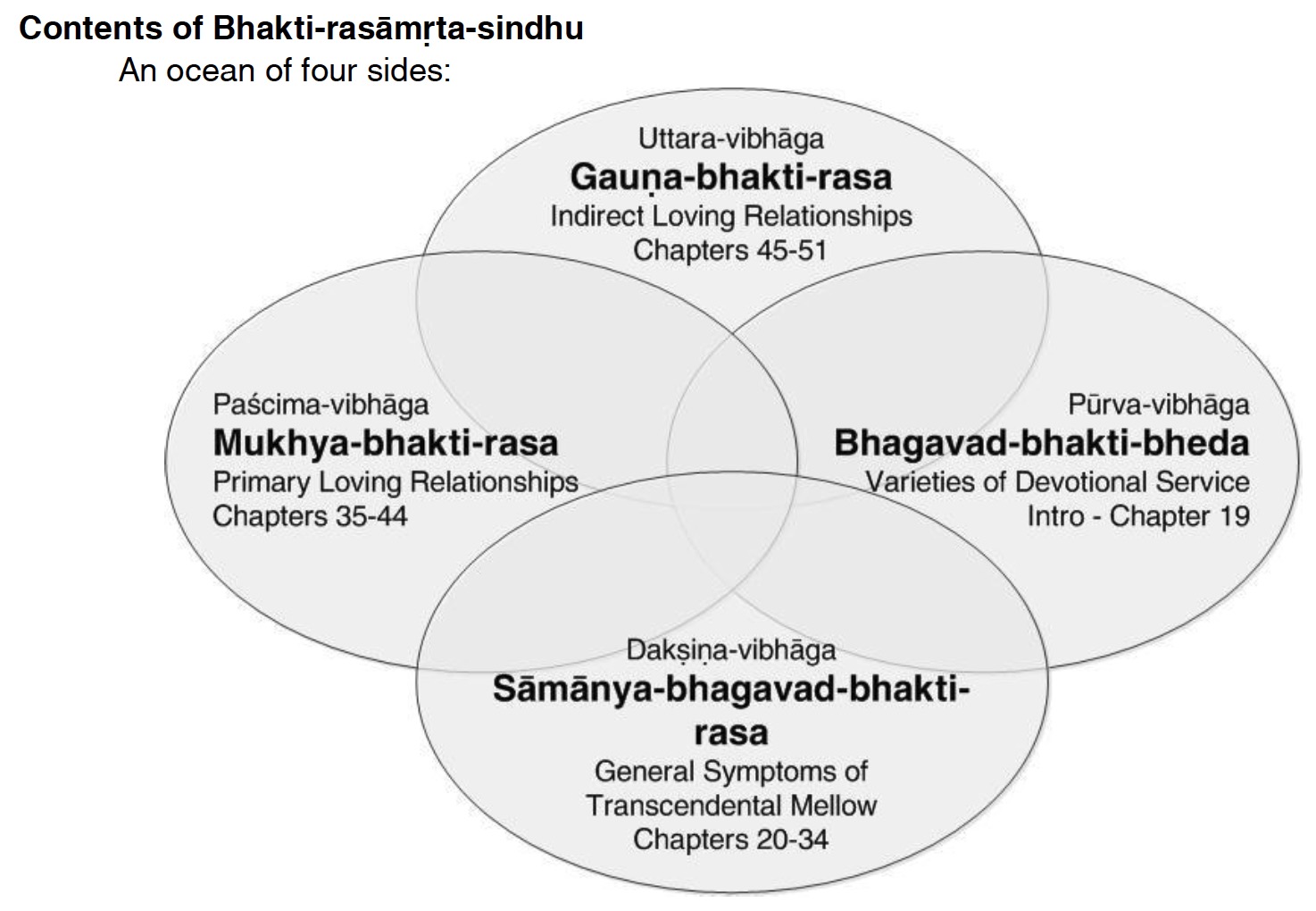
We'll be studying Purva-vibhaga - Bhagavad bhakti-bheda and Daksina.
Purva vibhaga 4 things to be discussed -
- Samanya bhakti - Ch 1 to 5
- What is devotional service and its stages
- types of Adhikaris
- Sadhana Bhakti
- Vaidhi Bhakti
- Raganuga bhakti
- Bhava Bhakti
- Prema Bhakti
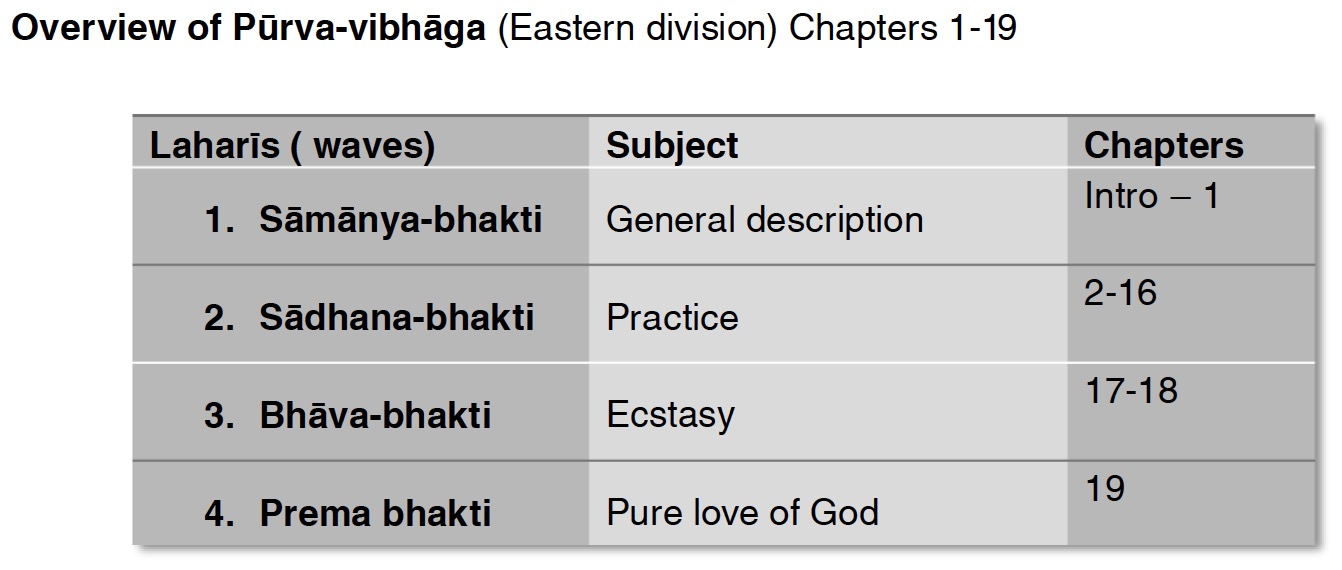
In the first part there are four waves, the first being a general description of devotional service. The second concerns the regulative principles for executing devotional service, and the third wave, devotional service in ecstasy. In the fourth is the ultimate goal, love of God. These will be explicitly described along with their different symptoms.
The authorized descriptions of bhakti, or devotional service, following in the footsteps of previous ācāryas, can be summarized in the following statement by Śrīla Rūpa Gosvāmī: “First-class devotional service is known by one’s tendency to be fully engaged in Kṛṣṇa consciousness, serving the Lord favorably.”
Lesson 2 - Pure Devotional Service
11th Sloka of BRS
anyābhilāṣitā-śūnyaṁ
jñāna-karmādy-anāvṛtam
ānukūlyena kṛṣṇānu-
śīlanaṁ bhaktir uttamā
Synonyms
anya-abhilāṣitā-śūnyam — without desires other than those for the service of Lord Kṛṣṇa, or without material desires (such as those for meat-eating, illicit sex, gambling and addiction to intoxicants); jñāna — by the knowledge of the philosophy of the monist Māyāvādīs*; karma — by fruitive activities; ādi — by artificially practicing detachment, by the mechanical practice of yoga, by studying the Sāṅkhya philosophy, and so on; anāvṛtam — not covered; ānukūlyena — favorable; kṛṣṇa-anuśīlanam — cultivation of service in relationship to Kṛṣṇa; bhaktiḥ uttamā — first-class devotional service.
Translation
When first-class devotional service develops, one must be devoid of all material desires, knowledge obtained by monistic philosophy, and fruitive action. The devotee must constantly serve Kṛṣṇa favorably, as Kṛṣṇa desires.
Characteristcs of Devotional Services
- Svarupa-laksanam - primary characteristic
- Tatastha-laksanam - secondary characteristic
Definition of Uttamä-bhakti
Tatastha-laksana
- anyābhilāṣitā-śūnyaṁ - other desires zero
- jñāna-karmādy-anāvṛtam - monism fruitive activity etc. not covered by
Svarupa-laksana
- Anukulyena
- Krsna should get pleasure from it
- Devotee's attitude towards Krsna should be favorable
- Krsna
- Krsna and various expansions
- Krsna's paraphernalia of
- Krsna's pure devotees
- anu-silanam
- constant / activity → following predecessor acaryas
Svarupa-laksanam
- Anukulyena - Devotional service is for Krishna
- Anusilanam - Devotional service is active engagement
- Anukulyena - Devotional service is to be done with favourable intent to please Krishna
Anusilanam - cultivation by following the predecessors
Anu - following and constantly
Silanam - behaviour
Anu-silanam
The word Anu suggests that one should engage himself in the service of the Lord without any interval. He must be engaged in the service cent percent and always. There must not be any interruption in such progress of devotional service.
Bhakti Rasamrita Sindhu
BTG Volume 3, May 20, 1960
ānukūlyena kṛṣṇānu-
śīlanaṁ bhaktir uttamā
The definition of a pure devotee, as given by Rüpa Gosvämé in Bhakti-rasämäta-sindhu, can be summarized thus: his service is favorable and is always in relation to Káñëa....
Introduction Page xxiv
Tatastha Laksanam
- Anyabhilasita sunyam
- Jnana Karmady anavrtam
Anya - other
Abhilasha - Desires
Ita - Motive
Sunyam - zero
Desire and motive are 2 different things. Both of these has to be zero when engaging into devotional service.
Jnana Karmady Anavrtam
Jnana - Impersonal philosophy
Karma - Fruitive activity
Anavrtam - Uncovered
Anävrtam, uncovered by mental speculation or fruitive activities, karma-kända. Jnäna-karmädy-anävrtam Not covered. If you mix up karma with bhakti, if you mix up jiäna with bhakti, or if you mix up yoga, it is contaminated. It is not pure...
Actually, Krsna consciousness can be based simply on hearing, chanting, remembering, etc.
Described in the Srimad-Bhägavatam are nine different processes, besides which everything done is unfavorable to Krsña consciousness. Thus, one should always be guarding against falldowns...
Introduction Page xxiv
There are five kinds of liberation, namely to become one with the Lord, to live with the
Supreme Lord on the same planet, to have the same features as the Lord, to enjoy the same
opulences as the Lord and to live as a companion of the Lord. A devotee, what to speak of
rejecting material sense gratification, does not even want any of the five kinds of
liberation. He is satisfied simply by discharging loving service to the Lord. That is the
characteristic of pure devotion.
The 6 Characteristics of Pure Devotional Service
klesa-ghni subhadà moksa-laghutã-krt sudurlabhà |
sandrananda-visesatma sri-krsnakarsini ca sa ||1.1.17||
Bhakti-rasämäta-sindhu1.1.17
He states that there are six characteristics of pure devotional service, which are as follows:
(1) klesa-ghni - Pure devotional service brings immediate relief from all kinds of material distress.
(2) subhadà - Pure devotional service is the beginning of all auspiciousness.
(3) moksa-laghutã-krt - Pure devotional service automatically puts one in transcendental pleasure.
(4) sudurlabhà - Pure devotional service is rarely achieved.
(5) sandrananda-visesatma - Those in pure devotional service deride even the conception of liberation.
(6) sri-krsnakarsini - Pure devotional service is the only means to attract Krsña.
- Sadhana Bhakti
- Klesha-ghni
- Subhada
- Bhava Bhakti
- klesha-ghni
- Subhada
- moksa-laghutã-krt
- sudurlabhà
- Prema Bhakti
- klesha-ghni
- Subhada
- moksa-laghutã-krt
- sudurlabhà
- sandrananda-visesatma
- sri-krsnakarsini
Klesaghni → Relief from all kinds of material distress.
Material distress 3 causes:
- papam — sinful reactions
- bijam — material desires
- avidya - ignorance
Subhada → All auspicious.
- Compassion for everyone
- Attracts everyone
- Produces good qualities
- Bestows superior happiness
Moksa-laghutakrt → derides conception of liberation
Sudurlabhã → rarely achieved
- Cannot be achieved by own efforts....
- Kna rarely awards it
Sandrananda-visesatmã → Incalculably condensed bliss
Sri-krsnakarsini → the only means to attract Krsna.
j. Under the control of the internal potency of Krsna
Klesha-ghni
Klesha - Material suffering
Agni - destory / fire
Root cause of our suffering is avidya
तत्रास्याः क्लेशघ्नत्वम् —
क्लेशास् तु पापं तद्-बीजम् अविद्या चेति ते त्रिधा ॥१.१.१८॥
tatrāsyāḥ kleśaghnatvam —
kleśās tu pāpaṃ tad-bījam avidyā ceti te tridhā ||1.1.18||
3 causes of suffering BRS 1.1.18 -
- Papam - sinful reactions
- Bijam - material desires
- Avidya - ignorance - starts here
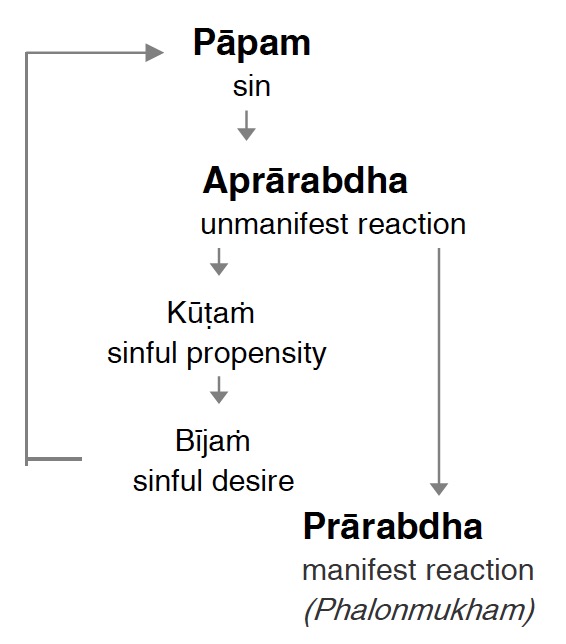
Papa is of 2 types
- Prarabdha - manifested
- Aprarabdha - unmanifested
Sinful activities are of two kinds: those that are mature and those which are not mature....
The sinful activities for which we are suffering at the present moment are called mature. The many sinful activities stored within us for which we have not yet suffered are considered immature.
Chapter 1 Page 4
yan-nāmadheya-sravananukirtanad yat-prahvanād yat-smaranad api kvacit svado 'pi sadyah savanaya kalpate kutah punas te bhagavan nu darsanāt
Even a person born in a family of dog-eaters immediately becomes eligible to perform Vedic sacrifices if he once utters the holy name of the Supreme Personality of Godhead or chants about Him, hears about His pastimes, offers Him obeisances or even remembers Him.
Devahüti to Kapiladeva,
SB 3.33.6
One who is engaged in Kañea consciousness and devotional service has without doubt become freed from all contaminations of material sinful activities. Devotional service therefore has the power to actually nullify all kinds of reactions to sinful deeds.
Chapter 1 Page 5
aprarabdha-phalam papam kütam bijam phalonmukham
amenaiva praliyeta visnu-bhakti-ratatmanăm
For those who are engaged in the devotional service of the Supreme Personality of Godhead, all sinful reactions, whether fructified, in the stock, or in the form of a seed, gradually vanish.
- Padma Purana (Quoted in Bhagavad-gita 9.2)
Session 3 - 27 November 2025
When we kill mosquitoes, we force them to rebirth in the same form. We shouldn't interfere this way.
If we think that if I don't pious activities, we'll not grow
Session 4 - 2 December 2025
We are doing Devotional Service because of some pious activity in previous lives, which gave us Shraddha.
Chapter 3
Eligibility of Vaidhi Sadhana-Bhakti
Bhakti is not like - mere mann ko bhaya, kutta kaat ke khaya.
Vaidhi Sadhana-Bhakti means rules and regulations to be followed for Sadhana Bhakti. Essence of VSB is to take us to RSB.
Raganuga Sadhana-Bhakti follows Vaidhi Sadhana-Bhakti.
यदृच्छया मत्कथादौ जातश्रद्धस्तु य: पुमान् ।
न निर्विण्णो नातिसक्तो भक्तियोगोऽस्य सिद्धिद: ॥ ८ ॥
yadṛcchayā mat-kathādau
jāta-śraddhas tu yaḥ pumān
na nirviṇṇo nāti-sakto
bhakti-yogo ’sya siddhi-daḥ
Translation
If somehow or other by good fortune one develops faith in hearing and chanting My glories, such a person, being neither disgusted with nor very much attached to material life, should achieve perfection through the path of loving devotion to Me.
Niskama-karma yoga will lead us towards Bhakti-yoga.
We need some amount of attachment to the material world, before coming to KC, otherwise we won't understand the principle of attachment to Krishna. We dont have to give up those attachments, but channelise / divert them towards KC.
Attachment develops / increases by -
- Previous life devotional service
- Good fortune by mercy of devotees
- Sincerity in present life
Bhakti is independent of the material pious activities / karma.
Good fortune here only means rendering service to pure devotee or hearing from him.
VSB is based on faith in scriptures. Without faith in the scriptures, we'll not follow rules and regulations. Attraction for the pastimes of Krishna.
Eligibility for devotional services
- Faith in scriptures / Attraction for the pastime of Krishna
- Sincerity to acquire knowledge from scriptures
With knowledge, over time we develop Bhakti, when His mercy flows.
Pure Devotees' mercy is more potent than Lord's mercy. Lord's mercy follows the devotees' mercy. If the devotees are being merciful, the Lord will be bound to be merciful.
Cause of Lord's mercy -
- Pure Devotees' mercy
3 classes of men based on faith and knowledge -
- Uttam Adhikari
- Deep faith knowledge, can convince others
- Madhyam Adhikari
- Knowledge is good, strong faith, but cannot defend or defeat. Does not deviate his shraddha though
- Kanishta Adhikari
- Weak faith, komal shraddha, less knowledge, faith can be broken by strong arguments
Those new bhaktas / neophyte will always fight.
Most realised jnani who have gained knowledge of atma and brahman, can only enter Bhakti by mercy of the lord.
Chatuskumars were brahma-vadi / jnani, but they got transformed by aroma of tulsi leaves at the foot of Lord. They gave up the desire of liberation and material enjoyment. With these desires we cannot become devotees.
Gajendra also eventually offered himself to Lord and got saved / changed.
Dhruva Maharaj is another example.
Desire for liberation is also considered demoness (pishachi), especially the desire to merge with the Lord (sayujya). That cannot help one become a bhakt / pure devotee.
One who is haunted will always bide by the desires of the occupying the ghost / soul. They cannot do anything else.
Kamesa krodhesa... are the ones making us do things we don't want to do ( #BG-3-37 )
Krishna will award bhakti only to those who are not inclined towards mukti.
When the heart of the devotee is pure, he is fully satisfied and surrendered to Krishna. He is already drowning in the ocean of ecstasy and hence he does not want anything else.
Chapter 4
5 types of liberation -
- Sayujya-mukti - negative. merging with the Supreme being. merging with the impersonal effulgence / brahma jyoti.
- Sarupya-mukti - same form as lord
- Samipya-mukti - staying close to the Lord
- Salokya-mukti - staying in the same planet as the Lord
- Sasthin-mukti - having the same opulences as the Lord
It is easier for someone to divert their svabhava into Bhakti.
Siksha-guru knows what is best for our nature and at that point of time.
Session 5 - 4 December 2025
Chapter 5
SRG is re-emphasising the independent nature of Bhakti.
Bhakti gives rise to Bhakti, nothing else can give rise to Bhakti. Mercy of devotees and Krishna is the only reason we can get Bhakti.
Devotional service is independent of material considerations -
- Birth
- Varnashrama
It is the natural tendency / capacity of the soul to do Bhakti, not the body. Bhakti has nothing to do with anything material. It is the birth right (daya bhava) of a soul to do Bhakti.
Sanätana Gosvämi in his book Hari-bhakti-viläsa, which is the Vaisñava guide. Therein he has clearly stated that any person who is properly initiated into the Vaisñava cult certainly
becomes a brähmana, as much as the metal known as kamsa (bell metal) is turned into gold by the mixture of mercury. A bona fide spiritual master, under the guidance of authorities,
can turn anyone to the Vaisñava cult so that naturally he may come to the topmost position of a brähmana.
त्रैगुण्यविषया वेदा निस्त्रैगुण्यो भवार्जुन ।
निर्द्वन्द्वो नित्यसत्त्वस्थो निर्योगक्षेम आत्मवान् ॥ ४५ ॥
trai-guṇya-viṣayā vedā
nistrai-guṇyo bhavārjuna
nirdvandvo nitya-sattva-stho
niryoga-kṣema ātmavān
Translation
The Vedas deal mainly with the subject of the three modes of material nature. O Arjuna, become transcendental to these three modes. Be free from all dualities and from all anxieties for gain and safety, and be established in the self.
Gaudiya Sampradaya didn't have any brahman initiation concept. BSST introduced this concept along with janeu.
LCM says that initiation means brahman initiation, which is important only for deity worship.
Being Vaisnava or brahman initiated doesn't absolve you of rules and regulations. Everyone needs to follow them. We have to be under strict guidance.
We need to hold on to lotus feet of devotees and Krishna, with both hands, and stay away from lotus feet of Mayadevi.
Çréla Rüpa Gosvämé warns, however, that if a person is properly initiated by a bona fide spiritual master, he should not think that simply by the acceptance of such initiation his business is then finished. One still has to follow the rules and regulations very carefully.
Atonement / prayascita when falling down
Real prayascita is spiritual activities. No ritualistic process of karma kanda to get rid of the sins committed. Just re-engage in devotional service and follow rules & regulations. By His mercy all sinful reactions can be taken away.
Srimad-Bhägavatam, Eleventh Canto, Fifth Chapter, verse 41, in which Karabhäjana Muni addresses Mahäräja Nimi as follows: "My dear King, if someone gives up his occupational duties as they are prescribed
for the different varnas and äsramas, but takes complete shelter, surrendering himself unto the lotus feet of the Lord, such a person is no more a debtor, nor has he any obligation to perform the different kinds of activities we render to the great sages, ancestors, living entities and family and society members. Nor has he any need to bother executing the five kinds of yajnäs [sacrifices] for becoming free from sinful contamination. Simply by discharging devotional service, he is freed from all kinds of obligations."
Chapter 6
44 items of Bhakti are mentioned
- 20 items are primary
- 1-10 - Pravritti - Do's
- 11-20 - Nivritti - Dont's - Seva Apradh and Naam Apradh
- 44 items are do's and dont's
Basic principles -
- accepting the shelter of the lotus feet of a bona fide spiritual master (guru-padasraya)
- becoming initiated by the spiritual master and learning how to discharge devotional service from him (sri-krsnani)
- obeying the orders of the spiritual master with faith and devotion (guru-seva)
- following in the footsteps of great äcäryas (teachers) under the direction of the spiritual master
- inquiring from the spiritual master how to advance in Krsña consciousness
- being prepared to give up anything material for the satisfaction of the Supreme Personality of Godhead, Sri Krsña (this means that when we are engaged in the devotional service of Krsna, we must be prepared to give up something which we may not like to give up, and also we have to accept something which we may not like to accept)
- residing in a sacred place of pilgrimage like Dvärakä or Våndävana
- accepting only what is necessary, or dealing with the material world only as far as necessary
- observing the fasting day on Ekädashi
- worshiping sacred trees like the banyan tree
- One should rigidly give up the company of nondevotees
- One should not instruct a person who is not desirous of accepting devotional service
- One should not be very enthusiastic about constructing costly temples or monasteries
- One should not try to read too many books, nor should one develop the idea of earning his livelihood by lecturing on or professionally reciting Srimad- Bhägavatam or Bhagavad-gitä
- One should not be neglectful in ordinary dealings
- One should not be under the spell of lamentation in loss or jubilation in gain
- One should not disrespect the demigods
- One should not give unnecessary trouble to any living entity
- One should carefully avoid the various offenses in chanting the holy name of the Lord or in worshiping the Deity in the temple
- One should be very intolerant toward the blasphemy of the Supreme Personality of Godhead, Krsña, or His devotees.
Without following the above-mentioned ten principles, one cannot properly elevate himself to the platform of sädhana-bhakti, or devotional service in practice. Altogether, Çréla Rüpa Gosvämé mentions twenty items, and all of them are very important. Out of the twenty, the first three—namely accepting the shelter of a bona fide spiritual master, taking initiation from him and serving him with respect and reverence—are the most important.
First 3 are related to Guru.
- Receiving instructions from a bonafide spiritual master
- Without spiritual master there is no scope, there is no hope
- Why a spiritual master
- Qualifications of spiritual master
- He is able to teach same conclusions to his disciples in a way that they can understand
- He can give shelter against the attacks of maya
- They will reveal Krishna in their heart, only after we have surrendered, served and then inquired
Session 6 - 11 December 2025
Group Presentations
Group 2: Briefly present important points from 5 to 8 of Vaidhi Sadhana Bhakti
- Define what a bhakt lifestyle should be, and the discipline to be cultivated
- Sad-dharma - enquiring about devotional principles from seniors / guru
- Sadhu-marga anugaman - following path of devotees
- Bhoga-tyaga - collecting for
- Yavartha-vyavahara - dealing with world only if necessary
SRG - Take whatever one needs for maintenance of spiritual life.
There's a thin line between thinking of doing for Krishna and actually doing for Krishna.
Spiritual attachment is called "lolyam" and that's required.
Material attachment is nothing bus suffering.
We should not be too attached as well as not too detached from everything. We need "love" and all soft feelings to
Being prepared to give up everything for Krishna's satisfaction.
If you are chanting, with your mind focused on the chanting, then it is sankirtan - since both are focused on chanting.
Vaidhi Bhakti is a way for us to know how to engage our body, mind and activities in KC.
Chapter 9
We should avoid sadhu-ninda - both speaking and hearing.
Tulsi mala should be worn like a dog collar.
Vaidhi sadhana bhakti has to be done with all heart and feeling - all the time! Never take for granted.
If one does not perform Bhakti with bhaav and respect, then ruchi does not come.
4-step formula by SP for growing in KC
- family members chanting together
- family reading bg / krishna / sb - spiritual books together
- Honor prasadam
- deity worship
Sravan of 3 types -
- Naam
- Katha
- Gunadi
Session 7 - 15 December 2025
BRS 1.2.235-237
In the beginning of Çrémad-Bhägavatam it is said that unless one has the ability to throw out, just like garbage, the fruitive results of ritualistic ceremonies, economic development and becoming one with the Supreme (or salvation), one cannot understand Çrémad-Bhägavatam. The Bhägavatam deals exclusively with devotional service.
ISKCON Standard is siksha-guru focused. They can easily uplift from the position you are in to an elevated one. They will prepare you to serve under your Spiritual Master. And spiritual master prepares to serve under SP. And SP prepares to serve under Caitanya Mahaprabhu.
Doorway to devotee relationship is prasadam.
Chapter 14
BRS 1.2.245 onwards
Varna and asrama is for the beginners to get started with bhakti and reach the stage where we are completely devoted to Krishna. Varna and asrama have checks for material engagements. It is required to bring an individual to a platform where an individual becomes receptive of devotional service. (SB 11.20.9)
Yukta-vairagya and phalgu-vairagya
Yukta-vairagya - using things for Krishna's service.
Phalgu-vairagya - rejecting something which could be used in Krishna's service - false renunciation. For example, taking a mouna-vrata.
Phalgu river in Bihar where it seems dry from outside, but its flowing inside.
3 types of prayers we can offer -
- Feelingly offering prayers - samprarthanatmika
- dainyabodhika - expressing insignificance. humbly submitting oneself.
- Lalasamayi - expressing desire for a specific spiritual perfection
In the Tenth Canto, Fourteenth Chapter, verse 8, it is said, "My dear Lord, any person who is constantly awaiting Your causeless mercy to be bestowed upon him, and who goes on suffering the resultant actions of his past misdeeds, offering You respectful obeisances from the core of his heart, is surely eligible to become liberated, for it has become his rightful claim." This statement of Çrémad-Bhägavatam should be the guide of all devotees. A devotee should not expect immediate relief from the reactions of his past misdeeds.
When such impediments arise he should simply think of Kåñëa and expect His mercy. That is the only solace. If the devotee passes his days in that spirit, it is certain that he is going to be promoted to the abode of the Lord. By such activities, he earns his claim to enter into the kingdom of God.
Session 8 - 18 December 2025
Raganuga Bhakti - BRS 1.2.270 to 1.2.309
Rägätmikä-bhakti
Çré Rüpa Gosvämé has defined
rägä as spontaneous attraction for something while completely absorbed in thoughts in it, with an intense desire of love.
Nectar of Devotion Page 119
Rägätmikä-bhakti precedes Raganuga Bhakti
Bhakti is a thirst and Ragatmika Bhakti is spontaneous thirst towards Krishna.
Raga - intense attachment
The spontaneous dealings of the residents of Vṛndāvana in relationship with Kṛṣṇa are called rāgānugā.
rägätmikä-bhakti
'mukhyä' vraja-väsi-jane
The original inhabitants of Vändävana are attached to Kañea spontaneously in devotional service. Nothing can compare to such spontaneous devotional service, which is called rägätmikä bhakti....
Caitanya-caritämäta
Madhya 22.149
When we follow ragatmik-bhaktas, we can become raganuka bhakta. Ragatmika-bhakta are the original residents of Vrindavan.
tära anugata bhaktira
'rägänugä' -näme
When a devotee follows in the footsteps of the devotees of Vandävana, his devotional service is called rägänugä bhakti.
Caitanya-caritämäta
Madhya 22.149
Two types of Ragatmika-Bhakti
- Kamarupa - sensual attraction - conjugal love (Chapter 15)
- Sambandharupa - relationship - parent, friend, servant (Chapter 16)
Kama - lusty desire (not material, but spiritual)
Rupa - like
Materially when we are in love with someone, we want to satisfy ourselves, but spiritually when we love someone, we want to satisfy them - make them happy.
If we are focused on me or mine, we cant progress spiritually.
What is the root of all our offenses? SP quotes from Padma Purana in NOI and CC Adi 8.24 - ahaṁ-mamādi-paramo
Raganuga Bhakti only applies to Gokul section of Goloka which also has Vrindavan, Dwarka and Mathura. Navadvip is same as Vrindavan, just that devotees in Navadvip does not enter the same mood as those in Vrindavan. In Mayapur, Radharani is in the form of Gadadhar Pandit, while in Vrindavan she's Radharani. But she is very independent and not submissive to Krishna.
- Vaidhi Bhakti
- Raganuga Bhakti
- Bhaav Bhakti
- Prema Bhakti
The order in which a person goes through these 4 bhakti steps could be different.
Vaikuntha has sankhya, dasya and to some extent dasya.
Kämarüpä Rägätmikä-Bhakti
...the gopés' ecstatic love for Krñna is sometimes described by scholars as being like the "lusty desire" of the material world, but actually this should not be taken as a literal fact. It is simply a way of trying to understand the transcendental situation.
Nectar of Devotion Page 123
Sambandharüpä Rägätmikä-Bhakti
...spontaneous love of Kañea in the parental relationship is found both among those denizens of Därakä who belonged to the dynasty of Vañei and among the inhabitants of Vandävana.
Nectar of Devotion Page 125
The attraction of the gopés for Kañea and the affection of the members of the Yadu dynasty are both accepted as spontaneous, or ragänuga. ....
Again, he analyzes the affection of the Yadus. If it is on the platform of friendship, then it is spontaneous love, but if it is on the platform of regulative principles, then it is not.
Nectar of Devotion Page 120
Rägänuga-sädhana-bhakti
There is a stage called anartha-nivrätti, which means the disappearance of all material contamination...
When one is actually spontaneously attracted to the loving principles of the gopés, there will be found no trace of any mundane contamination in his character.
It is said by Sré Rüpa Gosvämé, "When one is actually liberated from material contamination, he can always remember an eternal devotee in Vandävana in order to love Kañea in the same capacity. And developing such an aptitude, one will always live in Vandävana, even within his mind."
But when he realizes his actual position in relationship with the Lord, he can, along with the discharging of regulative service, think within himself of the Lord, under the guidance of a particular associate of the Lord, and develop his transcendental sentiments in following that associate.
Nectar of Devotion Page 126
We need to have a greed to serve Krishna in some form. And SRG says that greed is the price one pays to get Raganuga Bhakti.
A devotee who is actually advanced in Kañea consciousness, who is constantly engaged in devotional service, should not manifest himself, even though he has attained perfection..
Sadhana-rupena
Siddha-rupena
Räga-märga in ISKCON
First of all, he's trying to bring the devotee to the standard devotional service. Vidhi-märga. Then gradually, when he becomes accustomed, then räga-märga will be revealed.... Everyone has got a particular relationship with Kañea in his original constitutional position. That will be revealed gradually as you advance in devotional service in the prescribed rules and regulations as they are directed in the gästras and by spiritual master....Just like sun. Sun becomes visible when the sun rises automatically. You cannot force the sun to ...That is not possible. Sun will rise. You just wait.
The Nectar of Devotion
Văndävana, October 20, 1972
Every anga of bhakti can arouse raganuga bhakti or bhakti in devotees.
Rägänugä, räga-bhakti is executed following the footprints of the devotees in Vandävana. That is called räga-bhakti. Krñëa's personal associates. Not to become directly Kañëa's personal associate, but following the footprints of Krñna's eternal associates, we can come to the stage of räga-bhakti. That is called parä-bhakti. That parä-bhakti is required....So this Käñëa consciousness movement is gradually developing up to the stage of räga-bhakti or parä-bhakti. Then life is successful.
Srémad-Bhägavatam 3.26.35-36
Bombay, January 12, 1975
NOI - 4
dadāti pratigṛhṇāti
guhyam ākhyāti pṛcchati
bhuṅkte bhojayate caiva
ṣaḍ-vidhaṁ prīti-lakṣaṇam
SYNONYMS
dadāti—gives charity; pratigṛhṇāti—accepts in return; guhyam—confidential topics; ākhyāti—explains; pṛcchati—enquires; bhuṅkte—eats; bhojayate—feeds; ca—also; eva—certainly; ṣaṭ-vidham—six kinds; prīti—of love; lakṣaṇam—symptoms.
TRANSLATION
Offering gifts in charity, accepting charitable gifts, revealing one’s mind in confidence, inquiring confidentially, accepting prasāda and offering prasāda are the six symptoms of love shared by one devotee and another.